Hey, I didn't forget about finishing this series. Sorry about taking awhile to update Crunching the Numbers, but I underestimated how much time it takes to follow 13 shows, or rather 8 shows as you'll see I dropped quite a few shows since the last time. I'll briefly talk about the shows I dropped and why I dropped them, but first I want to discuss the future of Crunching the Numbers.
There won't be any Crunching the Numbers after this. Don't worry, I'm not stopping the season reviews just yet. Quite simply, Crunching the Numbers will be receiving a new name with some new rules that are designed to make it so that following every show will be easier on me. I won't be revealing the name change and new rules just yet, but you'll know about them eventually.
However, you're going to have to wait until the fall. I may or may not do some summer previews (though at the time of this writing Free! is the only new anime I'd say is worth anything), but I won't be doing any extensive coverage of the season. Instead, I'll be focusing on a new weekly anime project which I will be announcing next week. Look forward to it.
So with that out of the way, let's crunch the numbers one more time!
Spoiler Warning!
1) Flowers of Evil
Flowers of Evil embodies both the best and worst traits of this season. The good definitely outweighs the bad in this case, but let me talk to you about the biggest problem of this season: pacing. You might not think that's such a big deal, but bad pacing actually killed what were once good shows for me as we'll see later. Pacing is what dictates the flow of a story and consequently the mood, the character motivations, and most importantly the audience's reaction. Flowers of Evil is a slow burn of a show, which sometimes really makes the creepy mood of the show even better (the tension of Kasuga entering Nakamura's room for the first time for example), or sometimes the mood will become blissful and ethereal (the amazing classroom sequence in episode 7).
Oh yeah, episode 7. You might have heard people lavish praise for this episode in particular. It's not even the best episode (episode 10 takes that spot for me), but episode 7 completely justifies the use of rotoscoping, not just for the show but as a tool that can be used in any animated work. The show has been building up the rocky relationship between Kasuga and Nakamura up to this point. Nakamura's goal has been to expose Kasuga as a terrible deviant, possibly because she needs someone to justify her misanthropic look on life. It results in a beautiful little piece of destruction and awe-inspiring visual direction. It's up there with the Green Bird sequence from Cowboy Bebop as one of those moments that makes anime totally worth watching.
Let's get back to the pacing problems I mentioned earlier. As amazing as moments like episode 7 are, the earlier episodes have the problem of not much actually happening in them. The slow pacing is intentionally done, but it does test your patience. The worst offender of bad pacing has to be the first 8 minutes of episode 8. Yes, right after that amazing segment of animation I was telling you about, the show decides to show you 8 minutes of Kasuga and Nakamura walking home. In theory this would work as a nice cool-down moment after the insanity of the previous episode, but 8 minutes of just walking is overindulgent. Luckily the pacing picks up again afterwards, but the show never shakes off that feeling of being a little too slow.
Episode 10 feels like the real climax of the show to me, with the last three episodes wrapping up some of the fallout nicely, but episode 10 feels like where the show finally makes its point about the characters of the show. Is Kasuga this smart person who understands a book as difficult as Baudelaire's Flowers of Evil? No, he's just some lonely kid who is empty inside, and doesn't understand Flowers of Evil any more than Saeki understands it. Kasuga is truly pathetic and no one cares. It's a harsh message, but extremely refreshing for an anime to say. Too many times have we been treated to stories about kid protagonists who are special, who might be misunderstood but are good down deep, or completely awful characters who are justified by having a tragic backstory. No, Kasuga is awful because he hasn't grown up yet. He holds onto these childish and creepy fantasies of Saeki being a pure angel. It's an extremely unhealthy way of thinking, and yet it's biting because there are people like Kasuga out there. Hell, the idea of sexual purity is one that is disturbingly common among Japanese otaku. You needn't look any further than any idol fan to find these ideas. That Flowers of Evil has the balls to make statements like this makes it truly special and worth watching.
One last thing I have to talk about, and no it's not the rotoscoping because that's been talked about before, though I will point out that as the show goes on, the direction and rotoscoping drastically improves, though are a few hilarious moments where a character played by Oshimi Shuuzou (yes THAT Oshimi Shuuzou), is obviously wearing a fake mustache. What I really want to talk about is the ending and how it makes Flowers of Evil less of a standalone story than it should be. I was expecting that I'd want to read the manga afterwards because I knew that the anime wouldn't cover the whole story, but with the direction it was heading in I thought it'd pick a good point to stop and make the whole thing work as its own smaller version of the manga. Sadly, the ending teases future events that happen in the manga and ends with the words "Part 1: END". It's a horrible tease that really doesn't need to be there when the rest of the ending works fine and there's no guarantee that this show will get a second season. If it does, I'll definitely watch it, but given the backlash this show received it has a snowball's chance in hell of getting that second season.
Fortunately, that tease is not enough to diminish the quality of this show. We need more anime like Flowers of Evil. We need more anime that are bold enough to make something different and refuse to pander to audiences while sacrificing artistic intent (though given the anime I'll be watching this summer this is really ironic). Flowers of Evil is one of those anime that proves why anime can be special, and that's why it's a must-see.
2) Chihayafuru 2 (second half)
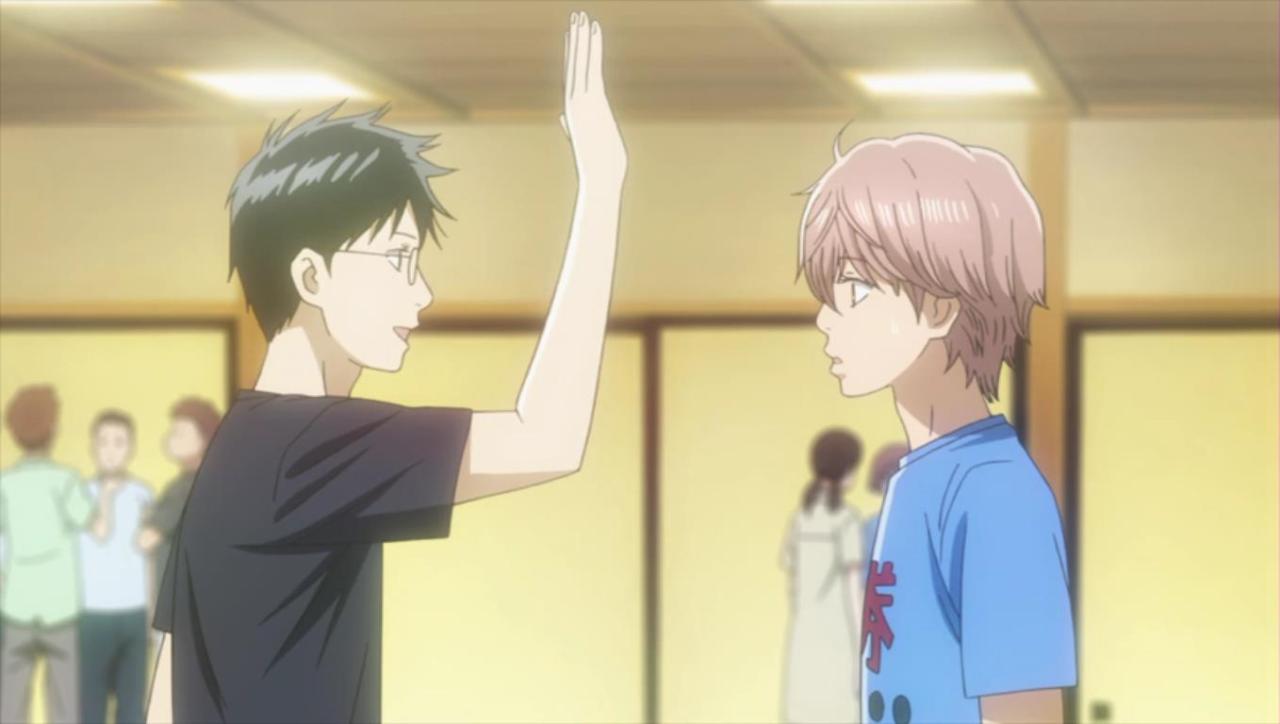
SEASON 3 PLEASE!
Okay, I'm getting ahead of myself, but I really hope we get at least one more season of Chihayafuru because it's so good. Like many other shows this season, Chihayafuru 2 had pacing problems; it covers less ground than the first series by having most of the season focus on one tournament, and some of the karuta matches go on for one episode too many. However, Chihayafuru still shows what it needs to show, that being the emotionally satisfying triumphs and losses that our characters go through. Arata finally feels like a proper part of the show now, and the issues of the love triangle Chihaya has been involved in from the start have been mostly resolved in one scene where Chihaya basically admits who she loves to the audience (though not her love in person). Season 2 ends on a good note; like season 1, it leaves room for more, but it's a nice reflection on all that has happened before and shows just how far our characters have come since first forming the karuta club.
Maybe one day I'll do a full review of Chihayafuru in general, but for now I feel as though I've already said as much about the show as I can. I've seen 50 episodes of characters playing a card game I've never heard of before, and I loved nearly every bit of it.
3) The Devil is a Part-Timer
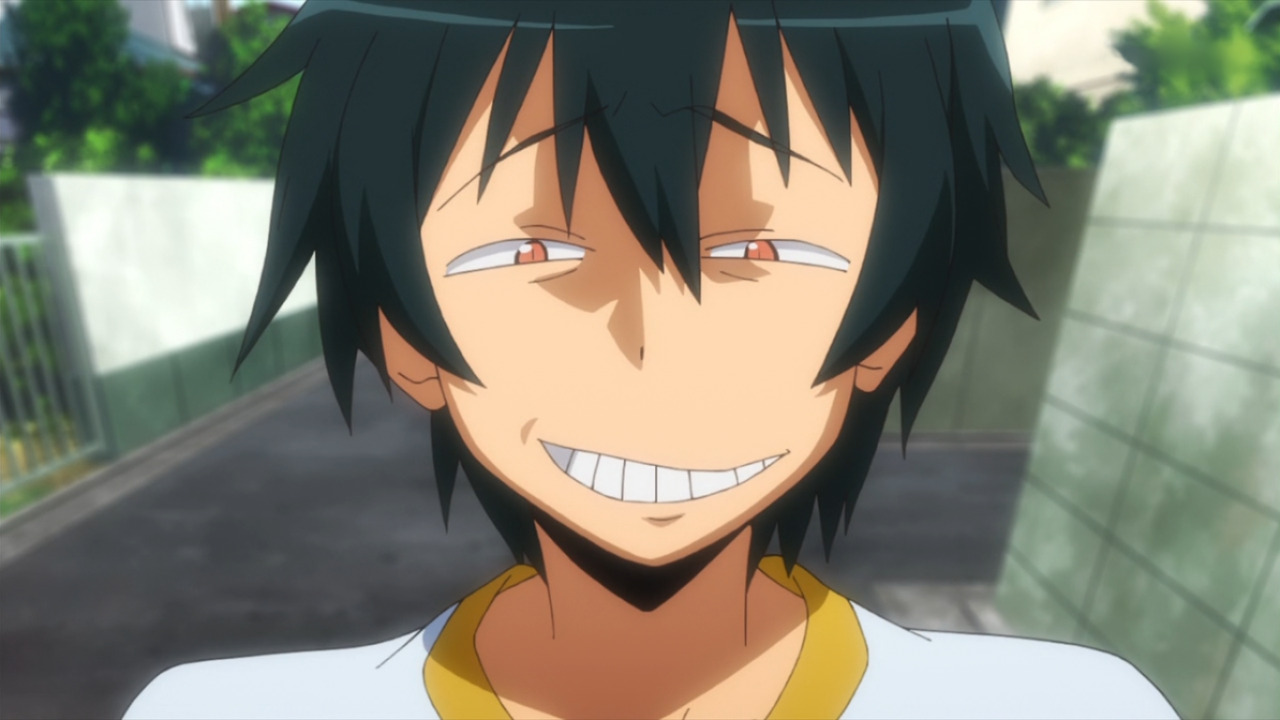
If Flowers of Evil didn't exist, this would be the most surprising anime of the season for me. An anime about Satan working at McDonald's (named MgRonald's in this show)? That sounds really dumb, it can't be that be good. Cut to me laughing for 13 episodes. Maybe this says more about my taste in comedy than about anime comedy in general, but there hasn't been an anime that has made me laugh this much in a long time.
What makes The Devil is a Part-Timer stick out from other anime comedy is that it doesn't fall prey to most of the same mistakes those shows make. Too often will anime comedy rely on overreactions, prat-falls, and yelling as jokes, when those aren't jokes at all. Devil's comedy comes from its natural character reaction and dialogue. You've got this great ensemble cast of demons, heroes, angels, and humans that all have really funny interactions with each other, whether it be just how well Satan adapts to working at MgRonald's or how budget-conscious Ashiya is or how Lucifer becomes this NEET, they all work. I ended up liking nearly all the characters due to their well-written personalities and quirks.
I mentioned earlier that most of the shows had pacing problems this season. Even my two favorite shows of the season couldn't avoid this, but Devil is a Part-Timer? Never feels too fast or too slow and the progression always feels natural. The action is actually somewhat good, though obviously not as good or important as the comedy and characters. There are a few moments in the show where Satan gets to let loose his powers, and those fight scenes are a ton of fun to watch. They border on being too serious for the show, but again, the characters are so likable by that point that the audience will be willing to let them be serious for a moment. Also, because I think it's fun to point this out, Satan saves more lives than Superman does in Man of Steel. Don't go see Man of Steel, watch The Devil is a Part-Timer instead.
However, like Chihayafuru and Flowers of Evil, the show does end on an open note. Will our heroes get back to their homeworld or be stuck in our world forever? The show doesn't say, opting to just end after an episode about Lucifer getting swindled by a door-to-door salesman. There's no real ending for the show, and I'm not sure it needs one, but some resolution for the characters would be nice. I've heard there was more material in the light novels that the show could adapt, so there's hope for a second season, but the amount of The Devil is a Part-Timer we got is still really good. It's that rare anime comedy that's actually funny.
4) Attack on Titan (first 13 episodes)
What do I need to say about Attack on Titan? What can I say about Attack on Titan that hasn't been said before? You've probably already seen the show at this point, indulged in the countless Attack on Titan opening parody videos or possibly made your own, or at least heard people talking about how awesome this show is. With all the hype behind it, Attack on Titan can't possibly live up to those expectations, right?
No, this show is really good. Oh, it's far from perfect. As cool as the idea of humans zipping around like Spider-Man and killing titans is, it drags its feet in the later episodes. I cannot tell you how sick I was of seeing "Battle of Trost" in the title card for nine episodes straight. It takes 3 episodes just for Eren (who now has the power to summon a titan body for him to control) to move a rock to stop the titans from getting into the town. It's a problem that persists in many shonen fighting anime adaptations, and there is a reason for it (writers don't want to overtake the manga storyline), but the chapter-per-episode pacing near the end of the first half does grate a bit.
Despite the pacing problems, the show's still a ton of fun. Earlier on it was a little hard to connect to the characters, but by episode 13 I found myself liking them much more. Mikasa is the stoic badass who pretty much needs no help when it comes to killing titans, and while this is a personality type I'm not often fond of, it's refreshing to see a female character like this in a show where the majority of human characters will die. Jean started out as something of an asshole rival to Eren, but through the Battle of Trost he's become a likable guy who feels guilty over losing his friends in battle. Surprisingly Armin has become my favorite character. Yeah, the wimpy blonde kid who you'd think would be among the first to die, but he's become an invaluable part of the Survey Corps thanks to his tactical intellect, and after he stood up for Eren and Mikasa in episode 10 he really won me over. I don't see much love for Eren, and it's easy to see why. He's a little archetypal "main character" for my tastes, the kind of guy who succeeds through sheer determination and heart. He's not a bad character by any means, and his titan abilities are responsible for some of the best action scenes in the series, but eh, he's not a great character.
The real reason this doesn't place as high as you'd think it would is not just the pacing problems, but the animation problems. Attack on Titan has some of the coolest looking fights, but more often than not the animation looks unfinished and the show resorts to still-shots, flashbacks, and camera pans and shakes to hide that fact, but it's still really obvious. Still, that shouldn't deter anyone from enjoying this show. It's incredibly entertaining, and I'm glad that it'll still be on this summer.
5) Valvrave the Liberator
The more I watched of Valvrave, the more I loved it. It's not good in the traditional manner; the story is honestly quite stupid and Haruto isn't the most likable or relatable protagonist in the world, but each episode makes you think "oh there's no way this show can get crazier", and then it proves you dead wrong. It's entertaining trash at its finest.
And then Haruto rapes Saki.
There's no getting around this. Valvrave has stirred up an enormous amount of controversy by having its hero rape another main character. Yes, I know Haruto was under the influence of his vampire powers at the time, but that doesn't take away the fact that the writers thought this series needs a rape scene, and a really tasteless one at that. How the show handles the rape afterwards is even worse, uncomfortably tiptoeing around the issue for an entire episode which culminates in Haruto PROPOSING TO MARRY SAKI. She doesn't accept the issue because Saki knows better, but what the hell Haruto? The rape scene leaves an uncomfortable aura over the entire series. As fun as the rest of it is, it'll be impossible to forget just how badly the show handled it.
Valvrave will be coming back for a second season in the fall, and after much debate with myself over the issue... I'm still going to watch it. Say what you like about how tasteless or bad the show is, it's great at getting you to come back for more because of how unpredictable it is, and that last episode was kind of fun, although the final Valvrave is a brat who will have to work hard to earn any sympathy. I halfheartedly recommend Valvrave the Liberator. I wouldn't call it good, but there's a fanbase for fun trash like this, and I'm among them.
6) Gargantia on the Verdurous Planet
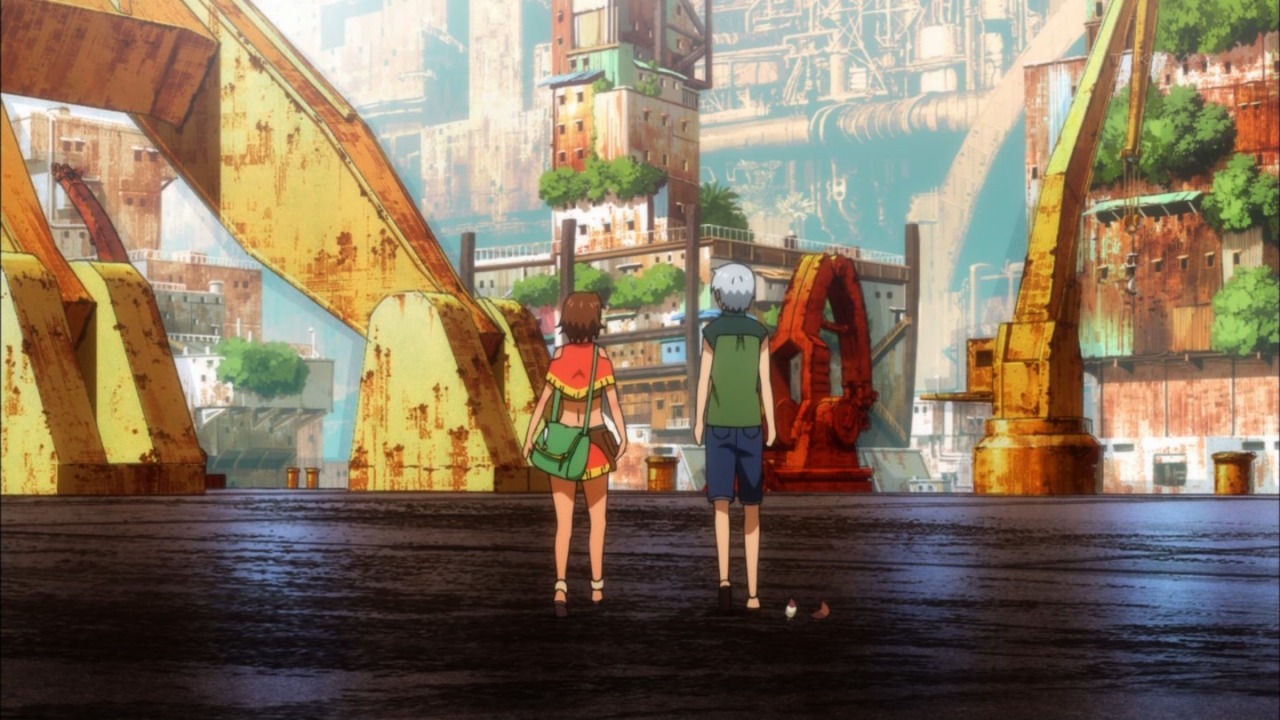
I bet you're really tired of hearing me mention the word "pacing", but my god does the pacing murder this show. What was once a show I had high expectations for became one of the more trying experiences I had this spring.
I'll get the good out of the way first: the first four episodes are a great fish-out-of-water tale with a sci-fi bent. The color design is phenomenal. There are some really good ideas behind the Galactic Alliance and Gargantia's differing philosophies on life. That's pretty much what I liked about Gargantia.
And then episodes 5 and 6 exist solely as fluffy fanservice. In a longer series, this might have been more acceptable, but they're still pointless and deter from the story. Even when the story comes back in episodes 7 and 8, the damage is still done; the plotting still feels too slow for a 13 episode series, and we spend way too much time on the funeral of a supporting character. But I still held out hope. Episode 9 takes the story away from the Gargantia and brings Ledo face-to-face with the true history of the Earth and the Galactic Alliance, and admittedly the story works at making the Hideauze important again. But then the series decides "oh, you thought we were being slow? Well now we're going to be as fast as possible! Screw your pacing!" The final 4 episodes show Pinion becoming the dictator of his own fleet, Ledo questioning Chamber's and the Galactic Alliance's motives, a cult that worships another robot like Chamber, and Amy and the rest of Gargantia no longer matters until the very end.
All this stuff comes out of nowhere and ends just as quickly, and thinking about it, I could see the show going in this direction had it been a 24-26 episode series. The fact that all this happens in the last 4 episodes makes the character motivations seem way off and the whole thing rushed, to the point that the emotional beats just feel hollow. All the plot threads are quickly resolved in the space of two minutes. I don't know what went wrong here. What was once the story of a soldier trying to find a new life in a strange land became a jumbled mess that doesn't know what it wants to be.
7) Devil Survivor 2 the Animation
So did Devil Survivor 2 break the video game adaptation and manage to be an engaging standalone story? Uh, no. Actually, from what I've heard even fans of the game don't seem to happy, so even as a way to pander to the fans it fails. So what went wrong?
Devil Survivor 2 has a huge cast of characters. Only two characters are truly important, those characters being our hero Hibiki and the villain Yamato, who have one of the most homoerotic rivalries I've seen in animation, and I've seen He-Man. Every other character exists to die. Anytime they have a moment that looks like character development is almost always immediately followed up with them biting the dust, so you never get to know them and their deaths don't register as being dramatic or shocking, just pointless. The show is trying to make a point about it being the end of the world, so some death would be expected, but the way in which the show kills off its characters is a boring pattern. Somehow Devil Survivor 2 made death and the apocalypse boring.
The show deals with big themes such as rebirth, the fate of humanity, and chaos vs order, all themes that have been explored in previous Shin Megami Tensei games, and they feel stagnant here. I think I know what the problem is, and this is a problem that seems to be persistent in anime adaptations of this franchise. The SMT games have always been built around choices; Devil Survivor 2 the game features multiple routes to choose, and your characters can die or you can save them. The power of choice is what gives the story and characters more power, and when stripped of that choice you're left with a soulless husk like Devil Survivor 2 the Animation. Though I am looking forward to seeing the Hibiki/Yamato doujinshi. Get to work on that, yaoi fans.
8) Muromi-san
There's really not much to say about Muromi-san. It's a gag comedy about a mermaid and her mythological friends who are introduced every week. There's no real story to speak of, so the show lives and dies by its gags, and honestly the show is too hit-and-miss to recommend. However, as with all comedy, taste is super subjective. I did laugh at a few jokes here and there (Muromi's relationship with penguins), but then there are episodes like episode 12 where the joke is "hey, how much can we gross the audience out by abusing this big-breasted mermaid?". Had the episodes not been 12 minutes long as opposed to 24, I probably would have dropped Muromi-san long ago. It exists, and it might make you laugh, but it'll quickly be forgotten as is the fate for most dumb gag comedies. Stick to Devil is a Part-Timer if you want some good yuks.
Dishonorable Mentions:
Mushibugyo (dropped at episode 8):
Great color design and humorous character designs can only get a bland tired story so far. I enjoyed the first few episodes of Mushibugyo, but I quickly realized it was going nowhere and the tiresome repetitive shonen fighting cliches got to me.
The Severing Crime Edge (dropped at episode 8):
I thought the relationship between the two leads was kind of cute, but the series quickly fell into tiresome battle of the week cliches and none of the other characters were particularly interesting.
Henneko (dropped at episode 7):
It was cute for one episode, and then AAAAAAAAAAAAAH IMOUTO SHIT WHHHHYYY? Incest jokes aren't funny, and neither are the other countless otaku-bait tropes in this show.
Arata the Legend (dropped at episode 7):
The terrible fire effects were amusing, but other than that? Meh, bland fantasy story.
Karneval (dropped episode 3):
It's pretty, but what's the story? Nothing made any sense and I had no reason to watch any more.
Okay, that does it for the spring! The summer sun is here and there are swimming anime to be watched. Next week I'll be starting my new anime project for the season. I think all of you space lovers will enjoy it. Stay tuned!
Showing posts with label Chihayafuru. Show all posts
Friday, July 5, 2013
Saturday, April 13, 2013
Crunching the Numbers: Winter Wrap-Up
I'm a bit late with this one, mostly because I've been busy checking out the new spring anime. Don't worry, you won't have to wait long for the next Crunching the Numbers where I give my initial thoughts on the spring season, but you'll be happy to know that I'll have a lot to talk about. But first, I have to give my final thoughts on the winter season.
My overall thoughts on this season are disappointment. I didn't even think that'd be possible given my low expectations for the season, but some shows had given me hope that this season wouldn't be a waste. Truth be told, the season wasn't a complete waste, but not counting Chihayafuru 2, a sequel to an already great show, I ended up liking only 2 shows, and even then I wouldn't be in a rush to rewatch those shows. Well, no point in delaying, let's take a final look at the anime of Winter 2013.
1) Chihayafuru 2 (episodes 11-13)
Actually, I can't give final thoughts on this anime, because it will be continuing into the spring, which I'm really happy about. I won't spend much time on this show in this particular article because of that and I want to focus on my final thoughts on the other shows, but I have a few new things to say about Chihayafuru 2.
The recent karuta match has actually felt slow for once. A fan pointed out that the team was done with the team matches at this point in season one, yet we're still stuck in semifinals. I don't mind the slower feel of the match, as the tension and mindgames are still really high, but some time is wasted with flashbacks, making me wonder if the show is padding. This does make me worry that season 2 won't cover as much story as season 1, and with the manga still not over and the chances of a season 3 up in the air, I hope season 2 ends on a good note. The show's still great, it's Chihayafuru, but there are the occasional flaws.
2) The Unlimited: Hyobu Kyosuke (12 episodes)
So who knew that the best new show of the season (Chihayafuru's a continuation) would be a spin-off of a show I'd never seen? Chalk it up to competent writing and pacing.
While this is by no means an instant classic, it's a perfectly likable little series which has the benefit of being watchable by fans of Zettai Karen Children and people who've never heard of the franchise. That's a hard task to pull off, and I appreciate it when writers can pull that off. I may even check out Zettai Karen Children at some point because I enjoyed the characters in this so much, though I know it'll lack Andy.
The main selling point of the show, besides the awesome psychic fights, are the characters of Andy and Hyobu. You may recall that I criticized Hyobu for being a bit of a bore at the start of the show, being an unstoppable badass with little else to characterize him, but thankfully the show goes out of his way to explain him and flesh him out. Even though the show is about him, the show smartly makes Andy the character the audience follows for the majority of the series. He's a character who is neither truly human nor ESPer, making him an outcast even among PANDRA and therefore a good point-of-view character for the audience. He doesn't need everything explained to him thankfully, but he's enough of an outsider that his acclimating to his new environment mirrors our own, making the new reveals feel natural. Both him and Hyobu play off each other nicely, and in the final episodes they make for a badass battle couple.
The final episode of the show doesn't change much, which is understandable given the spin-off nature of the show and the fact that the original manga is still on-going, but it ends on a good note with the characters having gone through a pretty good story and some changes. Nothing life-changing or epic, but it's a fitting and satisfying ending, and the overall show is just that, satisfying. If you're looking for a good anime with super-powered fights but don't necessarily want costumed heroes, this is a good choice.
3) Love Live: School Idol Project (13 episodes)
There was some concern that the show was going to end on a downer. I didn't think it would, and thankfully it doesn't, as it really wouldn't fit the show's upbeat can-do-anything attitude.
Love Live is proof that moe as a concept can make for good wholesome entertainment. It's very much like K-On in its themes and characters, having girls doing cute things involving music, but what separates this from stuff like K-On is the driving inspiration of the characters to save the school and meet their goals of being idols. It's still very much cute fluff, but it's fluff with energy to it.
Some of that energy does go away in the final episodes, when the characters realize they don't need to be idols anymore, and there's a lot of moping around and fears that the girls won't be together anymore, but it comes right back as the girls have an epiphany and realize what they want to do and for what reasons. It's super cute and charming, and leaves the viewer with a warm feeling.
I think what I like most about this show is that even though it's not meant for kids (it's meant to sell CDs to otaku who love idols), I could see kids enjoying this show. It lacks the creepy male gaze that other moe shows tend to have. To those not paying attention, they might assume that based on the short skirts on the costumes the show would go for a more sketchy tone, but actually watching the show destroys that perception. The dance sequences are gorgeously animated.... half of the time when they're not using awkward CG, but it's worth it for when the animation is great. The production values are good.
There's not much complexity to Love Live. None of the girls get much development, but they're all likable regardless. The plot is simple, but at least there is an on-going plot that leads to a conclusion. There is room for a season 2, but like The Unlimited, the ending is fitting. I didn't care for idol anime before this show, but Love Live proved that with enough effort and charm, even I can like the genre. It's not a must-see, but if you're looking for something cute, competently made, and lacking the calculated creepiness of other moe shows, Love Live fits the bill.
4) OreShura (13 episodes)
And now on with the disappointment. I didn't expect to be disappointed in a harem show, but OreShura had the advantage of not being a true harem for the first half of the show, and then they added Himeka and Ai, two completely useless characters who only exist to fill in harem archetypes. What's worse is that they drag Chiwa down as well into Harem Land, to the point that Masuzu is the only engaging girl in the main cast. Even Eita manages to be overcome with Harem Protagonist syndrome, stupidly unaware of his harem for most of the show's run and unable to commit to any of them. The plot of the second half of the show is basically "Eita must decide if he really loves his fake girlfriend or one of the three other girls who love them", and I do mean three other girls as they basically just become competition for Masuzu, who is the clear choice for Eita and the show makes it very obvious.
What's sad is that while I did want to see Eita get together with Masuzu, changing the set-up like this makes it a hollow victory. Earlier on, the writing was actually clever, making Chiwa a full-fledged character and making the main conflict be her and Masuzu fighting over Eita. It was very balanced, avoided most of the harem stereotypes, and most importantly funny. There's nothing clever about Himeka and Ai's characters. They're inserted into the story as girls from Eita's past that were never mentioned before and are extra baggage weighing the show down. Worst of all, despite the first half of the final episode seemingly have Eita make a choice about who he loves, it ends with the status quo being reset. Nothing is accomplished!
This show used to have balls. It did such a good job at avoiding the typical rom-com harem problems, and then it tried really hard to be meta about it but only ended up falling into the same stereotypes it once mocked. I can only recommend the first 4 or 5 episodes of the show, because not only are those episodes funny, the production values are some of A1 Pictures' best, but after that stop watching because it goes nowhere. Speaking of going nowhere....
5) Maoyu (12 episodes)
Maoyu, you have some splaining to do. Actually wait, don't explain, you already talk too much.
Maoyu is a great example off "good concept, poor execution". I was taken with Maoyu at the start because it had a fresh idea for a show, a fantasy show that delved into the economics and politics of war. Initially I was able to get over the lack of dynamic characters, and even the long talks about farming techniques and trade, because I thought the ideas presented were pretty good. There's a limit to just how long a show can run on having good ideas without going somewhere with those ideas, and sad to say this show didn't know what to do with itself. It has a non-ending, ultimately not having a satisfying conclusion at all and instead just stopping at a weird point. The show kept introducing new ideas and characters each episode up to the very end. We even finally got to meet the Mage, who I thought was interesting. She has some weird multiple personality thing going on, yet the show never delves into her character. Instead she has the cure for small pox! Yup, she delivers the cure for small pox to the king, and then it's never spoken of again.
The final episode's main conflict deals with the Demon King performing a ceremony that's supposed to "renew her license" as the king, whatever that means. She ends up becoming possessed by a past Demon King, who's kind of a dick and attacks Head Maid, but Hero easily snaps her out of it. Conflict gone, let's party and blow up a mountain! Wait what? No no no, all you guys did was talk about the glories of potatoes and the exchange rate throughout the show, but you never actually ended the war. You know, the goal that was driving the show in the first place?
Even as an action show Maoyu kind of fails. There's a couple of battles seen throughout the show, and they're perfectly fine, entertaining even, but for a show about war it shows very little of the war. I know it's about the economy and trying to fix the kingdoms so they have no reason to fight anymore, but you'd think there'd be more of the war on display. The show alludes to the Hero having several fights off-screen, and they sound cool, so why couldn't we see them, and if you cut those fights out, why didn't you have time to wrap anything up?
A bunch of cool ideas which go nowhere and get old and lack of any real characters really sour the experience. I wanted to love this show, but in the end it's very lacking. Stick to Spice and Wolf for your fantasy economics.
6) Kotoura-san (12 episodes)
If the second half of OreShura has the balancing of an elephant on a teetering plank, the entirety of Kotoura-san has the balance of a drunk manic-depressive. I don't get this show; it never seems to know whether it wants to be a heart-breaking melodrama or a comedic slice-of-life show with a psychic, and it fails at both of those things. Let it be known that drama and comedy can work together; Trigun completely shifts from comedy to drama halfway through its run, but it effectively foreshadows the drama and uses the comedy to warm you up to the characters before horrible things happen to them. Ouran High School Host Club is mostly comedy, but it occasionally dips into melodrama, and does so believably, again because you really like the characters and know how they behave. The characters in Kotoura-san? Well, the ESP Club for the most part is tolerable, but I never felt particularly endeared to them. Actually, the couple of Yuriko and Daichi was sort of likable, and their conflict, the boy not noticing the girl liking him, is an old plot but it affected me more than the main couple of Kotoura and Manabe. Actually, Yuriko's sub-plot of trying to prove ESP is real because her mother, an actual psychic, committed suicide because no one believed her. That's far more probable and sympathetic than Kotoura's arc in the show. Why didn't the show focus on her and Daichi instead?
Instead, we get Kotoura, who never develops as a character despite the first arc of the show being about her moving on, and Manabe, who is supposed to be a likable pervert but is mostly just the butt of the show's one running gag. I've complained about the overuse of Manabe's perverted thoughts as a running gag, because the show rarely does anything funny with them. I wasn't disgusted, I was bored. I like perverted humor, when it's done right, but repeating a joke to death is a job for unfunny Internet comedians. The one good thing I'll say about Manabe is that his heart is in the right place for the most part, and he did stick up for Kotoura as early as episode 1, so that's commendable.
But we have to talk about the main problem with the show, and that's Kotoura herself. You know, now I know why she would get bullied, and it's not for her ESP. It's because she's such a doormat. She eventually sticks up for herself in the final episode, in a brief rewarding moment where she pushes her bitch of a mom, the woman who need I remind you abandoned Kotoura when she was a young girl. This moment of self-respect goes flying out the window when Kotoura reads her mother's mind and realizes her mom regretted leaving her years ago. Sure, this could be a touching moment. It almost was. But Kotoura's conclusion? "It's my fault for not understanding you". No. No no no. You were a little girl who didn't know how to shut her mouth, that was your only problem. The fact that your mother ABANDONED you gives you the right to be angry with her, and it is in no way your fault. The entire point of episode 4 was that you got over this idea that your psychic powers were the cause of all problems, and yet now blaming yourself is what solves this conflict? So victim blaming is apparently okay. There was an earlier episode where someone with multiple personality disorder was attacking people, and when Kotoura confronts her, she comes to same exact conclusion that it's somehow her fault! Did this girl learn nothing from the show?
Not only is Kotoura herself kind of unlikable, the show is really fond of characters doing mean, villainous things and then instantly forgiving them. Moritani, a girl with a crush on Manabe, had some goons BEAT THE CRAP OUT OF HIM and send him to the hospital, which was all part of some convoluted plan to get rid of Kotoura. For the rest of the show, she's part of the ESP club and friends with the main cast. That attacker I mentioned earlier? Police easily forgives her. Kotoura's mother? I don't even need to elaborate on how easily forgiven her character is. Is the show serious or not? It's comedy half of the time, so is its usage of easily forgiving characters just part of its weird sense of humor? Well, I don't think it's funny. I think it's lazy.
While this is not the worst show of the season, it's easily the one that aggravated me the most due to its inconsistent humor and drama and deplorable implications when it comes to the "growth" of its title character. For every time I actually laughed at a joke or found a character moment touching, the show found 5 ways to piss me off.
7) Vividred Operation (12 episodes)
I hate the power of friendship so much. Yes, friends are a wonderful thing, and I'd hate to live without them, but do I want to see an entire show about preaching friendship that doesn't understand what the power of friendship actually is? Hell no.
The finale of Vividred Operation is both painfully dull and painfully sweet. The Alone (I finally get why they're called that, and it's really dumb), have unleashed their ultimate monster, and Rei, who's revealed to be not of this world, has been absorbed by it. Our heroes are told they have no chance to defeat the monster and save Rei, but they know they'll win because of their friendship with Rei and yadayadayada. They beat the monster, save Rei, and everyone's happy the end.
Truth be told, I should have dropped this show ages ago. I only kept it because I thought it might get hilariously bad, and there are a couple of moments like that, but the show is mostly just two-dimensional girls showing off their butts and talking about how wonderful friendship is. You could replace all of their voices with Tea from Yu-Gi-Oh Abridged and the effect would be the same, in addition to feeling like Chris Hanson's watching you. Even the magical girl fights aren't fun, ruined by the fact that no one cares about the heroes because they have such stock personalities. The show wallows proudly in cliches, offering nothing new and exciting for the viewer. I won't lose any sleep over telling you not to watch this.
Since I finished and posted my final thoughts on Problem Children weeks ago, there's no review for it here, but if you're curious as to where it would rank among the shows I finished this season, I'd put it just below Vividred Operation and right above Bakumatsu Gijinden Roman. Though the difference in quality between these shows isn't much. They're all pretty colossal wastes of time if you ask me.
9) Bakumatsu Gijinden Roman (12 episodes)
I will, however, probably fall asleep if I have to talk about this show anymore.
I never thought Monkey Punch would be a detriment to a show, but he actually is. The designs are fine, don't worry, but when you see those character designs, what do you see? You see Lupin III, and when I see Lupin III, I expect fun shenanigans and great adventure. Roman tries to have some fun shenanigans... try being the key word here. Most of the show is pointless one-shots about Roman trying to find or steal something for a client. Lupin was built around one-shot adventures as well, but it had insane plots and lovable characters to make that format work. Roman lacks the charm and creativity of Lupin.
Eventually Roman tries to have an ongoing plot near the end. It sort of set it up near the beginning of the show, but it was quickly forgotten for lame adventure and dull characters. The plot itself is pretty dull too, which is disappointing because it's about Japan meeting American for the first time. That was kind of a big deal. I will say one thing in defense of the show: Cyborg Admiral Perry. It's really stupid, but it's the only time I've seen Cyborg Admiral Perry. I guess that counts for something.
I recommend skipping to the last episode just to see that. If you're thinking of watching Roman, go watch Lupin III instead.
All the shows reviewed this season are available to watch on Crunchyroll.
------------------------------------
There you have it, the winter is over. I'll continue to watch Chihayafuru, but next week I'll have a ton of new shows to talk about, and I actually like quite a few of them. Will it make up for a season of mediocrity? Find out on the next Crunching the Numbers!
My overall thoughts on this season are disappointment. I didn't even think that'd be possible given my low expectations for the season, but some shows had given me hope that this season wouldn't be a waste. Truth be told, the season wasn't a complete waste, but not counting Chihayafuru 2, a sequel to an already great show, I ended up liking only 2 shows, and even then I wouldn't be in a rush to rewatch those shows. Well, no point in delaying, let's take a final look at the anime of Winter 2013.
1) Chihayafuru 2 (episodes 11-13)
Actually, I can't give final thoughts on this anime, because it will be continuing into the spring, which I'm really happy about. I won't spend much time on this show in this particular article because of that and I want to focus on my final thoughts on the other shows, but I have a few new things to say about Chihayafuru 2.
The recent karuta match has actually felt slow for once. A fan pointed out that the team was done with the team matches at this point in season one, yet we're still stuck in semifinals. I don't mind the slower feel of the match, as the tension and mindgames are still really high, but some time is wasted with flashbacks, making me wonder if the show is padding. This does make me worry that season 2 won't cover as much story as season 1, and with the manga still not over and the chances of a season 3 up in the air, I hope season 2 ends on a good note. The show's still great, it's Chihayafuru, but there are the occasional flaws.
2) The Unlimited: Hyobu Kyosuke (12 episodes)
So who knew that the best new show of the season (Chihayafuru's a continuation) would be a spin-off of a show I'd never seen? Chalk it up to competent writing and pacing.
While this is by no means an instant classic, it's a perfectly likable little series which has the benefit of being watchable by fans of Zettai Karen Children and people who've never heard of the franchise. That's a hard task to pull off, and I appreciate it when writers can pull that off. I may even check out Zettai Karen Children at some point because I enjoyed the characters in this so much, though I know it'll lack Andy.
The main selling point of the show, besides the awesome psychic fights, are the characters of Andy and Hyobu. You may recall that I criticized Hyobu for being a bit of a bore at the start of the show, being an unstoppable badass with little else to characterize him, but thankfully the show goes out of his way to explain him and flesh him out. Even though the show is about him, the show smartly makes Andy the character the audience follows for the majority of the series. He's a character who is neither truly human nor ESPer, making him an outcast even among PANDRA and therefore a good point-of-view character for the audience. He doesn't need everything explained to him thankfully, but he's enough of an outsider that his acclimating to his new environment mirrors our own, making the new reveals feel natural. Both him and Hyobu play off each other nicely, and in the final episodes they make for a badass battle couple.
The final episode of the show doesn't change much, which is understandable given the spin-off nature of the show and the fact that the original manga is still on-going, but it ends on a good note with the characters having gone through a pretty good story and some changes. Nothing life-changing or epic, but it's a fitting and satisfying ending, and the overall show is just that, satisfying. If you're looking for a good anime with super-powered fights but don't necessarily want costumed heroes, this is a good choice.
3) Love Live: School Idol Project (13 episodes)
There was some concern that the show was going to end on a downer. I didn't think it would, and thankfully it doesn't, as it really wouldn't fit the show's upbeat can-do-anything attitude.
Love Live is proof that moe as a concept can make for good wholesome entertainment. It's very much like K-On in its themes and characters, having girls doing cute things involving music, but what separates this from stuff like K-On is the driving inspiration of the characters to save the school and meet their goals of being idols. It's still very much cute fluff, but it's fluff with energy to it.
Some of that energy does go away in the final episodes, when the characters realize they don't need to be idols anymore, and there's a lot of moping around and fears that the girls won't be together anymore, but it comes right back as the girls have an epiphany and realize what they want to do and for what reasons. It's super cute and charming, and leaves the viewer with a warm feeling.
I think what I like most about this show is that even though it's not meant for kids (it's meant to sell CDs to otaku who love idols), I could see kids enjoying this show. It lacks the creepy male gaze that other moe shows tend to have. To those not paying attention, they might assume that based on the short skirts on the costumes the show would go for a more sketchy tone, but actually watching the show destroys that perception. The dance sequences are gorgeously animated.... half of the time when they're not using awkward CG, but it's worth it for when the animation is great. The production values are good.
There's not much complexity to Love Live. None of the girls get much development, but they're all likable regardless. The plot is simple, but at least there is an on-going plot that leads to a conclusion. There is room for a season 2, but like The Unlimited, the ending is fitting. I didn't care for idol anime before this show, but Love Live proved that with enough effort and charm, even I can like the genre. It's not a must-see, but if you're looking for something cute, competently made, and lacking the calculated creepiness of other moe shows, Love Live fits the bill.
4) OreShura (13 episodes)
And now on with the disappointment. I didn't expect to be disappointed in a harem show, but OreShura had the advantage of not being a true harem for the first half of the show, and then they added Himeka and Ai, two completely useless characters who only exist to fill in harem archetypes. What's worse is that they drag Chiwa down as well into Harem Land, to the point that Masuzu is the only engaging girl in the main cast. Even Eita manages to be overcome with Harem Protagonist syndrome, stupidly unaware of his harem for most of the show's run and unable to commit to any of them. The plot of the second half of the show is basically "Eita must decide if he really loves his fake girlfriend or one of the three other girls who love them", and I do mean three other girls as they basically just become competition for Masuzu, who is the clear choice for Eita and the show makes it very obvious.
What's sad is that while I did want to see Eita get together with Masuzu, changing the set-up like this makes it a hollow victory. Earlier on, the writing was actually clever, making Chiwa a full-fledged character and making the main conflict be her and Masuzu fighting over Eita. It was very balanced, avoided most of the harem stereotypes, and most importantly funny. There's nothing clever about Himeka and Ai's characters. They're inserted into the story as girls from Eita's past that were never mentioned before and are extra baggage weighing the show down. Worst of all, despite the first half of the final episode seemingly have Eita make a choice about who he loves, it ends with the status quo being reset. Nothing is accomplished!
This show used to have balls. It did such a good job at avoiding the typical rom-com harem problems, and then it tried really hard to be meta about it but only ended up falling into the same stereotypes it once mocked. I can only recommend the first 4 or 5 episodes of the show, because not only are those episodes funny, the production values are some of A1 Pictures' best, but after that stop watching because it goes nowhere. Speaking of going nowhere....
5) Maoyu (12 episodes)
Maoyu, you have some splaining to do. Actually wait, don't explain, you already talk too much.
Maoyu is a great example off "good concept, poor execution". I was taken with Maoyu at the start because it had a fresh idea for a show, a fantasy show that delved into the economics and politics of war. Initially I was able to get over the lack of dynamic characters, and even the long talks about farming techniques and trade, because I thought the ideas presented were pretty good. There's a limit to just how long a show can run on having good ideas without going somewhere with those ideas, and sad to say this show didn't know what to do with itself. It has a non-ending, ultimately not having a satisfying conclusion at all and instead just stopping at a weird point. The show kept introducing new ideas and characters each episode up to the very end. We even finally got to meet the Mage, who I thought was interesting. She has some weird multiple personality thing going on, yet the show never delves into her character. Instead she has the cure for small pox! Yup, she delivers the cure for small pox to the king, and then it's never spoken of again.
The final episode's main conflict deals with the Demon King performing a ceremony that's supposed to "renew her license" as the king, whatever that means. She ends up becoming possessed by a past Demon King, who's kind of a dick and attacks Head Maid, but Hero easily snaps her out of it. Conflict gone, let's party and blow up a mountain! Wait what? No no no, all you guys did was talk about the glories of potatoes and the exchange rate throughout the show, but you never actually ended the war. You know, the goal that was driving the show in the first place?
Even as an action show Maoyu kind of fails. There's a couple of battles seen throughout the show, and they're perfectly fine, entertaining even, but for a show about war it shows very little of the war. I know it's about the economy and trying to fix the kingdoms so they have no reason to fight anymore, but you'd think there'd be more of the war on display. The show alludes to the Hero having several fights off-screen, and they sound cool, so why couldn't we see them, and if you cut those fights out, why didn't you have time to wrap anything up?
A bunch of cool ideas which go nowhere and get old and lack of any real characters really sour the experience. I wanted to love this show, but in the end it's very lacking. Stick to Spice and Wolf for your fantasy economics.
6) Kotoura-san (12 episodes)
If the second half of OreShura has the balancing of an elephant on a teetering plank, the entirety of Kotoura-san has the balance of a drunk manic-depressive. I don't get this show; it never seems to know whether it wants to be a heart-breaking melodrama or a comedic slice-of-life show with a psychic, and it fails at both of those things. Let it be known that drama and comedy can work together; Trigun completely shifts from comedy to drama halfway through its run, but it effectively foreshadows the drama and uses the comedy to warm you up to the characters before horrible things happen to them. Ouran High School Host Club is mostly comedy, but it occasionally dips into melodrama, and does so believably, again because you really like the characters and know how they behave. The characters in Kotoura-san? Well, the ESP Club for the most part is tolerable, but I never felt particularly endeared to them. Actually, the couple of Yuriko and Daichi was sort of likable, and their conflict, the boy not noticing the girl liking him, is an old plot but it affected me more than the main couple of Kotoura and Manabe. Actually, Yuriko's sub-plot of trying to prove ESP is real because her mother, an actual psychic, committed suicide because no one believed her. That's far more probable and sympathetic than Kotoura's arc in the show. Why didn't the show focus on her and Daichi instead?
Instead, we get Kotoura, who never develops as a character despite the first arc of the show being about her moving on, and Manabe, who is supposed to be a likable pervert but is mostly just the butt of the show's one running gag. I've complained about the overuse of Manabe's perverted thoughts as a running gag, because the show rarely does anything funny with them. I wasn't disgusted, I was bored. I like perverted humor, when it's done right, but repeating a joke to death is a job for unfunny Internet comedians. The one good thing I'll say about Manabe is that his heart is in the right place for the most part, and he did stick up for Kotoura as early as episode 1, so that's commendable.
But we have to talk about the main problem with the show, and that's Kotoura herself. You know, now I know why she would get bullied, and it's not for her ESP. It's because she's such a doormat. She eventually sticks up for herself in the final episode, in a brief rewarding moment where she pushes her bitch of a mom, the woman who need I remind you abandoned Kotoura when she was a young girl. This moment of self-respect goes flying out the window when Kotoura reads her mother's mind and realizes her mom regretted leaving her years ago. Sure, this could be a touching moment. It almost was. But Kotoura's conclusion? "It's my fault for not understanding you". No. No no no. You were a little girl who didn't know how to shut her mouth, that was your only problem. The fact that your mother ABANDONED you gives you the right to be angry with her, and it is in no way your fault. The entire point of episode 4 was that you got over this idea that your psychic powers were the cause of all problems, and yet now blaming yourself is what solves this conflict? So victim blaming is apparently okay. There was an earlier episode where someone with multiple personality disorder was attacking people, and when Kotoura confronts her, she comes to same exact conclusion that it's somehow her fault! Did this girl learn nothing from the show?
Not only is Kotoura herself kind of unlikable, the show is really fond of characters doing mean, villainous things and then instantly forgiving them. Moritani, a girl with a crush on Manabe, had some goons BEAT THE CRAP OUT OF HIM and send him to the hospital, which was all part of some convoluted plan to get rid of Kotoura. For the rest of the show, she's part of the ESP club and friends with the main cast. That attacker I mentioned earlier? Police easily forgives her. Kotoura's mother? I don't even need to elaborate on how easily forgiven her character is. Is the show serious or not? It's comedy half of the time, so is its usage of easily forgiving characters just part of its weird sense of humor? Well, I don't think it's funny. I think it's lazy.
While this is not the worst show of the season, it's easily the one that aggravated me the most due to its inconsistent humor and drama and deplorable implications when it comes to the "growth" of its title character. For every time I actually laughed at a joke or found a character moment touching, the show found 5 ways to piss me off.
7) Vividred Operation (12 episodes)
I hate the power of friendship so much. Yes, friends are a wonderful thing, and I'd hate to live without them, but do I want to see an entire show about preaching friendship that doesn't understand what the power of friendship actually is? Hell no.
The finale of Vividred Operation is both painfully dull and painfully sweet. The Alone (I finally get why they're called that, and it's really dumb), have unleashed their ultimate monster, and Rei, who's revealed to be not of this world, has been absorbed by it. Our heroes are told they have no chance to defeat the monster and save Rei, but they know they'll win because of their friendship with Rei and yadayadayada. They beat the monster, save Rei, and everyone's happy the end.
Truth be told, I should have dropped this show ages ago. I only kept it because I thought it might get hilariously bad, and there are a couple of moments like that, but the show is mostly just two-dimensional girls showing off their butts and talking about how wonderful friendship is. You could replace all of their voices with Tea from Yu-Gi-Oh Abridged and the effect would be the same, in addition to feeling like Chris Hanson's watching you. Even the magical girl fights aren't fun, ruined by the fact that no one cares about the heroes because they have such stock personalities. The show wallows proudly in cliches, offering nothing new and exciting for the viewer. I won't lose any sleep over telling you not to watch this.
Since I finished and posted my final thoughts on Problem Children weeks ago, there's no review for it here, but if you're curious as to where it would rank among the shows I finished this season, I'd put it just below Vividred Operation and right above Bakumatsu Gijinden Roman. Though the difference in quality between these shows isn't much. They're all pretty colossal wastes of time if you ask me.
9) Bakumatsu Gijinden Roman (12 episodes)
I will, however, probably fall asleep if I have to talk about this show anymore.
I never thought Monkey Punch would be a detriment to a show, but he actually is. The designs are fine, don't worry, but when you see those character designs, what do you see? You see Lupin III, and when I see Lupin III, I expect fun shenanigans and great adventure. Roman tries to have some fun shenanigans... try being the key word here. Most of the show is pointless one-shots about Roman trying to find or steal something for a client. Lupin was built around one-shot adventures as well, but it had insane plots and lovable characters to make that format work. Roman lacks the charm and creativity of Lupin.
Eventually Roman tries to have an ongoing plot near the end. It sort of set it up near the beginning of the show, but it was quickly forgotten for lame adventure and dull characters. The plot itself is pretty dull too, which is disappointing because it's about Japan meeting American for the first time. That was kind of a big deal. I will say one thing in defense of the show: Cyborg Admiral Perry. It's really stupid, but it's the only time I've seen Cyborg Admiral Perry. I guess that counts for something.
I recommend skipping to the last episode just to see that. If you're thinking of watching Roman, go watch Lupin III instead.
All the shows reviewed this season are available to watch on Crunchyroll.
------------------------------------
There you have it, the winter is over. I'll continue to watch Chihayafuru, but next week I'll have a ton of new shows to talk about, and I actually like quite a few of them. Will it make up for a season of mediocrity? Find out on the next Crunching the Numbers!
Wednesday, March 20, 2013
Crunching the Numbers: Houston, We Have A Problem Child
Spring is upon us, which means in a few weeks a brand new
season of anime will greet us and the anime of winter will vanish into the
aether. You’ll notice that Problem Children isn’t on the list proper this time;
this is because the series recently concluded, and thus I’ll be giving it a
final review and ranking separate from the shows that haven’t finished quite
yet. Next time the list of final analyses will be much longer, but let’s not
worry about that yet. It’s time once again to Crunch the Numbers and find out
what anime are positive and which ones deserve to be factored out.
1) Chihayafuru 2 (episodes 8-10) (no change in ranking)
Yaaaaaaay, more Arata!
Yes, after teasing us with Arata all season, we finally get an
episode with focus on Arata, and it’s pretty good, building on questions asked
about the character since the season started: why doesn’t he want to make a
karuta team of his own? Episode 9 has a good set-up for exploring this
question, and it’s a welcome change of pace to delve into Arata’s mind instead
of Chihaya’s team.
That’s not to say that Chihaya’s team hasn’t had some great
moments as well. Episode 8 is probably the funniest yet, pitting the team
against a bunch of foreigners who love karuta as much as they do. There’s a
little bit of Japanese racism involved (Tsukuba in particular), but considering
Japan’s track record of treating non-Japanese people, this is relatively
benign, and more importantly hilarious. There’s a fun bit of Engrish exchanged
between the two teams that had me cackling like mad.
The national tournament arc is still going strong. With some
appearances from Arata and another certain rival, and a really funny match,
Chihayafuru still refuses to be anything but great.
2) The Unlimited: Hyobu Kyosuke (episodes 9-11) (+2)
Holy shit has this show been on fire lately. After the
relatively slow flashback episodes, the pacing for this show has been perfect.
It very much feels like the end of a second act of a badass action movie;
everything as we know it has changed forever, alliances are broken and
reforged, and the plot has been sprinting towards the finale without missing
anything important. Mind you, it is all conventional action anime stuff, but it’s
done thoroughly and impressively enough that I can’t take points off for a lack
of originality. There’s plenty of talent and care going into this series.
There’s a particularly great fight sequence featuring Andy
and Hyobu in episode 11. It’s mostly just cool fighting and shots, but there’s
a little moment between the two of them that neatly sums up their relationship.
There’s definitely going to be some dumb shipping coming out of this episode
(though I imagine there was some already), but that’s not going to hurt this
show at all. I don’t want to say more for risk of spoiling the story, as the
point of this column is to help you decide whether these shows are worth watching
or not, and since I think this show is definitely worth watching, you should
watch it to find out what happens. All you need to know is that this is perhaps
the best paced action show this entire season, with good character writing and
visuals to boot.
3) Love Live: School Idol Project (episodes 9-11) (no change in ranking)
Now that Muse has all of its members together, all that’s
left for the team is training for the Love Live competition and increasing
their ranking among the other idol groups. There’s not much else necessary for
this plot, and the show could have easily relied on a few filler episodes. In
fact, episodes 9 and 10 could have easily been confused for filler if you were
to look at their plot summaries. One’s about one of the girls having a side job
at a maid café and the other is a beach episode. Both are conventional anime
filler episode plots, but Love Live is smart with its storytelling. Sure, there’s
plenty of cute fluff in these episodes; after all, the show in itself is very
cute and fluffy, but its economical with its fluff.
At the end of the
day, these episodes help flesh out the characters and strengthen the bonds between
the group of idols. They come up with new songs inspired by their achievements,
they play with each other, they help each other overcome obstacles. It’s all
endearing and moves the plot and characters forward, and that’s good writing.
Sure, nothing new is being said here; girls becoming idols to save their school
isn’t exactly high art. However, credit must be given to just how well this
simple premise has been used to create an adorable and heartwarming show like
this. It helps that the show isn’t above putting the characters through some
hardships. So much goes wrong for Muse in episode 11, to the point where they’re
on the verge of crying, and yet they persevere, and the perseverance is super
sincere and not at all contrived. Only the most cynical of anime fans would not
find this cute.
4) Maoyu (episodes 9-10) (-2)
What I like about Maoyu is that it’s been able to dip its
toes into a multitude of things and do pretty well with itself. It’s balanced
economics, action, and romance fairly effectively throughout the show, but I’m
starting to think it’s a jack of trades: proficient at everything but a master
of nothing.
Episode 9 mostly deals with the Church calling the Crimson
Scholar (the Demon King’s human name she has taken) a heretic and putting her
on trial. What follows is a rousing speech which empowers the people who listen
to it and gives a good middle finger to the Church. It builds on previous
episodes with effective flashbacks and gives nearly every character a part to
play. But it makes one thing very clear: this is the Demon King’s show, not the
Hero’s.
At least that’s how it comes across. Pardon another Spice
and Wolf reference, but that show was true to its name: both Holo and Lawrence
were equally important. Hero in this show is ostensibly the muscle and
important to the plan the Demon King has, but his accomplishments compared to
hers are astonishingly lacking. He gets nothing in these past couple of
episodes. Instead, the focus is on the Demon King and the economics of the
country. Most of episode is discussion on taxes, which while sort of
interesting if you’re like me and into that kind of thing, but it’s a dull
episode otherwise. Oh wait, there is a bit near the end where we learn the
reason why the Demon King “loves” the Hero, and it’s disappointing. It cheapens
the romance by essentially boiling it down to the “Chosen One” trope. The
romance was rushed at the start of the show, but I could sort of buy that the
love was genuine. Now it just feels forced, and does not sit well for me,
especially after the Lady Knight’s romance was portrayed well earlier in the
show.
Is this show running out of steam? I’d say it’s still good,
but it’s in an extremely small niche that’s dominated by a much better-written
and compelling show, so it’s always going to seem lacking in that regard. We’ll
see if this show has anything left to offer.
5) Oreshura (episodes 9-11) (-1)
I was too easy on this show last time when I ranked it. I
admitted that the show had seen better days when it didn’t have a full harem,
but it’s gotten to the point where I’m not enjoying the show much at all. The
core of the series is still there; it’s still about Eita’s childhood friend and
his fake girlfriend fighting over Eita, but it’s been buried under crappy harem
tropes and badly written characters.
Fuyuumi is just awful. She’s a generic tsundere character
with a generic childhood marriage promise plotline, and yet the show thought it
was necessary to give her as much screentime as possible. Himeka didn’t get
nearly this much screentime when she was introduced. Look, no one cares about
these two characters. The character balance was near perfect when it focused on
Eita, Chiwa, and Masuzu; Himeka and Fuyuumi exist solely to pad the series out
and to fulfill harem tropes, tropes the show cleverly avoided up until now. Not only is the plot getting dumber, Eita
seems to be getting dumber as well. He’s gone from naïve to just plain stupid,
unable to realize that these girls are in love with him despite them outright
fighting over him.
In the most recent episode, it tries hard to be meta by
having Eita’s aunt working on a visual novel which mirrors the plot of the
show. There’s a funny bit or two here, even some mocking of Fuyuumi that I
liked. There were even a few scenes where Eita and Masuzu talk about their
relationship in a serious manner, one that suggests actual character
development for the two. Its moments like these that remind me of how good the
show was when it was starting out. Maybe the show can salvage what good it has
left, but after a slew of mediocre episodes, I won’t get my hopes up.
6) Kotoura-san (episodes 8-10) (no change in ranking)
You know, after weeks of dullness with Roman and Problem
Children and being subjected to the stupidity that is Vividred
Operation, this show doesn’t seem so bad any more. I will be fair to the show
and say it’s not bad; it’s just not very impressive.
My major complaint against Kotoura-san is that it’s too
simple for its premise. Psychic girl reads the minds of other people and causes
problems. Yeah, that happens, but it’s trying to make that premise funny...
when it’s not trying to be dramatic. The tone is never consistent, and when it’s
trying to be funny it’s pretty lame, and when it’s being dramatic it’s
hilariously lame. Kotoura’s mother is an over-the-top villainous bitch to her
daughter. If it were better written, they could get some genuinely good drama
out of the stressful relationship between Kotoura and her mother who abandoned
her. It seems like the show is trying to be serious about this. The first time
Kotoura and her mother meet is hilariously inept, reminding me of the show’s
infamous first ten minutes of ultra-tragedy. It’s not as ridiculous, but the
meeting essentially consists of Kotoura’s mother being dismissive of everything
her daughter has accomplished and trying to be as horrible as possible to her.
This show would work better if it were to make the comedy
and drama more consistent. It doesn’t grasp how to mix the two, so instead we
get awkward portions of both. The actual jokes aren’t particularly witty; at
best, they’re not annoying, and at worst they’re extremely repetitive. I could
take a shot for every time this show relied on the “Manabe is a perv” gag and
get drunk relatively quickly, and that might be the preferable way to watch
this show, drunk as a skunk. It’s not a good drama and it’s not a good comedy, but a mediocre hybrid of both. You can watch far worse this season, but that’s
faint praise.
7) Vividred Operation (episodes 8-10) (+2)
This is nothing more than a commercial to sell figures. That
should have been obviously clear from the get-go, but I need to address this
fact because the show has little else going for it. I actually have a nitpick
about this; if the purpose is to sell figures, why can the girls only dock and
fuse with Akane? Wouldn’t it make more sense to have the girls dock with anyone
to increase the amount of figures you could sell, or are those going to be
exclusive items or something?
Well, regardless of the commercial aspect of the show, the
rules of docking are pretty lame. It’s one of the unique aspects of the show,
yet there’s an episode where this element is completely removed by having Akane
in the hospital for the entire episode. The idea of having the rest of the team
take down the monster without her isn’t bad, but it makes it abundantly clear
how dependent they are on Akane, and that’s disappointing.
There’s another really dumb character moment between Akane
and Rei in which Rei freaks out when Akane discovers her true motives. Rei
comes up with the dumbest assumption about Akane that she can possibly come up,
because it relies on Rei not knowing that Akane has been taking down the Alone
since the start of the show. Considering how much time Rei and Akane have spent
with each other and the earlier implications that Rei knew what Akane was doing
(hell, she should have at least noticed Akane taking down the Alone considering
she was present for every fight), this is idiotic.
That’s the show in a nutshell. It’s a dumb commercial to
sell cute girl figures to otaku. When we
finish this show for the next column, I doubt that will change. At least there's stuff to talk about, unlike...
8) Bakumatsu Gijinden Roman (episodes 9-11) (-1)
Call me lazy, but I really don’t want to talk about this
show right now. Should I just sum up the plot of the last few episodes? It’s a
basic “hero is defeated but comes back better and stronger” story. The show is
otherwise still really dull and safe, so I have nothing new to talk about. It
ends next week, so when I do my next article, I’ll give a final review and a
more complete summary of the show, but I’d rather not waste my time this week
by going any further with the show than necessary.
Finished
Problem Children Are Coming From Another World, aren’t they?
(10 episodes)
This is supposed to be an overall review of the show, but
there’s not as much to talk about as I’d like. This is because I’ve realized
what my main problem with this show is: it’s a tower defense game in anime
form. The only structure this show knows is to throw new demons at the No-Name
community, have an arbitrary game with ill-defined rules that ultimately don’t
matter because our main characters is essentially Superman with less
personality than a brick, and then rinse and repeat. There’s no actual end for
the show, essentially just stopping with enough room for a second season, but
that’s because there’s no actual plot to end.
Not only is the plot nonexistent, the characters barely
qualify as characters. They’re most defined by their power-sets and fantasy
tropes. You have the flying brick, the mind controller, and Animal Man as a
girl. There’re a few other characters like a bunny girl, a vampire, a Pied
Piper with Emma Frost’s wardrobe, etc. They’re all stock to the point of
boredom and have little to no motivation or development.
Basically all the show has going for it is a bunch of
fantasy tropes that some nerds will eat up, but ultimately it’s not worth
sitting through the dull tower defense structure of the show. The animation’s
mediocre, characters flat, and overall the show is forgettable aside from the
somewhat catchy opening theme song. You can safely skip this show without
missing anything.
3/10 (Very Bad)
Thursday, February 28, 2013
Crunching the Numbers: Live Free or Love Hard
Welcome to the third edition of Crunching the Numbers, where we analyze the currently running anime shows and calculate which is the best and worst. You'll notice that this week there are some extra numbers. Shows that have moved up on the list will have a green number next to them showing how many ranks they've gone up. Red numbers mean the opposite. Considering the relatively small pool of shows I'm watching right now, there probably won't be many changes, but there are a few this week. Let's do the math and crunch those numbers!
1) Chihayafuru 2 (episodes 5-8)
![]() |
| BEEEEEEEEAAAAAAAR! |
This show is still the best thing this season and you should all watch it. The end.
Okay, I’ll say more, but at this rate, do I really need to? The recent tournament match between
Misuzawa and Hokuo was even better than the first time they met. I even went back and watched their
match from the first season, because I wanted to compare the two and because season 1 is worth
rewatching. Every time a new tactic is introduced in karuta, it never feels forced, and effectively ups the
stakes of the match. It’s amazing to see how far the team has come, but they still have their faults that
they recognize and need to overcome.
It’s not just the karuta matches that make this show so good. The character interactions and drama are
still top-notch. Chihaya’s family usually doesn’t get much focus, so it was nice to have an episode
where Chihaya and her mom hang out. It quickly reinvigorates the story right after the exhausting and
nerve-breaking school match in the previous two episodes. Arata is still making brief appearances, and
Chihaya still longs to play karuta with him again. I’m still rooting for Taichi to get with Arata, but
it’s looking less likely now. Shipping’s not what the show’s about, though. It’s about the love of
karuta and the engaging relationships it creates, and this show exceeds at that and so much more.
2) Maoyu (episodes 6-8) (+1)
![]() |
| I hear that girl is real spicy, if you know what I mean. |
Was Maoyu watching Oreshura a few weeks ago? Because it just added a love triangle, and the show
strangely has become even more compelling because of it.
Well, that’s not all this show has been doing lately. There’s been much discussion about the war in this
show, but for the first time we get to see a battle, and the wait’s been well worth it. Demon King
shows that she’s as equally effective at battle strategy as trade negotiations, and the results are nothing
if not clever. Lady Knight gets much more to do, and her relationship with Hero has been fleshed out
more. The Church becomes a new obstacle in Demon King’s plans, adding even more layers to the
complexities of the war. We see that the humans and demons might be able to get along after all.
A lot happens in these last three episodes, but it’s never overwhelming. The story fast-forwards
through some of these parts, having gone through over a year within 8 episodes. To some, they might
feel as if they’re being cheated out of seeing some world building. Hero has mentioned some
adventures that have happened off-screen. If this were a larger show with more money and more
episodes, I’d have liked to see them, but given the length and budget of this show, it’s probably for the
better that it stick to the important plot points and fast forward through some parts.
It’s still incredibly unique regardless. I complained about the characters not having much depth early on, and while they’re not as complex as the characters from Spice and Wolf, the things they talk about
and their relationships are so interesting. Hero and Demon King are quickly becoming my favorite
anime couple of Winter 2013, with some competition from Oreshura’s Eita and Masuzu. The love
between the two is more believable, and they even spend some time together in bed. Well, nothing
serious happens, but it’s a cute scene. Hero still has his “dumb harem hero” moments, but they’re small
potatoes, as are the rare moments of fanservice. There’s no other show like this airing right now, and
not only is the subject great, the action and romance are now operating on a similar level, leaving
Maoyu is a much more balanced and engaging show than it was at the start.
3) Love Live: School Idol Project (episodes 5-8) (+2)
![]() |
| Good luck remembering all of them. |
Like Oreshura, this show might have too
many girls for its own good. Every episode adds another girl or two, and now we’re
at 9 girls total in Muse. However, I think it’s actually improving, or maybe
that’s just because I really like Nico, the Idol Club president who’s an uber
idol fan who’s prideful but often has her ego bruised by the other idols. She’s
almost a Wile E Coyote type character in one episode, in which she plans to
become leader of Muse but every one of her plans fails in the most hilarious
ways.
I honestly forget half of the girls’ names in
this show, mainly the underclassmen who seem to be there mostly to fill out the
roster, but some of the girls manage to stand out as fun characters, and the
underclassmen are still very likable. More importantly, and this sounds really
cheesy, this show has a lot of heart. The sincerity and sweetness of the show
is just as strong as ever, and never to an annoying degree. I actually do want
to see these girls succeed as idols and save their school, and there’s never an
episode wasted on what could be considered filler. This is what I wish K-On
could have been. Not only are our girls adorable and endearing, but they have
goals and aspirations that move the plot forward. In every episode we see our
characters work hard at their goals, improving and becoming closer as an idol
group. It’s not a complex story, but it’s simply good. The animation is still
top-notch and the dance scenes are impressive, only slightly marred by some
awkward CG shots. What can I say, there’s a lot to love about Love Live.
4) Oreshura (episodes 6-8) (-2)
![]() |
| Whoops, I think we made a mistake. |
Last time, I mentioned that I was worried
the show would start going downhill once Eita had a harem of 4 girls to deal
with. Is that true? Yes, the quality of the show is not as good as it was in
episode 4, but rather than an avalanche it’s more of a stumble. Himeka and Ai
are simply not as interesting as Chiwa and Masuzu, and the recent episodes take
time away from our original three characters. It’s as if this show realized it
wanted to be a harem and plucked two random characters that don’t really fit
the great chemistry of the show.
And yet, the show is still pretty good. The
current arc, which focuses on Masuzu trying to figure out Ai’s weakness by
having Eita going on a date with her, feels unnecessary, but the show is still
charming and more importantly funny. Even the old joke of Masuzu reading Eita’s
notebook has been kept fresh. If you have a running gag, you need to find new ways
to make the joke work, and this show gets that. I can’t say that for some shows
(more on that later). More importantly, the main three characters are still
well-written and engaging. I really like them and want to see Eita and Masuzu
get together for real.
So while the show has seen better days, it’s
still one of the strongest shows this season, and much better than any harem
show has the right to be. I do hope the show goes somewhere and there’s a
satisfying resolution to the romance, because it certainly has enough talent
behind it to achieve that.
5) The Unlimited: Hyobu Kyosuke
(episodes 6-8) (-1)
![]() |
| I don't think he can get much whiter. |
The moment we’ve all been waiting
for is here. Andy’s big moment is here, the status quo will be changed,
and… wait, why are we wasting two episodes on Hyobu’s backstory?
Episode 6 really delivers on the
developing plot threads this show has been weaving since episode 1, but we won’t
get to see the results of until episode 9, because the writers of the show
thought it’d be best to interrupt the story for two episodes to elaborate on
Hyobu’s backstory. It’s okay, but my problem with the way the backstory is
handled mainly has to do with the pacing and how redundant it is. I’ll note
that the opening is slightly changed for these episodes; there’s a black and
white filter applied to give it an old movie feel, which fits the aesthetic of
the time period the backstory episodes focus on. It’s not much of a change, but
it’s a neat little gimmick. The backstory itself is fine, but I don’t think it
justified being two episodes, mainly because a good deal of information
presented here was already revealed in prior episodes. We know why Hyobu is the
way he is already. The extra details are interesting, but not integral to the
story, and what’s worse is that this is thrust on us at a crucial turn in the
show. Okay idea, mistimed execution.
Next week’s episode returns us to
modern day. Now that the plot will be moving again, I expect to see Unlimited higher
on the list next time, but we’ll see.
6) Kotoura-san (episodes 5-7) (+1)
![]() |
| More like Kotoura-YAWN |
So,
this show is still going. It’s abundantly clear that this show wants to be more
of a comedy than a drama, and to be honest I’m okay with that direction. Its
attempts at drama came off as dark comedy in the first episode, so why not? So
why am I not laughing?
As much as Oreshura is doing wrong right now, it’s doing
everything Kotoura-san should be doing. Funny jokes? None here. There’s really
only two jokes in this show: Manabe (sometimes Kotoura’s grandpa, eeeewwww)
having perverted thoughts about Kotoura, and Moritani being the chew toy of the
ESP Club. Have I laughed at these jokes? Like maybe once, but I was desperately
trying to laugh at these recent episodes, and nothing. The comedy is almost as
lame as the drama, which is really lousy. I had problems with the earlier
episodes, but I at least got some chuckles out of them.
Right now the show seems aimless. We’ve gone from having
Kotoura deal with her being a problem for the ESP Club to generic beach
episodes. If the jokes weren’t so stale, I could deal with some bad filler, but
I’m begging this show to throw me a bone, because it’s just disappointing at
every turn. What's keeping it from the bottom of the heap is that it's at least trying, and the characters aren't necessarily bad, it's just stagnating badly.
7) Bakumatsu Gijinden Roman (episodes 6-8) (-1)
![]() |
| Ass ass ass ass ass |
Oh hey, another aimless show that’s been
losing me. Roman continues to be super safe, much to its detriment. It attempts
to have some drama in the recent episode by having our hero doubt himself, but
the whole ordeal is dragged out and meandering.
Last year, TMS and Monkey Punch worked on The
Woman Called Fujiko Mine, a stellar show with unique visuals and great
ambition. To go from that to this really sucks, and while it’s really not fair
to compare those two, it’s hard to forget considering Roman’s origins. It looks
like Lupin, but it’s no Lupin. If you’re looking for something mindless to
watch that won’t offend your sensibilities, I guess this show would be fine,
but there’s very little meat here. There’s been slightly more story lately, but
it’s a case of too little too late.
Is this show even trying to have a story?
Do we know these characters any better now? Is the opening really catchy? Only
of these things seem to be true.
I almost considered putting Roman and this
show in the same category, because my problems basically come down to the same
reason: there’s no substance to chew on. I actually think this is the more
disappointing of the two given the setting. There’re vampires, dragons, demons,
and all sorts of fantasy tropes that could really spice this show up, but there’s
no rhyme or reason to it all. None of it seems compelling when it should be.
Roman may be an underachiever, but this show is downright failing to live up to
its potential. I’m not expecting art here, I’m expecting some of these tools to
be used.
9) Vividred Operation (episodes 5-7)
Can we never do beach episodes
again? After Kotoura-san and this, I never want to see anime characters waste time
on a beach ever again.
So, our four magical girls are all
together, but in typical red ranger fashion Akane and the mysterious girl who
may become the fifth Vivid are the only ones that seem to matter. Actually, our
mysterious magical girl’s been hogging most of the screentime lately. Turns out
she’s a collage of every good dark magical girl you’ve seen before, and yet
somehow less compelling. So Kraehe, er, Rei is working for the Alone. She doesn’t
have the Vivid’s powers, but she has a magical bow that can revive the Alone.
She’s also skilled with guns like another dark magical girl *coughHomuracough*.
You know what show I’d rather be
watching right now? Any of those magical girl shows this show is stealing from,
or Evangelion, which this show takes some cues from as well. What’s the deal
with the Alone? They want to destroy the Manifestation Engine for what purpose?
Why do they force Rei to go to school? Rei makes a comment in the recent
episode. “Only six left”. Well, there’s about six episodes of this show left,
but that seems like too many. Practically everything about this show has been
done better by other shows, and they don’t all have a fixation with underage
booties.
Subscribe to:
Posts (Atom)