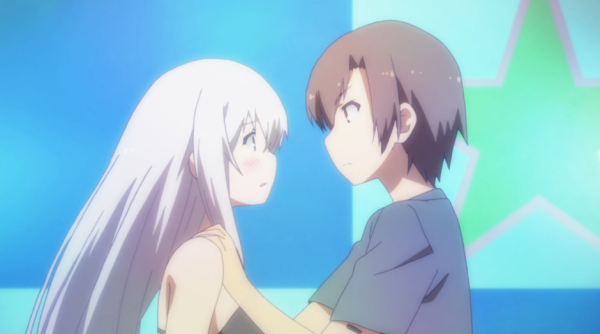
Hey, I didn't forget about finishing this series. Sorry about taking awhile to update Crunching the Numbers, but I underestimated how much time it takes to follow 13 shows, or rather 8 shows as you'll see I dropped quite a few shows since the last time. I'll briefly talk about the shows I dropped and why I dropped them, but first I want to discuss the future of Crunching the Numbers.
There won't be any Crunching the Numbers after this. Don't worry, I'm not stopping the season reviews just yet. Quite simply, Crunching the Numbers will be receiving a new name with some new rules that are designed to make it so that following every show will be easier on me. I won't be revealing the name change and new rules just yet, but you'll know about them eventually.
However, you're going to have to wait until the fall. I may or may not do some summer previews (though at the time of this writing Free! is the only new anime I'd say is worth anything), but I won't be doing any extensive coverage of the season. Instead, I'll be focusing on a new weekly anime project which I will be announcing next week. Look forward to it.
So with that out of the way, let's crunch the numbers one more time!
Spoiler Warning!
1) Flowers of Evil
Flowers of Evil embodies both the best and worst traits of this season. The good definitely outweighs the bad in this case, but let me talk to you about the biggest problem of this season: pacing. You might not think that's such a big deal, but bad pacing actually killed what were once good shows for me as we'll see later. Pacing is what dictates the flow of a story and consequently the mood, the character motivations, and most importantly the audience's reaction. Flowers of Evil is a slow burn of a show, which sometimes really makes the creepy mood of the show even better (the tension of Kasuga entering Nakamura's room for the first time for example), or sometimes the mood will become blissful and ethereal (the amazing classroom sequence in episode 7).
Oh yeah, episode 7. You might have heard people lavish praise for this episode in particular. It's not even the best episode (episode 10 takes that spot for me), but episode 7 completely justifies the use of rotoscoping, not just for the show but as a tool that can be used in any animated work. The show has been building up the rocky relationship between Kasuga and Nakamura up to this point. Nakamura's goal has been to expose Kasuga as a terrible deviant, possibly because she needs someone to justify her misanthropic look on life. It results in a beautiful little piece of destruction and awe-inspiring visual direction. It's up there with the Green Bird sequence from Cowboy Bebop as one of those moments that makes anime totally worth watching.
Let's get back to the pacing problems I mentioned earlier. As amazing as moments like episode 7 are, the earlier episodes have the problem of not much actually happening in them. The slow pacing is intentionally done, but it does test your patience. The worst offender of bad pacing has to be the first 8 minutes of episode 8. Yes, right after that amazing segment of animation I was telling you about, the show decides to show you 8 minutes of Kasuga and Nakamura walking home. In theory this would work as a nice cool-down moment after the insanity of the previous episode, but 8 minutes of just walking is overindulgent. Luckily the pacing picks up again afterwards, but the show never shakes off that feeling of being a little too slow.
Episode 10 feels like the real climax of the show to me, with the last three episodes wrapping up some of the fallout nicely, but episode 10 feels like where the show finally makes its point about the characters of the show. Is Kasuga this smart person who understands a book as difficult as Baudelaire's Flowers of Evil? No, he's just some lonely kid who is empty inside, and doesn't understand Flowers of Evil any more than Saeki understands it. Kasuga is truly pathetic and no one cares. It's a harsh message, but extremely refreshing for an anime to say. Too many times have we been treated to stories about kid protagonists who are special, who might be misunderstood but are good down deep, or completely awful characters who are justified by having a tragic backstory. No, Kasuga is awful because he hasn't grown up yet. He holds onto these childish and creepy fantasies of Saeki being a pure angel. It's an extremely unhealthy way of thinking, and yet it's biting because there are people like Kasuga out there. Hell, the idea of sexual purity is one that is disturbingly common among Japanese otaku. You needn't look any further than any idol fan to find these ideas. That Flowers of Evil has the balls to make statements like this makes it truly special and worth watching.
One last thing I have to talk about, and no it's not the rotoscoping because that's been talked about before, though I will point out that as the show goes on, the direction and rotoscoping drastically improves, though are a few hilarious moments where a character played by Oshimi Shuuzou (yes THAT Oshimi Shuuzou), is obviously wearing a fake mustache. What I really want to talk about is the ending and how it makes Flowers of Evil less of a standalone story than it should be. I was expecting that I'd want to read the manga afterwards because I knew that the anime wouldn't cover the whole story, but with the direction it was heading in I thought it'd pick a good point to stop and make the whole thing work as its own smaller version of the manga. Sadly, the ending teases future events that happen in the manga and ends with the words "Part 1: END". It's a horrible tease that really doesn't need to be there when the rest of the ending works fine and there's no guarantee that this show will get a second season. If it does, I'll definitely watch it, but given the backlash this show received it has a snowball's chance in hell of getting that second season.
Fortunately, that tease is not enough to diminish the quality of this show. We need more anime like Flowers of Evil. We need more anime that are bold enough to make something different and refuse to pander to audiences while sacrificing artistic intent (though given the anime I'll be watching this summer this is really ironic). Flowers of Evil is one of those anime that proves why anime can be special, and that's why it's a must-see.
2) Chihayafuru 2 (second half)
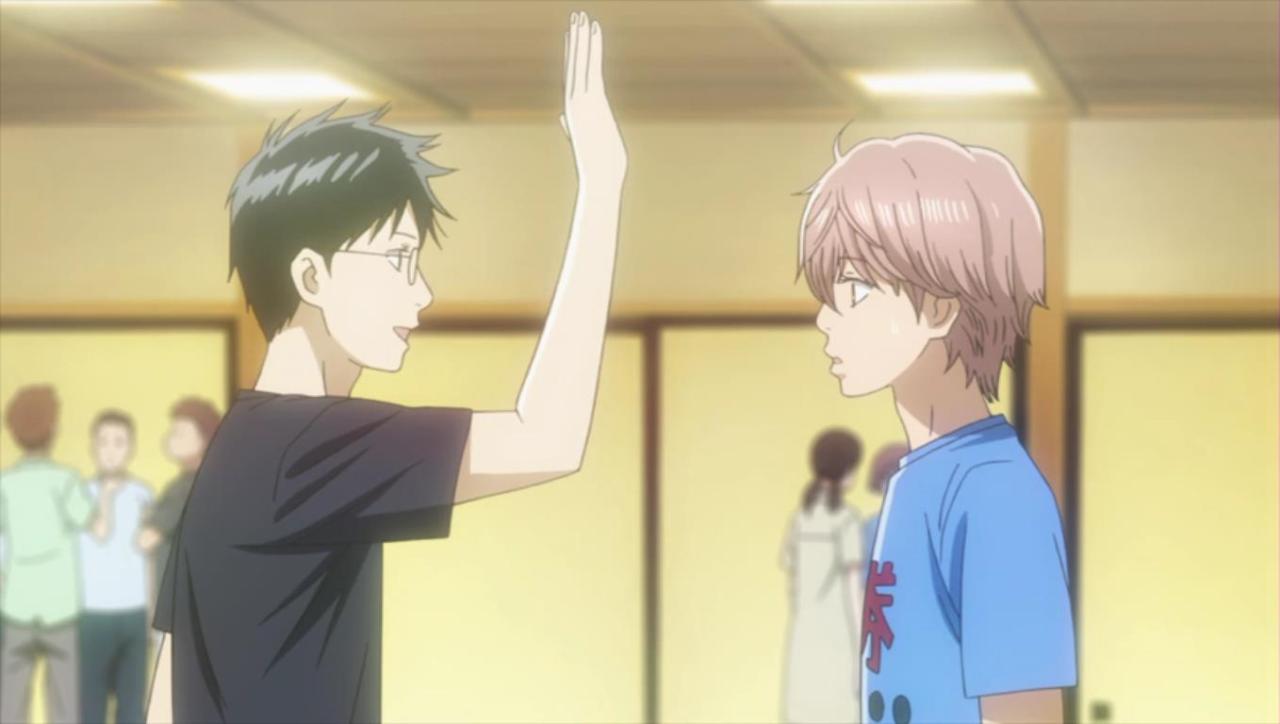
SEASON 3 PLEASE!
Okay, I'm getting ahead of myself, but I really hope we get at least one more season of Chihayafuru because it's so good. Like many other shows this season, Chihayafuru 2 had pacing problems; it covers less ground than the first series by having most of the season focus on one tournament, and some of the karuta matches go on for one episode too many. However, Chihayafuru still shows what it needs to show, that being the emotionally satisfying triumphs and losses that our characters go through. Arata finally feels like a proper part of the show now, and the issues of the love triangle Chihaya has been involved in from the start have been mostly resolved in one scene where Chihaya basically admits who she loves to the audience (though not her love in person). Season 2 ends on a good note; like season 1, it leaves room for more, but it's a nice reflection on all that has happened before and shows just how far our characters have come since first forming the karuta club.
Maybe one day I'll do a full review of Chihayafuru in general, but for now I feel as though I've already said as much about the show as I can. I've seen 50 episodes of characters playing a card game I've never heard of before, and I loved nearly every bit of it.
3) The Devil is a Part-Timer
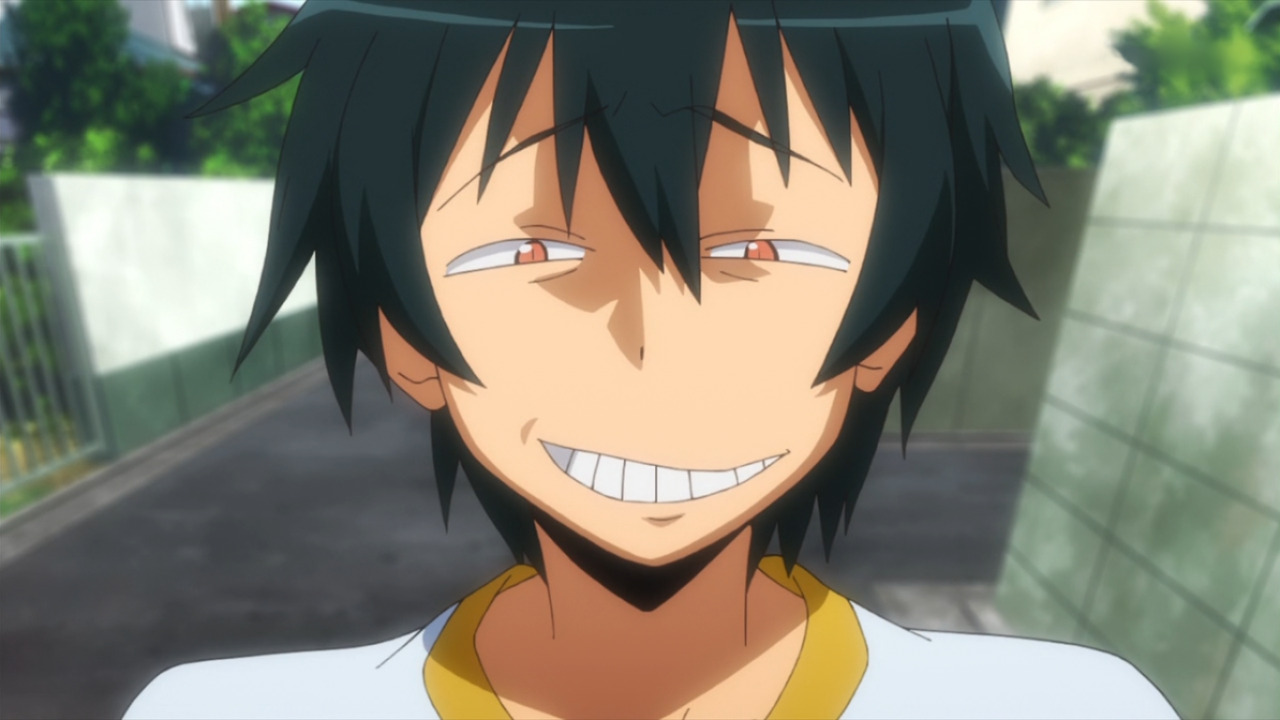
If Flowers of Evil didn't exist, this would be the most surprising anime of the season for me. An anime about Satan working at McDonald's (named MgRonald's in this show)? That sounds really dumb, it can't be that be good. Cut to me laughing for 13 episodes. Maybe this says more about my taste in comedy than about anime comedy in general, but there hasn't been an anime that has made me laugh this much in a long time.
What makes The Devil is a Part-Timer stick out from other anime comedy is that it doesn't fall prey to most of the same mistakes those shows make. Too often will anime comedy rely on overreactions, prat-falls, and yelling as jokes, when those aren't jokes at all. Devil's comedy comes from its natural character reaction and dialogue. You've got this great ensemble cast of demons, heroes, angels, and humans that all have really funny interactions with each other, whether it be just how well Satan adapts to working at MgRonald's or how budget-conscious Ashiya is or how Lucifer becomes this NEET, they all work. I ended up liking nearly all the characters due to their well-written personalities and quirks.
I mentioned earlier that most of the shows had pacing problems this season. Even my two favorite shows of the season couldn't avoid this, but Devil is a Part-Timer? Never feels too fast or too slow and the progression always feels natural. The action is actually somewhat good, though obviously not as good or important as the comedy and characters. There are a few moments in the show where Satan gets to let loose his powers, and those fight scenes are a ton of fun to watch. They border on being too serious for the show, but again, the characters are so likable by that point that the audience will be willing to let them be serious for a moment. Also, because I think it's fun to point this out, Satan saves more lives than Superman does in Man of Steel. Don't go see Man of Steel, watch The Devil is a Part-Timer instead.
However, like Chihayafuru and Flowers of Evil, the show does end on an open note. Will our heroes get back to their homeworld or be stuck in our world forever? The show doesn't say, opting to just end after an episode about Lucifer getting swindled by a door-to-door salesman. There's no real ending for the show, and I'm not sure it needs one, but some resolution for the characters would be nice. I've heard there was more material in the light novels that the show could adapt, so there's hope for a second season, but the amount of The Devil is a Part-Timer we got is still really good. It's that rare anime comedy that's actually funny.
4) Attack on Titan (first 13 episodes)
What do I need to say about Attack on Titan? What can I say about Attack on Titan that hasn't been said before? You've probably already seen the show at this point, indulged in the countless Attack on Titan opening parody videos or possibly made your own, or at least heard people talking about how awesome this show is. With all the hype behind it, Attack on Titan can't possibly live up to those expectations, right?
No, this show is really good. Oh, it's far from perfect. As cool as the idea of humans zipping around like Spider-Man and killing titans is, it drags its feet in the later episodes. I cannot tell you how sick I was of seeing "Battle of Trost" in the title card for nine episodes straight. It takes 3 episodes just for Eren (who now has the power to summon a titan body for him to control) to move a rock to stop the titans from getting into the town. It's a problem that persists in many shonen fighting anime adaptations, and there is a reason for it (writers don't want to overtake the manga storyline), but the chapter-per-episode pacing near the end of the first half does grate a bit.
Despite the pacing problems, the show's still a ton of fun. Earlier on it was a little hard to connect to the characters, but by episode 13 I found myself liking them much more. Mikasa is the stoic badass who pretty much needs no help when it comes to killing titans, and while this is a personality type I'm not often fond of, it's refreshing to see a female character like this in a show where the majority of human characters will die. Jean started out as something of an asshole rival to Eren, but through the Battle of Trost he's become a likable guy who feels guilty over losing his friends in battle. Surprisingly Armin has become my favorite character. Yeah, the wimpy blonde kid who you'd think would be among the first to die, but he's become an invaluable part of the Survey Corps thanks to his tactical intellect, and after he stood up for Eren and Mikasa in episode 10 he really won me over. I don't see much love for Eren, and it's easy to see why. He's a little archetypal "main character" for my tastes, the kind of guy who succeeds through sheer determination and heart. He's not a bad character by any means, and his titan abilities are responsible for some of the best action scenes in the series, but eh, he's not a great character.
The real reason this doesn't place as high as you'd think it would is not just the pacing problems, but the animation problems. Attack on Titan has some of the coolest looking fights, but more often than not the animation looks unfinished and the show resorts to still-shots, flashbacks, and camera pans and shakes to hide that fact, but it's still really obvious. Still, that shouldn't deter anyone from enjoying this show. It's incredibly entertaining, and I'm glad that it'll still be on this summer.
5) Valvrave the Liberator
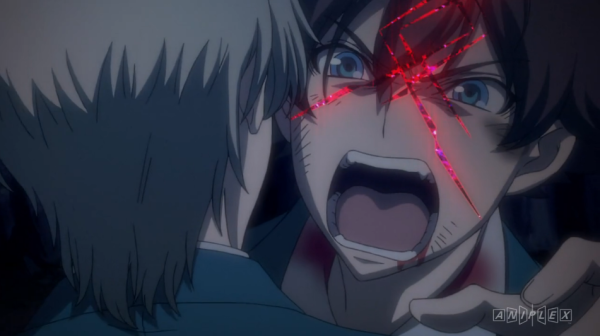
The more I watched of Valvrave, the more I loved it. It's not good in the traditional manner; the story is honestly quite stupid and Haruto isn't the most likable or relatable protagonist in the world, but each episode makes you think "oh there's no way this show can get crazier", and then it proves you dead wrong. It's entertaining trash at its finest.
And then Haruto rapes Saki.
There's no getting around this. Valvrave has stirred up an enormous amount of controversy by having its hero rape another main character. Yes, I know Haruto was under the influence of his vampire powers at the time, but that doesn't take away the fact that the writers thought this series needs a rape scene, and a really tasteless one at that. How the show handles the rape afterwards is even worse, uncomfortably tiptoeing around the issue for an entire episode which culminates in Haruto PROPOSING TO MARRY SAKI. She doesn't accept the issue because Saki knows better, but what the hell Haruto? The rape scene leaves an uncomfortable aura over the entire series. As fun as the rest of it is, it'll be impossible to forget just how badly the show handled it.
Valvrave will be coming back for a second season in the fall, and after much debate with myself over the issue... I'm still going to watch it. Say what you like about how tasteless or bad the show is, it's great at getting you to come back for more because of how unpredictable it is, and that last episode was kind of fun, although the final Valvrave is a brat who will have to work hard to earn any sympathy. I halfheartedly recommend Valvrave the Liberator. I wouldn't call it good, but there's a fanbase for fun trash like this, and I'm among them.
6) Gargantia on the Verdurous Planet
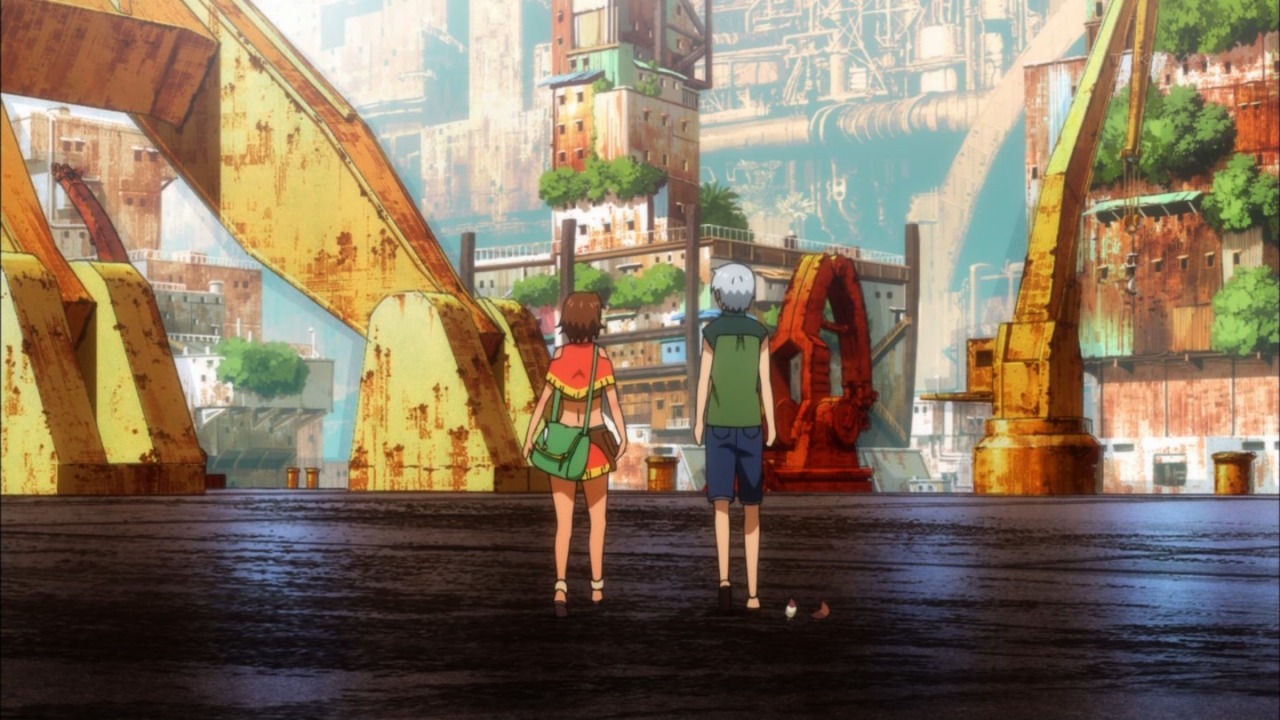
I bet you're really tired of hearing me mention the word "pacing", but my god does the pacing murder this show. What was once a show I had high expectations for became one of the more trying experiences I had this spring.
I'll get the good out of the way first: the first four episodes are a great fish-out-of-water tale with a sci-fi bent. The color design is phenomenal. There are some really good ideas behind the Galactic Alliance and Gargantia's differing philosophies on life. That's pretty much what I liked about Gargantia.
And then episodes 5 and 6 exist solely as fluffy fanservice. In a longer series, this might have been more acceptable, but they're still pointless and deter from the story. Even when the story comes back in episodes 7 and 8, the damage is still done; the plotting still feels too slow for a 13 episode series, and we spend way too much time on the funeral of a supporting character. But I still held out hope. Episode 9 takes the story away from the Gargantia and brings Ledo face-to-face with the true history of the Earth and the Galactic Alliance, and admittedly the story works at making the Hideauze important again. But then the series decides "oh, you thought we were being slow? Well now we're going to be as fast as possible! Screw your pacing!" The final 4 episodes show Pinion becoming the dictator of his own fleet, Ledo questioning Chamber's and the Galactic Alliance's motives, a cult that worships another robot like Chamber, and Amy and the rest of Gargantia no longer matters until the very end.
All this stuff comes out of nowhere and ends just as quickly, and thinking about it, I could see the show going in this direction had it been a 24-26 episode series. The fact that all this happens in the last 4 episodes makes the character motivations seem way off and the whole thing rushed, to the point that the emotional beats just feel hollow. All the plot threads are quickly resolved in the space of two minutes. I don't know what went wrong here. What was once the story of a soldier trying to find a new life in a strange land became a jumbled mess that doesn't know what it wants to be.
7) Devil Survivor 2 the Animation
So did Devil Survivor 2 break the video game adaptation and manage to be an engaging standalone story? Uh, no. Actually, from what I've heard even fans of the game don't seem to happy, so even as a way to pander to the fans it fails. So what went wrong?
Devil Survivor 2 has a huge cast of characters. Only two characters are truly important, those characters being our hero Hibiki and the villain Yamato, who have one of the most homoerotic rivalries I've seen in animation, and I've seen He-Man. Every other character exists to die. Anytime they have a moment that looks like character development is almost always immediately followed up with them biting the dust, so you never get to know them and their deaths don't register as being dramatic or shocking, just pointless. The show is trying to make a point about it being the end of the world, so some death would be expected, but the way in which the show kills off its characters is a boring pattern. Somehow Devil Survivor 2 made death and the apocalypse boring.
The show deals with big themes such as rebirth, the fate of humanity, and chaos vs order, all themes that have been explored in previous Shin Megami Tensei games, and they feel stagnant here. I think I know what the problem is, and this is a problem that seems to be persistent in anime adaptations of this franchise. The SMT games have always been built around choices; Devil Survivor 2 the game features multiple routes to choose, and your characters can die or you can save them. The power of choice is what gives the story and characters more power, and when stripped of that choice you're left with a soulless husk like Devil Survivor 2 the Animation. Though I am looking forward to seeing the Hibiki/Yamato doujinshi. Get to work on that, yaoi fans.
8) Muromi-san
There's really not much to say about Muromi-san. It's a gag comedy about a mermaid and her mythological friends who are introduced every week. There's no real story to speak of, so the show lives and dies by its gags, and honestly the show is too hit-and-miss to recommend. However, as with all comedy, taste is super subjective. I did laugh at a few jokes here and there (Muromi's relationship with penguins), but then there are episodes like episode 12 where the joke is "hey, how much can we gross the audience out by abusing this big-breasted mermaid?". Had the episodes not been 12 minutes long as opposed to 24, I probably would have dropped Muromi-san long ago. It exists, and it might make you laugh, but it'll quickly be forgotten as is the fate for most dumb gag comedies. Stick to Devil is a Part-Timer if you want some good yuks.
Dishonorable Mentions:
Mushibugyo (dropped at episode 8):
Great color design and humorous character designs can only get a bland tired story so far. I enjoyed the first few episodes of Mushibugyo, but I quickly realized it was going nowhere and the tiresome repetitive shonen fighting cliches got to me.
The Severing Crime Edge (dropped at episode 8):
I thought the relationship between the two leads was kind of cute, but the series quickly fell into tiresome battle of the week cliches and none of the other characters were particularly interesting.
Henneko (dropped at episode 7):
It was cute for one episode, and then AAAAAAAAAAAAAH IMOUTO SHIT WHHHHYYY? Incest jokes aren't funny, and neither are the other countless otaku-bait tropes in this show.
Arata the Legend (dropped at episode 7):
The terrible fire effects were amusing, but other than that? Meh, bland fantasy story.
Karneval (dropped episode 3):
It's pretty, but what's the story? Nothing made any sense and I had no reason to watch any more.
Okay, that does it for the spring! The summer sun is here and there are swimming anime to be watched. Next week I'll be starting my new anime project for the season. I think all of you space lovers will enjoy it. Stay tuned!
Showing posts with label Crunching the Numbers. Show all posts
Friday, July 5, 2013
Tuesday, June 4, 2013
Golden Ani-Versary of Anime
So for those not aware, 2013 is the 50th anniversary of televised anime, having started in 1963 with Tetsuwan Atom, aka Astro Boy. In recognition of this landmark, Geoff Tebbets started the Golden Ani-versary blog (which you can find here). A lot of talented writers have contributed to the blog, each of them taking a year of anime and talking about what made that year in anime special. Currently, the blog has reached 1997. Oh, and I may have contributed to the blog in some way. You might want to go read it here.
Also, update on my upcoming articles for the blog. Crunching the Numbers is coming out, but I've been thinking of changing the format, plus I've got some other projects I want to work on. I'll probably put out the last Crunching the Numbers when the Spring season ends, and when the Summer season starts, I'll be replacing it with a brand new title. Don't worry, I'll still be covering current anime, but the format will be different. Thanks for being patient with me, and keep reading.
Friday, April 26, 2013
Crunching the Numbers: Spring Fling
Exams are over, the sun is shining, and a slew of brand new anime is out for me to watch and complain about! Actually, there's not going to be a whole lot of complaining this time, because I happened to enjoy most of the shows this time around. See, winter is normally a wash for anime, much like how it is for American cinema. It's during the spring and fall that the anime studios like to put out their A-grade material... usually. Anyway, we've got a much beefier list this time around, so no point in delaying it any further!
1) Flowers of Evil (episodes 1-3)
School can be dull, monotonous, and horrible. This is the life that Takao Kasuga lives, a student with a crush on a girl named Saeki and an obsession with the real-life book Flowers of Evil by Baudelaire. One day, he steals Saeki’s gym clothes when no one is looking, except one girl notices him. Nakamura, an outcast with a dirty mouth, blackmails Takao into making a “contract” with him. No, she’s not asking him to become a magical girl, but she’s just as sinister as Kyubey.
Sinister is a great way to describe this show. The score is quiet and subtle, nonexistent at times and occasionally swelling into eerie strings and winds. The plotting is on the slow side; Takao doesn’t steal the gym clothes until the end of the first episode, and Nakamura doesn’t ask him for the contract until the end of the next episode. It’s planned for only 13 episodes, but the manga’s been going on for several volumes now; the pacing could become an issue, but the slow burn only adds to the show’s dark creepy atmosphere.
Okay, there’s no way to avoid talking about this; this anime is rotoscoped. For those who don’t know, rotoscoping is a technique in which the artists don’t create the characters from scratch; instead, live actors act out the scenes, and the artists draw over the live action footage to create animated characters. It’s a technique nearly as old as animation itself, dating back to the Betty Boop era, but it’s rarely used to animate an entire show, and for good reason; it makes the characters look weird. Cartoons don’t move the way people do, and when you see a cartoon moving like a person, it creates the uncanny valley effect. Personally, I’m not a fan of the technique; blame it on seeing Ralph Bakshi abuse the technique in several of his films and never making it work, but here? I have to give ZEXCS kudos for the sheer balls to take a popular manga like Flowers of Evil and completely change the artstyle like this, and yet it’s more faithful to the intent of the manga this way.
Flowers of Evil doesn’t want to portray the idealized moe version of school that we’re so used to in our anime. The characters actually resemble people, some of them even look ugly. Guess what, not everyone looks like a beauty model. It’s refreshing to see an anime attempt a realistic tone such as this. Now, one might ask why this wasn’t done in live action; in fact, the director wanted to do the manga in live action as he thought a typical anime adaptation wouldn’t suit the manga. The compromise of rotoscope was a double-edged sword; it was bound to piss people off for not looking like their moe blob schoolgirl shows or the manga, but on the other hand it’s created a huge reaction in which everyone must see this show for being so unique. I think the rotoscoping works primarily for two reasons: one, it is different, and anime needs variety, and two, it simultaneously creates a realistic and creepier tone for the story, thus enhancing the already realistic and creepy tone of the source material.
Someone has made an anime that no one else would dare to make, and the very idea of something truly new has excited me. Everyone should see at the least first episode of this show, if only to try something new and see how they feel about it. Variety is the spice of life, and this particular spice was fantastic.
Flowers of Evil is available streaming on Crunchyroll
2) Gargantia on the Verdurous Planet (episodes 1-3)
Far in the future, humanity has advanced far into the stars
and formed the Galactic Alliance of Humankind and a central colony called
Avalon. While seemingly a utopia society, the Galactic Alliance is stuck in an
endless war against the Hideauze, alien life forms that threaten the progress
of humanity. In a battle against the Hideauze, Ensign Ledo and his sentient
mecha named Chamber fall into a wormhole that leads them to a strange planet
full of life: Earth. Specifically, he ends up on a fleet of salvaging vessels
named Gargantia.
Mecha fans have it good this season; they have not one, not
two, but three mecha titles to choose from this season, but this is definitely my
favorite of the lot. From the first two minutes, I was hooked on the show. A
mysterious narrator gives us the details on the Galactic Alliance in a way
similar to a propaganda speech, referring to the humans as comrades and
praising them while demonizing the hell out of the Hideauze. One might be
reminded of the film Starship Troopers (the awesome one by Paul Verhoeven and
not the animated films or sequels) with its similar usage of a human-alien war
with its fair share of propaganda. However, that’s only a small part of the
show, as the focus seems to be on Ledo ending up on Earth, which according to
Chamber was supposed to have become inhabitable years ago.
The humans of Gargantia contrast well with the Galactic
Alliance’s attitudes and even dress code. The humans of Gargantia tend to wear
brighter colors and lack uniforms as opposed to the dark-colored and uniform
Galactic Alliance, and they’re more laid back as opposed to the militant and
rank-based Alliance. It makes for some conflict between Ledo and the Gargantia
when he first arrives. Chamber himself is a pretty cool mecha; his method of
propelling himself involves creating an energy orb of sorts above his head,
similar to a float.
There hasn’t been much action outside of the opening battle,
but Gargantia is so far a good example of sci-fi writing, presenting neat ideas
of the future and a great setting and story, and coming off of the recent
sci-fi anime Psycho-Pass, it’s nice to know that Gen Urobuchi isn’t repeating
himself with his major themes, at least not for now. The visuals as provided by
Production IG are stunning; the main colors of Gargantia are bright oranges and
blues, which pop nicely among the endless sea and rusting vessels. Overall,
Gargantia is a solid package, sure to suck in mecha enthusiasts and general
sci-fi fans in.
Gargantia is available streaming on Crunchyroll
3)The Devil is a Part-Timer (episodes 1-3)
Its demons vs knights in a fantasy realm ruled by none other but Satan himself! In an epic battle at his castle, Satan and his loyal minion Alsiel are forced to flee, but they swear to conquer the land once again. Cut to them warping to where else, Earth. Stranded and unable to use their magic, they’re forced to live like normal people and get part-time jobs. Satan swears to eventually conquer this world as well once he’s earned enough money, but has he grown accustomed to his new life as a human?
If someone weren't aware that this was supposed to be a comedy, you might mistake this for a serious show at first with the fantasy war. It only makes the shift to the human world all the more hilarious. The concept of Satan working at McDonald’s (well, they call it MgRonald’s instead, but you know what it is) alone is funny, but the writing and pacing of the show is witty enough to have you laughing every minute. Jokes come and go at a moment’s notice, and the show never slows down. The story’s no slouch either; as of episode 2 Satan (going by the name of Maou in the human world) encounters a hero from his world who’s come to slay him; hilariously she’s lost her magic as well and is working at a phone company, and she’s making a lot more money than Maou.
The problem with reviewing a comedy is that merely repeating the jokes does the show no service, but trust me when I say this is the funniest show of the season. The art and animation hold up as well; it’s not uncommon for anime comedies to look cheaper than their action and drama counterparts, but it looks just as nice as those other shows; the battle at Satan’s castle in particular looks like it were ripped straight out of a high-quality action show. If you’re looking for a high concept comedy that actually lives up to the premise, this is your show.
The Devil is a Part-Timer is available streaming on Funimation and Hulu
4) Chihayafuru 2 (episodes 14-16) (-3)
Remember last time when I talked about the pacing being a
bit on the slow side? Well, the semi-finals lasted THREE episodes. Mind you, by
shonen tournament standards this is nothing, but for Chihayafuru, it’s weird to
see them take this long to get through one match. It’s a good match, one with
lots of tension and a surprise victory for one character near the end, but
given the amount of flashbacks used in the match, this could have easily been
two episodes instead. Hell, in episode 15, most of the time is spent hyping up
the final match, and while it does help us get into the mindset of the opposing
team and lend itself well to humor, the show doesn’t have much time left and we’re
still at the national team matches. The individual matches haven’t even started
yet!
Don’t get me wrong, the show is still great; every character
is likable in some way and you really feel their struggles, but knowing that a
season 3 is highly unlikely, I’d love to know if the show will end on a
satisfying note and not a “read the manga” ending. Also, episode 16 is a recap episode. Yep.
Chihayafuru seasons 1 and 2 are available streaming on Crunchyroll
5)Attack on Titan (episodes 1-3)
Far in the future, instead of reaching the stars humanity lives in a medieval style city surrounded by 100 feet walls. There is peace so long as the humans don’t leave the walls, but this changes when the Titans attack and finally break through the outer wall. Well, I’m sure the titans won’t harm the humans, right? They can be reasoned with, or not, as they try to consume every human in sight.
Attack on Titan was perhaps the most anticipated title of the spring, and I’m glad to say it’s not a disappointing show so far. Thanks to the bombastic direction by Tetsuro Araki, who previously worked on the similarly energetic though not as action-packed Death Note, Attack on Titan aims to please the audience with an overwhelming sense of scale by introducing the titans as major threats from the first episode 1. The designs of the titans are a bit weird; some of them have rather dopey faces, but they become downright creepy when they’re chomping down on a human. Some of the titans lack FLESH, as if it had been burnt off, which is truly unsettling.
However, that's not to say there aren’t problems. The character designs have thick outlines, a look that normally doesn’t stick out in comics but can look odd in animation, and it’s a bit distracting here. The animation is amazing in places, but when the action isn’t happening the characters are largely static, sometimes relying on camera pans over still images. Also, there isn’t much to the characters yet. Eren’s our protagonist, a young boy who wants to join the Survey Corps and stop the titan, but he mostly spends the first two episodes yelling about the titans and being angry. There’s also his sister Mikasa and his best friend Armin, but they haven’t had much to do yet either. Given the nature of the first two episodes, which is mostly world-building and action, this is forgivable.
Episode 3 thankfully takes a break from the action to focus on the characters, as they begin training to become soldiers. We’re introduced to more of the supporting cast as well, and already relationships and rivalries are beginning to form, which will no doubt affect the rest of the story. By far my favorite character in the show so far is Sasha, a trainee with an obsession, and no, she’s not just a typical big eater given her backstory.
So far Attack on Titan is looking to be a fun fantasy romp with some grisly imagery for good measure. I’d say the hype for this show has been well-deserved.
Attack on Titan is available on Crunchyroll
6) Devil Survivor 2 (episodes 1-3)
It’s an ordinary day in Japan for our three high school
students. Get on subway, get an email video showing you how you’re going to
die, a demon attack, you know, another day in Japan. It turns out that a group
known as the Septentriones are invading Tokyo, but fortunately our three young
heroes receive their own demons via cellphone, and they fight back. A
government agency known as JP’s that knows about the demons appears to protect
the city and assist our main characters, but not much is known about them.
With a name like Devil Survivor 2, you might think this is a
sequel and would thus not qualify for Crunching the Numbers (ignoring Chihayafuru 2 because I love Chihayafuru). However, it’s
actually an adaptation of the video game of the same name, which was a sequel
but had a standalone story, and that’s the case here. The show is not shy about
its video game roots; the monster summoning mechanic is as old as Pokemon, and
between commercial breaks it shows off the status and bio of each character
much like a video game stat screen. To the show’s credit, this never gets in
the way of the plot; exposition happens but it never slows down the story and I
never feel like I’m watching a game tutorial. In one episode, a character
purchases a demon on his phone through an auction, which seems to be straight
from the game, but it casually happens during a scene without exposition and
doesn’t slow down.
So far the characters are pretty likable. The main
character, Hibiki, fits the hero archetype pretty well, but it’s clear he has a
personality unlike the mute protagonists of many RPGs; it helps that he speaks
of course. His friend Daichi plays the role of lovable loser well, and everyone
else is fine. The animation is pretty good, and seems to be better than
previous Shin Megami Tensei adaptation Persona 4. As an action show, it’s very
solid and has enough variance in the demon designs to keep you engaged. I
should note that the character design is being done by Suzuhito Yasuda of
Durarara fame; most of the characters have that thin stylish look to them, and
the opening sequence for the show is also reminiscent of Durarara, introducing
each character with their name on-screen.
Normally video game adaptations aren’t worth watching (oh
hai Devil May Cry), but this one seems to be pretty solid. I haven’t played the
game it’s based on, but it does a good job of welcoming new viewers in by not
overloading them with info from the game and letting them settle into this
setting, and I’m sure fans of the video game will enjoy seeing their favorite
characters competently animated.
Devil Survivor 2 is available on Crunchyroll
7) Mushibugyo (episodes 1-3)
Japan is being invaded by giant bugs! Luckily there’s the
Edo Bug Magistrate Office, which has the strongest warriors in all of Japan!
Our main character, Jinbe, wants to be the strongest warrior ever, and joins
the Office as a way to get stronger, but he gets no respect anyone. See, new
recruits never last more than week, so there’s an air of elitism among the
Office, but slowly Jinbe is growing on them with his tough attitude and need to
prove himself!
Welcome back to Shonen Land, where the heroes are
hot-blooded and the hairstyles are crazy! Mushibugyo has no pretense about
being a dumb shonen action series, but thankfully it’s very competent at being
one, a trend that seems to be strong this season. While the characters all fit
neatly into their little shonen archetypes, they’re all likable for the most
part. In the second episodes, there’s actually a bit of development between
Jinbe and the ninja Hibachi, who bond over their mutual like of the Office’s
greatest warrior, Mugai; it’s actually kind of adorable.
Mushibugyo’s not going to win awards for plot and character
this season, but it caught my eye with its stylish presentation. The opening
colors the characters with some thick shading around the outlines, to the point
that they resemble characters straight out of Redline, and each episode opens
with a preview of a scene later in the episode presented in black and white.
It’s as if someone saw Rurouni Kenshin and thought “yeah, I can make that, but
I’ll make it look cooler and not go on for 100 episodes”. This is Seven Arcs Pictures first time doing
animation production (to my knowledge), and if this is what they can do, I’d love to see what
they could do with a stronger script. I don’t expect much from Mushibugyo, but
the stylish direction and unabashed love of the shonen genre definitely put me
in good spirits.
Mushibugyo is available on Crunchyroll
8) Valvrave the Liberator (episodes 1-3)
From Sunrise studios, it’s yet another mecha show! Are you
surprised?
While Gargantia is my preferred mecha show of the season,
Valvrave has managed to carve a nice niche for itself. The plotting is standard
mecha fare; it’s the year TC 71 (a fancy term for THE FUTURE), and Earth has
been split into several space nations, two of which are the Dorssian Military
Alliance and the neutral nation JIOR. Haruto is a normal high school student
living in Jior when suddenly the Dorssians attack in an attempt to annex Jior.
Luckily, Haruto finds an experimental mech called Valvrave that allows him to
fight back. Oh, and it turns him into a vampire. You know, like mechs tend to
do.
So far Valvrave comes across as the dumber but more fun
cousin of Gundam. Plot-wise it’s not much different (young boy fights invading
army with mecha), but the twist of him becoming a vampire (okay, not really a
vampire since he can go into sunlight, but he is essentially immortal and bites
people on the neck) is kind of fun. Dialogue and character-wise the show’s
nothing special; Haruto has some understandable angst at least, and the
Dorssian spies are a bit of fun, particularly the headband kid who’s
enthusiastic about killing. The opening promises that there will be more mechs
like Valvrave, and the show has set up a decent rivalry between Haruto and a
character named L-Elf (yes, only in anime would a person have that name).
It doesn’t have anywhere near the same ambitions as
Gargantia, but as a stupid but ludicrous counterpoint to it, it has a reason to
exist this season. The gimmicky nature of it could rub off fast, but it’s
certainly better than the last mecha show of this season.
Valvrave is available on Crunchyroll
9) Arata the Legend (episodes 1-3)
Have you ever had a friend who turned out not to be your friend? This is how Arata Hinohara’s first day of high school begins, as a bully from his middle school days convinces Arata’s last friend to betray him. Meanwhile, in a fantasy world, another boy named Arata has been chosen to be the next ruler of the realm. However, the ruler must be a princess, so Arata crossdresses to overcome this problem and hopefully avoid detection. The plan goes awry when the current princess is assassinated and Arata is blamed for it. As he runs from the guards, he ends up in a magical forest which switches him with the Arata of our world. As if Hinohara’s day could get any worse.
Based on Yuu Watase’s manga of the same name, Arata the Legend shares much in common with her previous works, particularly Fushigi Yuugi with the normal person trapped in fantasy land plot. What sets this apart from her other work is the intended audience: the pretty boys will probably still get the girls to watch, but this is meant to be a shonen series. The main character’s (we’ll refer to the Japanese Arata as Hinohara to avoid confusion) more active than the female protagonist of Fushigi Yuugi; already in the first episode he’s obtained a magical sword called a Hayagami and managed to fight back against his pursuers. To draw one more Fushigi Yuugi comparison, the fantasy world invokes a magical Chinese look, with ever character wearing elaborate and beautiful robes.
So far Arata is a decent entry in the “trapped in another world” genre. Hinohara’s angst is understandable, and he’s not completely useless as a character, and if you like Watase’s designs then you’ll like the look of the show. It looks a little old among the slicker shows out this season, but you'll live. Not much else to say at the moment, but it’s entertained me enough to keep for now.
Arata the Legend is available to watch on Crunchyroll
10) Muromi-san (episodes 1-3)
Takurou, nickname “Takkun”, is a high school boy who loves to fish. One day, he catches an annoying mermaid named Muromi who can’t leave Takkun alone. She mentions being thousands of years old and being responsible for events such as the Kamikaze that saved Japan from the Mongols. Takkun doesn’t show much interest in her, but she keep coming back, and sometimes with friends.
What’s unique about Muromi-san is that it’s the only anime this season that airs in 12 minute episodes as opposed to the usual 24 minute episodes. This was probably a wise choice on the part of the creators, as the show doesn’t have much going for it. It’s purely a comedy, relying on slapstick and jokes about Muromi’s age and status as a mermaid, and not all the jokes hit home. Episode 1 made me laugh a few times (“don’t ask me, I’m just a starfish!”). Episode 2 was a bit duller, introducing Muromi’s friends and some historical in-jokes, but otherwise not as funny as the first episode.
Still, in small doses, it’s an okay show. Probably the best part of the show is the opening sequence, in which Muromi and her mermaid friends try to protect the Earth from a meteor. For the few laughs it gave me, I’ll keep it for now.
Muromi-san is available on Crunchyroll
11) The Severing Crime Edge (episodes 1-3)
Kiri Haimura loves cutting hair more than anything, to the point that it’s practically a fetish for him. As if fate were on his side, he meets a girl named Iwai Mushiyanokouji, who is cursed with long hair. Nothing can cut her hair except for Kiri’s scissors, which turn out to be a special item known as the Severing Crime Edge. It seems like Iwai’s problems are fixed, but things only get worse when serial killers who possess similar tools to the Crime Edge known as Killing Goods start attacking her. It’s up to Kiri to protect her with his own Killing Goods.
Okay, first I have to mention that having to say “Killing Goods” over and over again is rather silly, and the same goes for the other made up terms in the show like the Insteads. As for the show itself, it feels like a weird blend of a standard shonen fighting series and Mysterious Girlfriend X (yeah, that one anime with the “romantic” drool fetish). While not as creepy as MGX, it definitely has that same vibe of “does the author have some weird kinks?”. Kiri’s obsession with hair could be considered acceptable, but the level at which he expresses it is borderline psychotic. Iwai is a moe character through and through; innocent, needing to be constantly protected, and appeals to the main character’s interests. Whether this bothers you or not will tell you if you’re the target audience for this show.
As it stands, so far I can’t quite say Crime Edge is good; rather, I’m transfixed by just how strange and stupid it is so far. The characters don’t act like real people, and the premise is incredibly ludicrous and a tad convoluted. It’s definitely more interesting than something like Mysterious Girlfriend X (once you get past the spit in that show, it’s a dull rom-com). The uncertainty of where this show is going is enough to keep me watching.
Severing Crime Edge is available on Crunchyroll
12) Karneval (episodes 1-2)
The first episode kind of reminds me of the first episode of
Baccano; it involves a train and it’s really confusing. I got the basics of the
show down; there’s an organization called Circus, basically a bunch of
superpowered people with a circus theme that combat superpowered criminals and
monsters. They happen upon a thief named Gareki and a young white-haired boy
named Nai, and due to their special skills, they take an interest in them and
bring them aboard their flying ship.
When I first heard of the show, it was described as a josei
series, but it honestly feels more like a shonen series based on the set-up.
The female appeal seems to lie mostly in the art direction, and I must admit
there are some pretty men in this show, but the art should appeal to both
genders; the color design is very bright and stands out, the characters are all
very distinct, and the animation is fluid where it matters. It makes the first
couple of episodes easy to swallow despite their otherwise confusing nature.
We’re not really sure of the motivations of the characters just yet aside from
their occupations; Nai and Gareki are the biggest mystery of the show.
Hopefully later episodes will flesh them out; there’s nothing wrong with being
ambiguous for the sake of mystery, but more info up front would be nice.
It goes to show that being pretty does matter when it comes
to holding my attention. Had the art design not been nearly as good, I might
have considered dropping this early, but for now I’ll keep watching.
Karneval is available to watch on Funimation and Hulu
13) Henneko – The Hentai Prince and the Stony Cat (episode 1-2)
I recall an anime from last summer being about a perverted high school student who was open about his pervertedness. This show takes that one step further by prevented us with a perverted main character by the name of Yokodero Yoto who wants to be able to talk about his pervertedness. Thankfully for him, there’s a cat statue that can take away his mind’s filter, thus letting him freely talk about the things that come to mind. However, this backfires when he starts saying perverted things in front of everyone without any control, and he ends up being labeled “the Hentai Prince”. He wishes to have his façade back, but the cat statue already gave it away to someone else who needed it. Lucky for him, he’s not alone as a girl named Tsukiko, who lost the ability to make facial expressions to the stony cat, decides to help him find the person who has his façade if Yoto can help her get her facial expressions back.
Given the premise and main character, the show is on the raunchy side. The opening sequence features close-ups on the girls’ boobs, butts, and navels, and there are some fanservice shots, but the show’s not nearly as offensive to women as one might think. Yoto’s a pervert and he knows it, and he does like to leer at pretty girls, but on the scale of deplorable perverts, he ranks pretty low. The fact that he doesn’t want to be spewing out perverted things 24/7 shows that he’s not a complete idiot and has a little decency, which is a bit refreshing. Tsukiko’s lack of emotional expression in both her voice and face could get tiring, however. It makes sense that Yoto would have a character who suffered a similar fate to him to talk to, but a character lacking emotion doesn’t sound fun.
The main problem with the show is that the concept might not be able to fill out a single cour; by the end of the episode they’ve already figured out where Yoto’s façade has gone. Thankfully, there’s enough humor in the first episode to give me some hope for this show. The ending in which Yoto gives a ridiculous love confession to a girl is worth a few laughs. It’s far from a masterpiece; it doesn’t do much to stand out from other sex comedies out there, but the concept is neat enough and the jokes hit often enough to make it onto my list for now.
Henneko is available to watch on Crunchyroll
14) Majestic Prince (episodes 1-3) (Dropped)
So okay, have you heard this one yet? A bunch of teenagers
are training as mecha pilots and… oh wait, you have heard this one? Good, I can
keep this short then.
If Gargantia is smartly written and Valvrave is dumb fun,
Majestic Prince is the dumb mecha show trying to be the smart show. It takes
itself mostly serious with some lame comedy thrown in. However, the setting is
all too familiar. Our teenage protagonists really not likable; they don’t get
along well with each other, and while that could be used for some interesting
exchanges, it’s damaged by the generic archetypes. You have the leader, the
nerd, the pervert, the cute girl, the serious girl, blah blah blah. It doesn’t
help that the character designs (done by Hisashi Hirai of Gundam Seed fame),
aren’t appealing. The character have this weird squareness to their faces,
often lack noses or have huge noses, and somehow manage to look bland despite
not being typical anime designs. Apart from the “what’s wrong with your
face?!?” moments, I could barely pay attention.
Look, we’re blessed to have three mecha shows of different
flavors this season, because we can pick whether we want something like
Gargantia (good science fiction story) or Valvrave (stupid fun gimmicks). With
those two shows existing, there’s not much point to watching Majestic Prince.
Majestic Prince is available to watch on Crunchyroll
15) Zettai Boei Leviathan (episodes 1.5) (Dropped)
Yes, that episodes 1.5 thing is intentional. Why? Because I could not make it through the second episode of this, which should give you a hint to my feelings on this show.
Based on a mobile Japanese game of the same name, Zettai Boei Leviathan is the latest show from Gonzo. Man, remember when Gonzo made good shows like Ganktutsuou and Welcome to the NHK? In the magical land of Aquafall, there are three dragon girls who hang out and do cute things, until a fairy shows up and tells them that the world is in danger, and she’s recruiting people with magic to form a defense squad. Naturally, the dragon girls… continue to do to cute things and not care about the world’s safety. But hey, the girls are cute, right?
This show is painfully dull. The fantasy setting is completely wasted on the slice-of-life stuff. I imagine the girls are part-dragon (they grow wings and tails when they want to), probably to appeals to someone out there, and some people might like that the show is nothing but cute girls doing cute things, but there are better shows with cute girls out there, like last season’s Love Live. You know why Love Live was entertaining? There was actually a reason to give a damn for the characters beyond “cute girls doing cute things”. Even K-On, the poster child for the genre, had more urgency than this. There’s far better fantasy shows out this season, no need to watch this one.
Zettai Boei Leviathan is available to watch on Crunchyroll
These aren't on the list, but I also checked out Photo Kano and My Teen Romance Comedy is a SNAFU. The reason I don't talk about them more is that I just didn't think they were interesting enough to talk about. I also did not check out Date A Live because everyone unanimously agreed it was horrible, and I simply never got around to watching Red Data Girl because my list was already big enough.
Saturday, April 13, 2013
Crunching the Numbers: Winter Wrap-Up
I'm a bit late with this one, mostly because I've been busy checking out the new spring anime. Don't worry, you won't have to wait long for the next Crunching the Numbers where I give my initial thoughts on the spring season, but you'll be happy to know that I'll have a lot to talk about. But first, I have to give my final thoughts on the winter season.
My overall thoughts on this season are disappointment. I didn't even think that'd be possible given my low expectations for the season, but some shows had given me hope that this season wouldn't be a waste. Truth be told, the season wasn't a complete waste, but not counting Chihayafuru 2, a sequel to an already great show, I ended up liking only 2 shows, and even then I wouldn't be in a rush to rewatch those shows. Well, no point in delaying, let's take a final look at the anime of Winter 2013.
1) Chihayafuru 2 (episodes 11-13)
Actually, I can't give final thoughts on this anime, because it will be continuing into the spring, which I'm really happy about. I won't spend much time on this show in this particular article because of that and I want to focus on my final thoughts on the other shows, but I have a few new things to say about Chihayafuru 2.
The recent karuta match has actually felt slow for once. A fan pointed out that the team was done with the team matches at this point in season one, yet we're still stuck in semifinals. I don't mind the slower feel of the match, as the tension and mindgames are still really high, but some time is wasted with flashbacks, making me wonder if the show is padding. This does make me worry that season 2 won't cover as much story as season 1, and with the manga still not over and the chances of a season 3 up in the air, I hope season 2 ends on a good note. The show's still great, it's Chihayafuru, but there are the occasional flaws.
2) The Unlimited: Hyobu Kyosuke (12 episodes)
So who knew that the best new show of the season (Chihayafuru's a continuation) would be a spin-off of a show I'd never seen? Chalk it up to competent writing and pacing.
While this is by no means an instant classic, it's a perfectly likable little series which has the benefit of being watchable by fans of Zettai Karen Children and people who've never heard of the franchise. That's a hard task to pull off, and I appreciate it when writers can pull that off. I may even check out Zettai Karen Children at some point because I enjoyed the characters in this so much, though I know it'll lack Andy.
The main selling point of the show, besides the awesome psychic fights, are the characters of Andy and Hyobu. You may recall that I criticized Hyobu for being a bit of a bore at the start of the show, being an unstoppable badass with little else to characterize him, but thankfully the show goes out of his way to explain him and flesh him out. Even though the show is about him, the show smartly makes Andy the character the audience follows for the majority of the series. He's a character who is neither truly human nor ESPer, making him an outcast even among PANDRA and therefore a good point-of-view character for the audience. He doesn't need everything explained to him thankfully, but he's enough of an outsider that his acclimating to his new environment mirrors our own, making the new reveals feel natural. Both him and Hyobu play off each other nicely, and in the final episodes they make for a badass battle couple.
The final episode of the show doesn't change much, which is understandable given the spin-off nature of the show and the fact that the original manga is still on-going, but it ends on a good note with the characters having gone through a pretty good story and some changes. Nothing life-changing or epic, but it's a fitting and satisfying ending, and the overall show is just that, satisfying. If you're looking for a good anime with super-powered fights but don't necessarily want costumed heroes, this is a good choice.
3) Love Live: School Idol Project (13 episodes)
There was some concern that the show was going to end on a downer. I didn't think it would, and thankfully it doesn't, as it really wouldn't fit the show's upbeat can-do-anything attitude.
Love Live is proof that moe as a concept can make for good wholesome entertainment. It's very much like K-On in its themes and characters, having girls doing cute things involving music, but what separates this from stuff like K-On is the driving inspiration of the characters to save the school and meet their goals of being idols. It's still very much cute fluff, but it's fluff with energy to it.
Some of that energy does go away in the final episodes, when the characters realize they don't need to be idols anymore, and there's a lot of moping around and fears that the girls won't be together anymore, but it comes right back as the girls have an epiphany and realize what they want to do and for what reasons. It's super cute and charming, and leaves the viewer with a warm feeling.
I think what I like most about this show is that even though it's not meant for kids (it's meant to sell CDs to otaku who love idols), I could see kids enjoying this show. It lacks the creepy male gaze that other moe shows tend to have. To those not paying attention, they might assume that based on the short skirts on the costumes the show would go for a more sketchy tone, but actually watching the show destroys that perception. The dance sequences are gorgeously animated.... half of the time when they're not using awkward CG, but it's worth it for when the animation is great. The production values are good.
There's not much complexity to Love Live. None of the girls get much development, but they're all likable regardless. The plot is simple, but at least there is an on-going plot that leads to a conclusion. There is room for a season 2, but like The Unlimited, the ending is fitting. I didn't care for idol anime before this show, but Love Live proved that with enough effort and charm, even I can like the genre. It's not a must-see, but if you're looking for something cute, competently made, and lacking the calculated creepiness of other moe shows, Love Live fits the bill.
4) OreShura (13 episodes)
And now on with the disappointment. I didn't expect to be disappointed in a harem show, but OreShura had the advantage of not being a true harem for the first half of the show, and then they added Himeka and Ai, two completely useless characters who only exist to fill in harem archetypes. What's worse is that they drag Chiwa down as well into Harem Land, to the point that Masuzu is the only engaging girl in the main cast. Even Eita manages to be overcome with Harem Protagonist syndrome, stupidly unaware of his harem for most of the show's run and unable to commit to any of them. The plot of the second half of the show is basically "Eita must decide if he really loves his fake girlfriend or one of the three other girls who love them", and I do mean three other girls as they basically just become competition for Masuzu, who is the clear choice for Eita and the show makes it very obvious.
What's sad is that while I did want to see Eita get together with Masuzu, changing the set-up like this makes it a hollow victory. Earlier on, the writing was actually clever, making Chiwa a full-fledged character and making the main conflict be her and Masuzu fighting over Eita. It was very balanced, avoided most of the harem stereotypes, and most importantly funny. There's nothing clever about Himeka and Ai's characters. They're inserted into the story as girls from Eita's past that were never mentioned before and are extra baggage weighing the show down. Worst of all, despite the first half of the final episode seemingly have Eita make a choice about who he loves, it ends with the status quo being reset. Nothing is accomplished!
This show used to have balls. It did such a good job at avoiding the typical rom-com harem problems, and then it tried really hard to be meta about it but only ended up falling into the same stereotypes it once mocked. I can only recommend the first 4 or 5 episodes of the show, because not only are those episodes funny, the production values are some of A1 Pictures' best, but after that stop watching because it goes nowhere. Speaking of going nowhere....
5) Maoyu (12 episodes)
Maoyu, you have some splaining to do. Actually wait, don't explain, you already talk too much.
Maoyu is a great example off "good concept, poor execution". I was taken with Maoyu at the start because it had a fresh idea for a show, a fantasy show that delved into the economics and politics of war. Initially I was able to get over the lack of dynamic characters, and even the long talks about farming techniques and trade, because I thought the ideas presented were pretty good. There's a limit to just how long a show can run on having good ideas without going somewhere with those ideas, and sad to say this show didn't know what to do with itself. It has a non-ending, ultimately not having a satisfying conclusion at all and instead just stopping at a weird point. The show kept introducing new ideas and characters each episode up to the very end. We even finally got to meet the Mage, who I thought was interesting. She has some weird multiple personality thing going on, yet the show never delves into her character. Instead she has the cure for small pox! Yup, she delivers the cure for small pox to the king, and then it's never spoken of again.
The final episode's main conflict deals with the Demon King performing a ceremony that's supposed to "renew her license" as the king, whatever that means. She ends up becoming possessed by a past Demon King, who's kind of a dick and attacks Head Maid, but Hero easily snaps her out of it. Conflict gone, let's party and blow up a mountain! Wait what? No no no, all you guys did was talk about the glories of potatoes and the exchange rate throughout the show, but you never actually ended the war. You know, the goal that was driving the show in the first place?
Even as an action show Maoyu kind of fails. There's a couple of battles seen throughout the show, and they're perfectly fine, entertaining even, but for a show about war it shows very little of the war. I know it's about the economy and trying to fix the kingdoms so they have no reason to fight anymore, but you'd think there'd be more of the war on display. The show alludes to the Hero having several fights off-screen, and they sound cool, so why couldn't we see them, and if you cut those fights out, why didn't you have time to wrap anything up?
A bunch of cool ideas which go nowhere and get old and lack of any real characters really sour the experience. I wanted to love this show, but in the end it's very lacking. Stick to Spice and Wolf for your fantasy economics.
6) Kotoura-san (12 episodes)
If the second half of OreShura has the balancing of an elephant on a teetering plank, the entirety of Kotoura-san has the balance of a drunk manic-depressive. I don't get this show; it never seems to know whether it wants to be a heart-breaking melodrama or a comedic slice-of-life show with a psychic, and it fails at both of those things. Let it be known that drama and comedy can work together; Trigun completely shifts from comedy to drama halfway through its run, but it effectively foreshadows the drama and uses the comedy to warm you up to the characters before horrible things happen to them. Ouran High School Host Club is mostly comedy, but it occasionally dips into melodrama, and does so believably, again because you really like the characters and know how they behave. The characters in Kotoura-san? Well, the ESP Club for the most part is tolerable, but I never felt particularly endeared to them. Actually, the couple of Yuriko and Daichi was sort of likable, and their conflict, the boy not noticing the girl liking him, is an old plot but it affected me more than the main couple of Kotoura and Manabe. Actually, Yuriko's sub-plot of trying to prove ESP is real because her mother, an actual psychic, committed suicide because no one believed her. That's far more probable and sympathetic than Kotoura's arc in the show. Why didn't the show focus on her and Daichi instead?
Instead, we get Kotoura, who never develops as a character despite the first arc of the show being about her moving on, and Manabe, who is supposed to be a likable pervert but is mostly just the butt of the show's one running gag. I've complained about the overuse of Manabe's perverted thoughts as a running gag, because the show rarely does anything funny with them. I wasn't disgusted, I was bored. I like perverted humor, when it's done right, but repeating a joke to death is a job for unfunny Internet comedians. The one good thing I'll say about Manabe is that his heart is in the right place for the most part, and he did stick up for Kotoura as early as episode 1, so that's commendable.
But we have to talk about the main problem with the show, and that's Kotoura herself. You know, now I know why she would get bullied, and it's not for her ESP. It's because she's such a doormat. She eventually sticks up for herself in the final episode, in a brief rewarding moment where she pushes her bitch of a mom, the woman who need I remind you abandoned Kotoura when she was a young girl. This moment of self-respect goes flying out the window when Kotoura reads her mother's mind and realizes her mom regretted leaving her years ago. Sure, this could be a touching moment. It almost was. But Kotoura's conclusion? "It's my fault for not understanding you". No. No no no. You were a little girl who didn't know how to shut her mouth, that was your only problem. The fact that your mother ABANDONED you gives you the right to be angry with her, and it is in no way your fault. The entire point of episode 4 was that you got over this idea that your psychic powers were the cause of all problems, and yet now blaming yourself is what solves this conflict? So victim blaming is apparently okay. There was an earlier episode where someone with multiple personality disorder was attacking people, and when Kotoura confronts her, she comes to same exact conclusion that it's somehow her fault! Did this girl learn nothing from the show?
Not only is Kotoura herself kind of unlikable, the show is really fond of characters doing mean, villainous things and then instantly forgiving them. Moritani, a girl with a crush on Manabe, had some goons BEAT THE CRAP OUT OF HIM and send him to the hospital, which was all part of some convoluted plan to get rid of Kotoura. For the rest of the show, she's part of the ESP club and friends with the main cast. That attacker I mentioned earlier? Police easily forgives her. Kotoura's mother? I don't even need to elaborate on how easily forgiven her character is. Is the show serious or not? It's comedy half of the time, so is its usage of easily forgiving characters just part of its weird sense of humor? Well, I don't think it's funny. I think it's lazy.
While this is not the worst show of the season, it's easily the one that aggravated me the most due to its inconsistent humor and drama and deplorable implications when it comes to the "growth" of its title character. For every time I actually laughed at a joke or found a character moment touching, the show found 5 ways to piss me off.
7) Vividred Operation (12 episodes)
I hate the power of friendship so much. Yes, friends are a wonderful thing, and I'd hate to live without them, but do I want to see an entire show about preaching friendship that doesn't understand what the power of friendship actually is? Hell no.
The finale of Vividred Operation is both painfully dull and painfully sweet. The Alone (I finally get why they're called that, and it's really dumb), have unleashed their ultimate monster, and Rei, who's revealed to be not of this world, has been absorbed by it. Our heroes are told they have no chance to defeat the monster and save Rei, but they know they'll win because of their friendship with Rei and yadayadayada. They beat the monster, save Rei, and everyone's happy the end.
Truth be told, I should have dropped this show ages ago. I only kept it because I thought it might get hilariously bad, and there are a couple of moments like that, but the show is mostly just two-dimensional girls showing off their butts and talking about how wonderful friendship is. You could replace all of their voices with Tea from Yu-Gi-Oh Abridged and the effect would be the same, in addition to feeling like Chris Hanson's watching you. Even the magical girl fights aren't fun, ruined by the fact that no one cares about the heroes because they have such stock personalities. The show wallows proudly in cliches, offering nothing new and exciting for the viewer. I won't lose any sleep over telling you not to watch this.
Since I finished and posted my final thoughts on Problem Children weeks ago, there's no review for it here, but if you're curious as to where it would rank among the shows I finished this season, I'd put it just below Vividred Operation and right above Bakumatsu Gijinden Roman. Though the difference in quality between these shows isn't much. They're all pretty colossal wastes of time if you ask me.
9) Bakumatsu Gijinden Roman (12 episodes)
I will, however, probably fall asleep if I have to talk about this show anymore.
I never thought Monkey Punch would be a detriment to a show, but he actually is. The designs are fine, don't worry, but when you see those character designs, what do you see? You see Lupin III, and when I see Lupin III, I expect fun shenanigans and great adventure. Roman tries to have some fun shenanigans... try being the key word here. Most of the show is pointless one-shots about Roman trying to find or steal something for a client. Lupin was built around one-shot adventures as well, but it had insane plots and lovable characters to make that format work. Roman lacks the charm and creativity of Lupin.
Eventually Roman tries to have an ongoing plot near the end. It sort of set it up near the beginning of the show, but it was quickly forgotten for lame adventure and dull characters. The plot itself is pretty dull too, which is disappointing because it's about Japan meeting American for the first time. That was kind of a big deal. I will say one thing in defense of the show: Cyborg Admiral Perry. It's really stupid, but it's the only time I've seen Cyborg Admiral Perry. I guess that counts for something.
I recommend skipping to the last episode just to see that. If you're thinking of watching Roman, go watch Lupin III instead.
All the shows reviewed this season are available to watch on Crunchyroll.
------------------------------------
There you have it, the winter is over. I'll continue to watch Chihayafuru, but next week I'll have a ton of new shows to talk about, and I actually like quite a few of them. Will it make up for a season of mediocrity? Find out on the next Crunching the Numbers!
My overall thoughts on this season are disappointment. I didn't even think that'd be possible given my low expectations for the season, but some shows had given me hope that this season wouldn't be a waste. Truth be told, the season wasn't a complete waste, but not counting Chihayafuru 2, a sequel to an already great show, I ended up liking only 2 shows, and even then I wouldn't be in a rush to rewatch those shows. Well, no point in delaying, let's take a final look at the anime of Winter 2013.
1) Chihayafuru 2 (episodes 11-13)
Actually, I can't give final thoughts on this anime, because it will be continuing into the spring, which I'm really happy about. I won't spend much time on this show in this particular article because of that and I want to focus on my final thoughts on the other shows, but I have a few new things to say about Chihayafuru 2.
The recent karuta match has actually felt slow for once. A fan pointed out that the team was done with the team matches at this point in season one, yet we're still stuck in semifinals. I don't mind the slower feel of the match, as the tension and mindgames are still really high, but some time is wasted with flashbacks, making me wonder if the show is padding. This does make me worry that season 2 won't cover as much story as season 1, and with the manga still not over and the chances of a season 3 up in the air, I hope season 2 ends on a good note. The show's still great, it's Chihayafuru, but there are the occasional flaws.
2) The Unlimited: Hyobu Kyosuke (12 episodes)
So who knew that the best new show of the season (Chihayafuru's a continuation) would be a spin-off of a show I'd never seen? Chalk it up to competent writing and pacing.
While this is by no means an instant classic, it's a perfectly likable little series which has the benefit of being watchable by fans of Zettai Karen Children and people who've never heard of the franchise. That's a hard task to pull off, and I appreciate it when writers can pull that off. I may even check out Zettai Karen Children at some point because I enjoyed the characters in this so much, though I know it'll lack Andy.
The main selling point of the show, besides the awesome psychic fights, are the characters of Andy and Hyobu. You may recall that I criticized Hyobu for being a bit of a bore at the start of the show, being an unstoppable badass with little else to characterize him, but thankfully the show goes out of his way to explain him and flesh him out. Even though the show is about him, the show smartly makes Andy the character the audience follows for the majority of the series. He's a character who is neither truly human nor ESPer, making him an outcast even among PANDRA and therefore a good point-of-view character for the audience. He doesn't need everything explained to him thankfully, but he's enough of an outsider that his acclimating to his new environment mirrors our own, making the new reveals feel natural. Both him and Hyobu play off each other nicely, and in the final episodes they make for a badass battle couple.
The final episode of the show doesn't change much, which is understandable given the spin-off nature of the show and the fact that the original manga is still on-going, but it ends on a good note with the characters having gone through a pretty good story and some changes. Nothing life-changing or epic, but it's a fitting and satisfying ending, and the overall show is just that, satisfying. If you're looking for a good anime with super-powered fights but don't necessarily want costumed heroes, this is a good choice.
3) Love Live: School Idol Project (13 episodes)
There was some concern that the show was going to end on a downer. I didn't think it would, and thankfully it doesn't, as it really wouldn't fit the show's upbeat can-do-anything attitude.
Love Live is proof that moe as a concept can make for good wholesome entertainment. It's very much like K-On in its themes and characters, having girls doing cute things involving music, but what separates this from stuff like K-On is the driving inspiration of the characters to save the school and meet their goals of being idols. It's still very much cute fluff, but it's fluff with energy to it.
Some of that energy does go away in the final episodes, when the characters realize they don't need to be idols anymore, and there's a lot of moping around and fears that the girls won't be together anymore, but it comes right back as the girls have an epiphany and realize what they want to do and for what reasons. It's super cute and charming, and leaves the viewer with a warm feeling.
I think what I like most about this show is that even though it's not meant for kids (it's meant to sell CDs to otaku who love idols), I could see kids enjoying this show. It lacks the creepy male gaze that other moe shows tend to have. To those not paying attention, they might assume that based on the short skirts on the costumes the show would go for a more sketchy tone, but actually watching the show destroys that perception. The dance sequences are gorgeously animated.... half of the time when they're not using awkward CG, but it's worth it for when the animation is great. The production values are good.
There's not much complexity to Love Live. None of the girls get much development, but they're all likable regardless. The plot is simple, but at least there is an on-going plot that leads to a conclusion. There is room for a season 2, but like The Unlimited, the ending is fitting. I didn't care for idol anime before this show, but Love Live proved that with enough effort and charm, even I can like the genre. It's not a must-see, but if you're looking for something cute, competently made, and lacking the calculated creepiness of other moe shows, Love Live fits the bill.
4) OreShura (13 episodes)
And now on with the disappointment. I didn't expect to be disappointed in a harem show, but OreShura had the advantage of not being a true harem for the first half of the show, and then they added Himeka and Ai, two completely useless characters who only exist to fill in harem archetypes. What's worse is that they drag Chiwa down as well into Harem Land, to the point that Masuzu is the only engaging girl in the main cast. Even Eita manages to be overcome with Harem Protagonist syndrome, stupidly unaware of his harem for most of the show's run and unable to commit to any of them. The plot of the second half of the show is basically "Eita must decide if he really loves his fake girlfriend or one of the three other girls who love them", and I do mean three other girls as they basically just become competition for Masuzu, who is the clear choice for Eita and the show makes it very obvious.
What's sad is that while I did want to see Eita get together with Masuzu, changing the set-up like this makes it a hollow victory. Earlier on, the writing was actually clever, making Chiwa a full-fledged character and making the main conflict be her and Masuzu fighting over Eita. It was very balanced, avoided most of the harem stereotypes, and most importantly funny. There's nothing clever about Himeka and Ai's characters. They're inserted into the story as girls from Eita's past that were never mentioned before and are extra baggage weighing the show down. Worst of all, despite the first half of the final episode seemingly have Eita make a choice about who he loves, it ends with the status quo being reset. Nothing is accomplished!
This show used to have balls. It did such a good job at avoiding the typical rom-com harem problems, and then it tried really hard to be meta about it but only ended up falling into the same stereotypes it once mocked. I can only recommend the first 4 or 5 episodes of the show, because not only are those episodes funny, the production values are some of A1 Pictures' best, but after that stop watching because it goes nowhere. Speaking of going nowhere....
5) Maoyu (12 episodes)
Maoyu, you have some splaining to do. Actually wait, don't explain, you already talk too much.
Maoyu is a great example off "good concept, poor execution". I was taken with Maoyu at the start because it had a fresh idea for a show, a fantasy show that delved into the economics and politics of war. Initially I was able to get over the lack of dynamic characters, and even the long talks about farming techniques and trade, because I thought the ideas presented were pretty good. There's a limit to just how long a show can run on having good ideas without going somewhere with those ideas, and sad to say this show didn't know what to do with itself. It has a non-ending, ultimately not having a satisfying conclusion at all and instead just stopping at a weird point. The show kept introducing new ideas and characters each episode up to the very end. We even finally got to meet the Mage, who I thought was interesting. She has some weird multiple personality thing going on, yet the show never delves into her character. Instead she has the cure for small pox! Yup, she delivers the cure for small pox to the king, and then it's never spoken of again.
The final episode's main conflict deals with the Demon King performing a ceremony that's supposed to "renew her license" as the king, whatever that means. She ends up becoming possessed by a past Demon King, who's kind of a dick and attacks Head Maid, but Hero easily snaps her out of it. Conflict gone, let's party and blow up a mountain! Wait what? No no no, all you guys did was talk about the glories of potatoes and the exchange rate throughout the show, but you never actually ended the war. You know, the goal that was driving the show in the first place?
Even as an action show Maoyu kind of fails. There's a couple of battles seen throughout the show, and they're perfectly fine, entertaining even, but for a show about war it shows very little of the war. I know it's about the economy and trying to fix the kingdoms so they have no reason to fight anymore, but you'd think there'd be more of the war on display. The show alludes to the Hero having several fights off-screen, and they sound cool, so why couldn't we see them, and if you cut those fights out, why didn't you have time to wrap anything up?
A bunch of cool ideas which go nowhere and get old and lack of any real characters really sour the experience. I wanted to love this show, but in the end it's very lacking. Stick to Spice and Wolf for your fantasy economics.
6) Kotoura-san (12 episodes)
If the second half of OreShura has the balancing of an elephant on a teetering plank, the entirety of Kotoura-san has the balance of a drunk manic-depressive. I don't get this show; it never seems to know whether it wants to be a heart-breaking melodrama or a comedic slice-of-life show with a psychic, and it fails at both of those things. Let it be known that drama and comedy can work together; Trigun completely shifts from comedy to drama halfway through its run, but it effectively foreshadows the drama and uses the comedy to warm you up to the characters before horrible things happen to them. Ouran High School Host Club is mostly comedy, but it occasionally dips into melodrama, and does so believably, again because you really like the characters and know how they behave. The characters in Kotoura-san? Well, the ESP Club for the most part is tolerable, but I never felt particularly endeared to them. Actually, the couple of Yuriko and Daichi was sort of likable, and their conflict, the boy not noticing the girl liking him, is an old plot but it affected me more than the main couple of Kotoura and Manabe. Actually, Yuriko's sub-plot of trying to prove ESP is real because her mother, an actual psychic, committed suicide because no one believed her. That's far more probable and sympathetic than Kotoura's arc in the show. Why didn't the show focus on her and Daichi instead?
Instead, we get Kotoura, who never develops as a character despite the first arc of the show being about her moving on, and Manabe, who is supposed to be a likable pervert but is mostly just the butt of the show's one running gag. I've complained about the overuse of Manabe's perverted thoughts as a running gag, because the show rarely does anything funny with them. I wasn't disgusted, I was bored. I like perverted humor, when it's done right, but repeating a joke to death is a job for unfunny Internet comedians. The one good thing I'll say about Manabe is that his heart is in the right place for the most part, and he did stick up for Kotoura as early as episode 1, so that's commendable.
But we have to talk about the main problem with the show, and that's Kotoura herself. You know, now I know why she would get bullied, and it's not for her ESP. It's because she's such a doormat. She eventually sticks up for herself in the final episode, in a brief rewarding moment where she pushes her bitch of a mom, the woman who need I remind you abandoned Kotoura when she was a young girl. This moment of self-respect goes flying out the window when Kotoura reads her mother's mind and realizes her mom regretted leaving her years ago. Sure, this could be a touching moment. It almost was. But Kotoura's conclusion? "It's my fault for not understanding you". No. No no no. You were a little girl who didn't know how to shut her mouth, that was your only problem. The fact that your mother ABANDONED you gives you the right to be angry with her, and it is in no way your fault. The entire point of episode 4 was that you got over this idea that your psychic powers were the cause of all problems, and yet now blaming yourself is what solves this conflict? So victim blaming is apparently okay. There was an earlier episode where someone with multiple personality disorder was attacking people, and when Kotoura confronts her, she comes to same exact conclusion that it's somehow her fault! Did this girl learn nothing from the show?
Not only is Kotoura herself kind of unlikable, the show is really fond of characters doing mean, villainous things and then instantly forgiving them. Moritani, a girl with a crush on Manabe, had some goons BEAT THE CRAP OUT OF HIM and send him to the hospital, which was all part of some convoluted plan to get rid of Kotoura. For the rest of the show, she's part of the ESP club and friends with the main cast. That attacker I mentioned earlier? Police easily forgives her. Kotoura's mother? I don't even need to elaborate on how easily forgiven her character is. Is the show serious or not? It's comedy half of the time, so is its usage of easily forgiving characters just part of its weird sense of humor? Well, I don't think it's funny. I think it's lazy.
While this is not the worst show of the season, it's easily the one that aggravated me the most due to its inconsistent humor and drama and deplorable implications when it comes to the "growth" of its title character. For every time I actually laughed at a joke or found a character moment touching, the show found 5 ways to piss me off.
7) Vividred Operation (12 episodes)
I hate the power of friendship so much. Yes, friends are a wonderful thing, and I'd hate to live without them, but do I want to see an entire show about preaching friendship that doesn't understand what the power of friendship actually is? Hell no.
The finale of Vividred Operation is both painfully dull and painfully sweet. The Alone (I finally get why they're called that, and it's really dumb), have unleashed their ultimate monster, and Rei, who's revealed to be not of this world, has been absorbed by it. Our heroes are told they have no chance to defeat the monster and save Rei, but they know they'll win because of their friendship with Rei and yadayadayada. They beat the monster, save Rei, and everyone's happy the end.
Truth be told, I should have dropped this show ages ago. I only kept it because I thought it might get hilariously bad, and there are a couple of moments like that, but the show is mostly just two-dimensional girls showing off their butts and talking about how wonderful friendship is. You could replace all of their voices with Tea from Yu-Gi-Oh Abridged and the effect would be the same, in addition to feeling like Chris Hanson's watching you. Even the magical girl fights aren't fun, ruined by the fact that no one cares about the heroes because they have such stock personalities. The show wallows proudly in cliches, offering nothing new and exciting for the viewer. I won't lose any sleep over telling you not to watch this.
Since I finished and posted my final thoughts on Problem Children weeks ago, there's no review for it here, but if you're curious as to where it would rank among the shows I finished this season, I'd put it just below Vividred Operation and right above Bakumatsu Gijinden Roman. Though the difference in quality between these shows isn't much. They're all pretty colossal wastes of time if you ask me.
9) Bakumatsu Gijinden Roman (12 episodes)
I will, however, probably fall asleep if I have to talk about this show anymore.
I never thought Monkey Punch would be a detriment to a show, but he actually is. The designs are fine, don't worry, but when you see those character designs, what do you see? You see Lupin III, and when I see Lupin III, I expect fun shenanigans and great adventure. Roman tries to have some fun shenanigans... try being the key word here. Most of the show is pointless one-shots about Roman trying to find or steal something for a client. Lupin was built around one-shot adventures as well, but it had insane plots and lovable characters to make that format work. Roman lacks the charm and creativity of Lupin.
Eventually Roman tries to have an ongoing plot near the end. It sort of set it up near the beginning of the show, but it was quickly forgotten for lame adventure and dull characters. The plot itself is pretty dull too, which is disappointing because it's about Japan meeting American for the first time. That was kind of a big deal. I will say one thing in defense of the show: Cyborg Admiral Perry. It's really stupid, but it's the only time I've seen Cyborg Admiral Perry. I guess that counts for something.
I recommend skipping to the last episode just to see that. If you're thinking of watching Roman, go watch Lupin III instead.
All the shows reviewed this season are available to watch on Crunchyroll.
------------------------------------
There you have it, the winter is over. I'll continue to watch Chihayafuru, but next week I'll have a ton of new shows to talk about, and I actually like quite a few of them. Will it make up for a season of mediocrity? Find out on the next Crunching the Numbers!
Subscribe to:
Posts (Atom)