
Showing posts with label anime. Show all posts
Showing posts with label anime. Show all posts
Saturday, March 22, 2014
Anime Update
AFD's on break and on YouTube, Navi's headed for LI-Con and Gundam's headed for an epic 35th anniversary. This is your Anime Update!

Saturday, February 1, 2014
Anime For Dummies: Kill La Kill
From the guys who made Gurren Lagann: Schoolgirls in skimpy sailor uniforms fight with gigantic swords. It's Kill La Kill on Anime For Dummies!
Sunday, January 12, 2014
Anime For Dummies: Persona 4: The Animation
So, what happened to the first three? It's Persona 4: The Animation, on Anime For Dummies!
Sunday, December 29, 2013
cowCase Reviews: Arpeggio of Blue Steel

In the year 2039, the combined naval
forces of humanity suffer a crushing defeat at the hands of a
military force with weapons technology that far surpasses their own.
The fearsome assailants? A group of heavy warships, termed “The
Fleet of Fog,” who are commanded by “mental models,” robot-like
representations of the minds of the battleships that take the
physical form of little girls dressed in frilly clothing.
Fast-forward seventeen years, and one of these mental models, named
Iona, approaches a human naval cadet named Gunzou out of the blue,
offering herself (and, by extension, the advanced Fog submarine she
represents) to Gunzou to command. Gunzou accepts the offer, and
embarks on a mission, piloting the Fog submarine to defend humanity
using the very weapons that almost brought about its end. Meanwhile,
Iona and several of the other Fog mental models appear to be warming
up to Gunzou and developing emotions, which mental models are not
supposed to possess. It's almost impossible to not note that this
entire premise seems like a very elaborate way of creating a scenario
in which scantily-clad girls say things along the lines of “you're
my captain, please pilot me.” Judging a book by its cover is, of
course, wrong, but having thought about Arpeggio of Blue Steel for
longer than I ever really wanted to, I don't feel too bad about
saying that that initial impression was ultimately pretty close to
the money.

Perhaps fitting for a story that's
partially about machines coming to terms with life, the world of
Arpeggio seems to be constructed from the ground up using pure CGI.
Everything about it, from characters to ships, bears the obvious
stamp of computer generation, and this, unfortunately, is CG of a
cheap-looking and ugly breed. If there's one thing the show
consistently gets right, it's light—explosions, lasers, computer
displays and the like look good more often than not, but that's about
the only visual aspect that I can genuinely compliment, and I'm
reaching pretty far for that one. Backgrounds and other such niceties
don't look so nice, with the ocean in particular often being rendered
as a noxious purple-black cloud which bears shockingly little
resemblance to a body of water. The design and color choices are
poor—the characters all have the same pale, waxy complexion and
widely spaced eyes. Add some otherworldly hair and wardrobe
malfunctions, and everyone starts to look pretty ridiculous. Add some
extraordinarily stiff animation (all characters move with an awkward,
jerking hobble, all ships move at a stuttering crawl), and, frankly,
you'd be hard-pressed to tell who is supposed to be a human and who
is supposed to be a member of the more robotic Fog; they all look
equally like paste-colored marionettes. This condition is only
worsened by the show's repeated attempts to force its decidedly
mechanical characters to do something sexy; it's like watching aliens
awkwardly attempt to imitate aspects of human sex appeal, and
something about it is strangely disquieting. The core of the show's
aesthetic is thoroughly repulsive to no real artistic or thematic
end.
The music, mostly a mix of cheesy
techno and uninspired string/horn compositions that seem tailored to
fit the seafaring nature of the series, soars to mediocre heights.
Okay, cheesy techno aside, some of it actually isn't too bad, but
variety is an issue; this is one of those shows that have two or
three songs for battle, two or three songs for dramatic moments, and
a few minutes' worth of atmospheric noises that get recycled over and
over again. The music direction is sub-par, with tracks often
starting too late to have any impact on a given scene, or starting
too early and overriding dialogue. Sound certainly isn't the show's
worst department—actually, by simple process of elimination, it
might be the best—but suffice to say it doesn't excel or help cover
the show's weaknesses, as good music sometimes can.

Looking at Arpeggio's story in a “big
picture” light reveals interesting results in that, at the end of
the day, there's really no detail to it whatsoever. The
world-building is virtually nonexistent, to the point where I'd
venture to say there's little that you couldn't learn about the world
of Arpeggio from reading a three-sentence plot synopsis. The show
proffers a fairly elaborate premise, but it stubbornly refuses to
answer any questions about its overarching plot or setting—not the
ones that will naturally occur to you, and, perhaps worse, not even
the ones that it explicitly raises. Among the former will be
perfectly logical ponderings, the answers to which would be required
to achieve a minimum amount of richness in the setting, like: In a
war where both sides have advanced futuristic technology, why aren't
there any airplanes? If the Fog mental models are nearly
indestructible and visually indistinguishable from human beings, why
don't the Fog just send them ashore to covertly destroy vital
targets? And so on. Among the latter will be vital,
should-really-be-answered queries along the lines of “what are the
Fog?”

No, seriously, they never even attempt
to address that. The Fog battleships repeatedly refer to themselves
as “just weapons” that are “programmed to obey the Admirality
Code” (the Admirality Code being an ill-defined set of rules, first
mentioned three-quarters of the way into the show, that governs the
actions of the battleships). This leads to the assumption that the
Fleet of Fog are just tools, and the true masterminds behind the Fog
invasion lie elsewhere; weapons require weapons designers, and
programs require programmers. The show hints at human interactions
with the Fog—it's suggested that the main character's father
defected to the side of the Fog—but the idea lies abandoned and
utterly unexplored. The mysteries are never solved. Much of the show
is spent fighting a shadow enemy whose nature, origin, and
motivations remain completely veiled. Several episodes of the series
even have the audacity to end with a taunting overlay of text which
reads (presumably referring to the Fog): “Where do we come from?
What are we? Where are we going?” Even after the credits rolled at
the end of the final episode, I could still only answer all three
with “I don't know,” which spells trouble.

All of that might be forgivable if the
setting and war were only a backdrop used to stimulate some excellent
characterization—such tactics have been known to work . And,
honestly, that might be what the series is going for. Whatever else
might be wrong with it, it does expend a fair bit of effort (largely
wasted effort, but genuine effort nonetheless) trying to explore its
characters. Sometimes it comes within arm's reach of the right notes.
Like Haruna, an especially cold and vicious Fog mental model, forming
a bond with a perceptive young girl who emotionally disarms her, or
Iona's struggle to obey Gunzou's orders while knowing that obeying
could potentially cause his death. Those aren't bad ideas at all. The
show wants, desperately, to have characters who change, and change
they do. It's telegraphed at us, and not very subtle, but it's there.

The problem is that the impetus for
change is missing. The series has flawed internal logic—it presents
the Fog mental models as thoughtless machines, explicitly stating
that they are governed by programs that cannot learn from past
mistakes, adapt, or feel. There is never a convincing reason given
regarding why they suddenly adopt emotions and human values. And
that's kind of a big deal. I don't care how heartwarming the story of
a little girl is, or how charismatic a sailor is—if you put robots
who have no capacity for emotion next to them, the robots will not
suddenly be moved to tears and love. No amount of emotion can
overwhelm something that is literally incapable of feeling emotion.
Talk to a wall for a little while and you're likely to notice that,
no matter how much and how loud you talk, the wall does not respond.
This is because your voice's volume does not alter the complete and
utter inability of the wall to comprehend and reproduce your language
of choice. Same difference here; the presence of emotion in the
outside world can't simply inspire emotion in the void of a computer.
That's deeply flawed thinking which would require a workaround within
the context of the series. If there were some sort of external
explanation provided, even a cheap one like “turns out there was a
hidden emotion switch in the Fog after all,” some sense might be
made of the situation, but, predictably, there's nothing. Which
sucks, because that means that half of the equation is missing. If a
character changes, I'd like to know why it's happening, or it's just
as bad as having a character who is static and unmoving. If you
present characters as machines, and then they suddenly sprout the
mindset of normal human beings for no real reason, it defeats the
entire narrative purpose of presenting them as machines in the first
place. It essentially strips the characters of their distinguishing
features, and adds a big tint of insincerity to everything that they
go through.

The last thing that might have saved
Arpeggio would be the battles. It sounds next to impossible to screw
up “giant sentient battleships blow each other to hell,” and
while good execution of that concept would not necessarily result in
a good series, it would at least provide an audience with one reason,
lacking any others, to watch it. But even this somehow manages to go
awry. Never has large-scale warfare been so boring. The battles,
though sometimes as long as ten or fifteen minutes, are dreadfully
uneventful, usually consisting of a lot of technobabble about force
fields and gravitron cannons and the like. The more strategy-focused
crowd will be glad to know that our fearless captain, Gunzou, is the
proud creator of such novel naval warfare tactics as “wait for the
enemy to fire a bunch of torpedoes at us, then dodge them, then fire
back and hope it works.” Battles are regularly concluded with
routine and anticlimactic solutions, such as the above, or solutions
that appear out of nowhere, such as Gunzou realizing that he can just
use some weapon or defensive feature of the submarine that the
audience didn't even know existed. Even when things do get dire for
all of those aboard, the lack of emotional resonance in the writing
assures that the tension level remains at zero.
What I'm getting at is that this show
consists of misstep after misstep, and they often work together to
form seamless spans of pointlessness which would be a waste of time
for anyone to endure of their own free will. The lack of
world-building and knowledge about the Fog coincides nicely with the
characterization issues to form a gaping hole where the compelling
internals should be. The dreadful animation and boring battles sync
up all too well, affording the audience a chance to stare at a
low-stakes game of chicken that isn't even produced well enough to
serve as an eye-candy distraction. When all was said and done, I came
away with the impression that I had basically watched a show about
things who look like girls that do stuff for some reason. And I
wouldn't wish that experience on anyone.
Score: 3/10; exceedingly poor.
Sunday, December 8, 2013
cowCase Reviews: Kimera

Kimera is a one-part OVA, 45 minutes
in length.
Selected scene from Kimera, 1996: An
Air Force official maintains a roadblock on a rural mountain path. He
is armed, and there are numerous uniformed soldiers clearly visible
in the background, as well as the flaming wreckage of an overturned
army-green transport. As a bystander approaches to, y'know, see what
all the fuss is about, the official levels his assault rifle, its
muzzle six inches from the man's head, and says “you can't be here,
it's dangerous, run!” The bystander does the absolute last thing
that any thinking human being would do: Pushes the barrel of the gun
aside with his hand and demands to know WHAT, exactly, is dangerous
about this situation. Yes, it soon becomes clear that this particular
OVA takes place in a very special setting, a hilarious pseudo-reality
crafted with such bumbling ineptitude that it eventually makes the
logic of our own world seem warmly inviting by comparison.
 There’s nothing remarkable about the
way Kimera looks. It’s cheaply made. The backgrounds are flat and
minimal, and the color palette consists mostly of a muted mishmash of
grays and dark greens which, combined with the generally low
production values and lack of ambient lighting, give the OVA a very
dull and industrial aesthetic. The design work isn’t much better;
Kimera’s human characters have square, blocky, seemingly
featureless faces with dime-a-dozen expressions, while its monstrous
villains look like half-baked concoctions of various oozing creeps
from B-grade sci-fi films the world over. The animation itself can
vary, and at its best it’s actually not too bad, offering suitably
squirmy movements for the abundance of disgusting, gore-seeking
tentacles. However, speed lines, quick cuts away from action, and
other budget-savers are just as abundant, providing for a weird
fifty-fifty split between modest but acceptable animation and
terrible animation. Quality control appears to have been skimped on
altogether, and the show can’t maintain a constant level of visual
detail for more than seven or eight minutes at a time. Some of the
more consistently animated portions of its blessedly short running
length include a gratuitous sex scene and a thirty-second shot of a
man’s organs exploding out of his chest and forming a neat little
pile on the ground. These serve as good indicators of where the
priorities of the work’s creators lie, if nothing else.
There’s nothing remarkable about the
way Kimera looks. It’s cheaply made. The backgrounds are flat and
minimal, and the color palette consists mostly of a muted mishmash of
grays and dark greens which, combined with the generally low
production values and lack of ambient lighting, give the OVA a very
dull and industrial aesthetic. The design work isn’t much better;
Kimera’s human characters have square, blocky, seemingly
featureless faces with dime-a-dozen expressions, while its monstrous
villains look like half-baked concoctions of various oozing creeps
from B-grade sci-fi films the world over. The animation itself can
vary, and at its best it’s actually not too bad, offering suitably
squirmy movements for the abundance of disgusting, gore-seeking
tentacles. However, speed lines, quick cuts away from action, and
other budget-savers are just as abundant, providing for a weird
fifty-fifty split between modest but acceptable animation and
terrible animation. Quality control appears to have been skimped on
altogether, and the show can’t maintain a constant level of visual
detail for more than seven or eight minutes at a time. Some of the
more consistently animated portions of its blessedly short running
length include a gratuitous sex scene and a thirty-second shot of a
man’s organs exploding out of his chest and forming a neat little
pile on the ground. These serve as good indicators of where the
priorities of the work’s creators lie, if nothing else.
Kimera’s score bats a perfect
zero—without fail, when there was music playing, I found myself
wishing there wasn’t. Oh, the music itself is plenty awful; its
constituents include squealing, high-speed violin compositions,
overwrought operatic organ pieces, and vaguely 80s-sounding
synth-rock, none of which should have ever been allowed the privilege
of existing, much less coexisting within a single forty-minute span
of time. It’s all bad enough that I feel sorry for whoever was
tasked with integrating it into the OVA in a way that would benefit
all parties involved. That poor soul must have tried, because Kimera
usually at least attempts to put two and two together and play music
that is supposed to be sad over scenes that are supposed to be sad,
fast-paced music over scenes of action, so on and so on…but,
honestly, the effort was doomed from the start. The soundtrack is
such an ill-considered, intrinsically conflicting mixture that it's
pretty much unworkable, and it's the factor that pushes some scenes
in Kimera over the thin line between “weird and nonsensical” and
“unintentionally laughable.”
 In fairness, it's hard to not laugh at
a story like this one. Kimera posits that earthly legends about
vampires are actually the result of alien beings from another planet
(who survive by sucking the life force out of other beings) landing
on Earth in the past. Lately there has been turmoil on the vampire
homeworld, they're in danger of becoming extinct, and now three
vampires/aliens have crash-landed their spaceships on Earth with the
intention of starting a population of vampires there and using humans
as their livestock. The key to doing so is the female vampire,
Kimera, who is captured by the Air Force and kept in an underground
lab. Our two lead characters encounter Kimera before she's captured,
and one of them falls in love with her. Okay, so the concept itself
sounds like the demon-spawn of many terrible, terrible things, but
they could make it work if the execution were good enough.
Unfortunately, it carries all the hallmarks of hacky storytelling.
There are unexplained leaps in time, unexplained transitions from one
scene to the next (at one point the setting changes, as if by magic,
from an Air Force facility in the middle of nowhere to a bustling
city). Most of the backstory is revealed through a short flashback
which occurs thirty minutes into the OVA, which is quite untimely, to
say the least. The progression of events is hectic, cluttered, and
everything in between, and while it's not quite bad enough for me to
say I couldn't tell what was happening, it's pretty close.
In fairness, it's hard to not laugh at
a story like this one. Kimera posits that earthly legends about
vampires are actually the result of alien beings from another planet
(who survive by sucking the life force out of other beings) landing
on Earth in the past. Lately there has been turmoil on the vampire
homeworld, they're in danger of becoming extinct, and now three
vampires/aliens have crash-landed their spaceships on Earth with the
intention of starting a population of vampires there and using humans
as their livestock. The key to doing so is the female vampire,
Kimera, who is captured by the Air Force and kept in an underground
lab. Our two lead characters encounter Kimera before she's captured,
and one of them falls in love with her. Okay, so the concept itself
sounds like the demon-spawn of many terrible, terrible things, but
they could make it work if the execution were good enough.
Unfortunately, it carries all the hallmarks of hacky storytelling.
There are unexplained leaps in time, unexplained transitions from one
scene to the next (at one point the setting changes, as if by magic,
from an Air Force facility in the middle of nowhere to a bustling
city). Most of the backstory is revealed through a short flashback
which occurs thirty minutes into the OVA, which is quite untimely, to
say the least. The progression of events is hectic, cluttered, and
everything in between, and while it's not quite bad enough for me to
say I couldn't tell what was happening, it's pretty close.
The next time a work of fiction
introduces its two protagonists as “the hardest working corn cereal
salesmen in America,” a fact seemingly slipped in just for the
purpose of explaining why said characters know each other and why
they are driving through a deserted, mountainous, Air Force-patrolled
region in the dead of night, I'll probably take the hint and go watch
something else. Their names are Osamu and Jay (or Main Character and
Blonde Guy, if you prefer). Their personalities initially appear to
be pretty clear-cut—Osamu is a tepid and uninteresting everyman,
Jay is a constantly ribbing, buddy-buddy jokester type. We've seen
them before.

However, there is a gaping discrepancy
between what these characters are supposed to be and what they
actually are. Our two “cereal salesmen” break into government
laboratories plastered with warnings about biohazards seemingly on a
whim. One of them spends a good portion of the OVA french-kissing a
green-skinned alien succubus who has never even spoken one word to
him. Jay is the bystander mentioned above who appears to think that
swatting a loaded gun out of someone's hands is a good idea. It's one
thing for characters to make devastatingly stupid and irreversible
decisions; that's certainly not a problem in and of itself. To err is
human, as humans like to say. However, in reality and in well-written
stories, these would be weighty choices, potentially carrying great
consequences; the kind of choices that nobody would make without
putting some good, hard thought into it. But neither of these average
Joes appears to have any regard for life and limb. With the exception
of an initial, brief “this might not be a good idea” from Osamu,
the two treat breaking into an Air Force laboratory like it's a
prank, giggling with schoolyard glee about whether or not they'll
need a password to breach its giant interlocking doors (and they
don't, because that would make sense). And so Kimera rolls on, with
nobody ever pausing to consider anything, gape at any of the
fantastic events that occur, or do anything that would cause real
human beings to understand them or feel a connection to them. Point
being that these are only “characters” in the most cold and
mechanical sense; they're wheels that turn thoughtlessly to carry the
plot to whatever ridiculous landmark it wants to visit.
Ironically enough, it's something in
the same vein as that quality which prevents me from giving Kimera
the lowest possible score. I don't think this OVA is meant to be
taken as a joke, yet, having seen it, it's very hard to think of it
as anything but. Do I recommend watching this? No, definitely not.
It's excessive, poorly written, poorly presented, cheesy, and
constantly straining to cover its own screwups. But it's not truly
mean-spirited, and there's a (very) little something to be said for
this tiny universe where everyone, good guys and bad guys alike, are
brick-stupid, and the switch for common sense, reasoning, and
decision-making is covered with cobwebs which permanently tether it
in the “off” position. In spite of and because of its silly
incompetence, it inspires just the tiniest bit of admittedly
condescending affection, enough for me to turn the dial one unit to
the right of where it probably should be. Kimera says “take me
seriously,” and we can only shake our heads and smile knowingly, as
if gracefully rejecting the outlandish request of a child.
Score: 2/10; terrible.
Sunday, November 10, 2013
Anime For Dummies: Mobile Suit Gundam ZZ
It's Not Anime! It's Mobile Suit Gundam ZZ, on Anime For Dummies!
Sunday, October 27, 2013
Anime For Dummies: Attack on Titan
Dare to venture beyond the walls?
It's Attack on Titan on Anime For Dummies!
Sunday, October 6, 2013
Anime News: Gundam Build Fighters to stream in North America
Source is Anime News Network
 If you're a Gundam fan and you've wanted something to new to watch, well, it's your lucky... season. Gundam Build Fighters will start streaming this Monday, Ocotber 7th over on gundam.info in the United States and Canada as it airs in Japan.
If you don't know what it's about, it's set in a world where Gunpla Battles, competitions that pit Gunpla model kits against each other are popular. A boy named Sei Iori who is a good Gunpla model kit builder teams with a boy named Reiji who is an experienced Gunpla Battler and the duo look to become the world champions.

If you don't know what it's about, it's set in a world where Gunpla Battles, competitions that pit Gunpla model kits against each other are popular. A boy named Sei Iori who is a good Gunpla model kit builder teams with a boy named Reiji who is an experienced Gunpla Battler and the duo look to become the world champions.
Saturday, August 24, 2013
Anime For Dummies: Space Battleship Yamato (Star Blazers)
We're off to outer space . . . We're leaving Mother Earth . . .
It's Space Battleship Yamato on Anime For Dummies!
It's Space Battleship Yamato on Anime For Dummies!
Monday, August 5, 2013
Anime Review: Kaiba
 |
Anime has a reputation for being strange and off-kilter, and there is some truth to this reputation. Anime like FLCL have long been the pinnacle of "Japan, why so weird?", but anime like FLCL aren't really the norm for anime. Looking at anime nowadays, a lot of it tends to look the same: giant moe eyes, bland male leads meant to be an avatar for the otaku fanbase, and safe marketable art designs tend to be the norm. The most stunningly different show of the year was Flowers of Evil, which went over well with critics but was panned by otaku due to not resembling what they thought to be anime, and rumors of low video sales suggest that we won't be seeing anything like Flowers of Evil again for some time. It's understandable; anime is a commercial product first and foremost. As much as it pains me to see artistic achievements not reach the widest possible audience, this is the norm. That doesn't stop me from seeking anime out that boldly tries to be different, and more importantly succeeds in that regard.
Enter Masaaki Yuasa, an anime director whose work goes completely against the grain of "commercial anime". None of his character designs are conventional, his stories are told in complex and somewhat messy ways, and they're full of ambition. He's been getting more attention lately with Kick-Heart, a short film that was funded on Kickstarter (I contributed some money to the project), and if you want a quick crash-course in Yuasa's style, watch Kick-Heart. Super flashy, characters look super-fluid and cartoony, and at the heart of it all is an unconventional love story. Those same words could be used to describe Kaiba.
 |
| Ah, that romantic first date where you both get drunk and pass out. |
I'm convinced that discussing the plot of Kaiba is an exercise in futility; the first half of this 12 episode series is essentially a bunch of vignettes with vague hints toward the greater story, and the second half which does focus on the overall narrative is messy and twisty. It's best to just describe the starting point of Kaiba and then experience the rest of the plot for yourself; in the world of Kaiba, memories can be stored in chips and placed in new bodies in order to prolong lives. However, only the rich can afford new bodies, and at the start of the series there are now more chips than bodies, meaning some people have no bodies. The story beings when a man named Warp wakes up with a hole in his chest, a locket with a blurry picture of a girl inside, and no memories of his past. What follows is several adventures across the galaxy with Warp ending up in different bodies and the memories of other people.
Although the meat of the story is in the second half, I feel like the first half is the strongest part of the series, or at least the easiest to comprehend. The world of Kaiba is pure science fantasy; new technology, characters, and planets are introduced to the audience at a rapid pace and it takes awhile to adjust to how alien it all seems. However, once you adjust to Kaiba's alien environment, you can fully appreciate just how much thought was put into this series. From the very beginning a class system, which is at the heart of one of the show's conflicts, is introduced. The exchange of bodies is extremely important in this universe; those with the cash can upgrade to better bodies or even modify their memories to be more pleasant. The planet on which Warp wakes up literally has the poor underground and at the mercy of devices which steal bodies, while the rich live up electronic clouds. As strange as the locales may seem, the conflicts are universal.
 |
| Even perverted sheriffs have hearts. |
The other huge theme of the series is memories, and how much memories define a person and what they mean. In one of the most heart-wrenching episodes of the series, a woman trades away something dear to her to regain her memories, only to realize how horrible the thing she done is once she has her memories back. In fact, the best stories in the series I feel are the ones where Warp is an observer character and not the focus. Masaaki Yuasa and the rest of the staff manage to write some really sweet vignettes in this world, which range from strange to touching.
While I take issue with the second half of the show, it's not actually bad at all. Rather, the problems with the second half have to do with how messy and confusing things become. A rewatch of those episodes helps clear things up, but on your first go you're likely to be gawking at the screen asking yourself what just happened. I think the confusion is partly intentional, as characters have their memories altered and become unhinged, but with so many things happening at once it might have been nice to have an extra episode to explain things better. However, the love story involving Warp and the girl in the locket is delicately handled, and it's clear that Yuasa has a thing for love stories given it takes up the majority of his oeuvre. Who knew a man who created a scene where a woman blows up during sex could be such a romantic?
 |
| Seriously, this is messed up. |
As neat as the sci-fi conventions are and how touching the story gets, the immediate thing that sticks out to the viewer is the visual style. The character models look like they've come straight out of a 70's Tezuka cartoon, and the color pallet varies from dark and dingy to colorful and psychedelic depending on the episode. Sometimes the animation looks really off-model but intentionally so, particularly in episode five where the entire world looks nightmarish and unnatural. In short, it looks like nothing else in anime. If the unique look of the show wasn't good enough, the soundtrack for this series is honestly among the best I've heard in anime, full of ambient electronic music that ranges from tense to comical to gorgeous. The opening and ending songs will not leave your head, as not only are they beautiful, they're sung in pretty good English!
 |
| Not sure who finds this sexy, but I know they exist. |
Rarely is the anime industry blessed with titles as refreshingly unique as Kaiba, and I feel as though I could recommend it based solely on its style. Thankfully, Kaiba goes the extra mile and tries to tell a huge sci-fi story with varying themes and ideas relating to love and the importance of memories. Sometimes it's too confusing or disturbing, but it's easy to overlook those flaws when something is this visually and emotionally engaging.
Sadly, Kaiba is not licensed in America for streaming or physical release. Your only options for watching the series are to import the DVDs from Australia or to track down fansubs. I highly recommend you go out of your way to see this series if you can and need a break from "normal" anime. I also recommend you check out the rest of Masaaki Yuasa's work, such as The Tatami Galaxy which is actually available for streaming on Hulu.
Friday, July 12, 2013
MOVIE REVIEW: Pacific Rim

Normally I don't write movie reviews for the website. The focus of my posts has been and always will be anime. However, I do love film as much as I love anime, and Pacific Rim happens to be a special case where anime and movie fans definitely overlap. Pacific Rim has been hyped up as a love letter to mecha anime and kaiju films, so basically this film was made for people like me, but more importantly, in a summer full of cynical bloated blockbusters, Pacific Rim manages to be the most fun and hopeful.
The movie begins with a prologue explaining the origins of the Kaiju, giant monsters who have risen from a portal beneath the Pacific Ocean, and how they laid waste to the major coastal cities of the world. Humanity is able to kill some Kaiju, but it takes them days just to kill one Kaiju, and the Kaiju continue to appear. Unable to stop the Kaiju from coming and in desperate need of new weapons, the Jaeger Program is born, and what the Jaeger Program is is giant robots that kick ass. For awhile, that's exactly what happened; the Jaegers kicked Kaiju ass and became heroes, until the Kaiju started to get smarter. This is where our main character, Raleigh Beckett, comes in. He's one of the two pilots of the American Jaeger known as Gipsy Danger. Jaegers are so big and complex that they require two pilots to mind-meld in something called the Drift, which is basically like having your memories jump into a pool with someone else's memories. Raleigh's co-pilot is his brother Yancy; they're considered to be among the best Jaeger pilots, which makes it all the more shocking when a Kaiju manages to kill Yancy in combat. Raleigh manages to kill the Kaiju, but the loss of his brother while being in the Drift with him is enough to keep Raleigh from entering a Jaeger for five years.
This all happens in about fifteen minutes. All of the backstory on the world that we need to understand the story is told in a small yet effective amount of time, and on top of that we get the first of some of the coolest robot-monster fights to be shown on the big screen. When Raleigh is asked to join the Jaeger program for an assault on the Kaiju portal so as to end the Kaiju War, we understand his hesitation to get back in the game; he doesn't want to suffer that same experience of losing someone again. But rather than drag out the film by having him ponder whether to fight or not, he re-joins almost immediately. The film understands the point of urgency and pacing, and to never let the film be bogged down in moodiness for too long, but it allows its characters to have emotional moments and never skips over them. For as much as a spectacle as the film is, and that is the best part of this film, underneath the spectacle is heart and humanity which is just as important.
Pacific Rim has a culturally diverse cast, fitting the theme of "all of humanity vs monsters"; there's a team of Chinese triplets who pilot a three-armed Jaeger called the Crimson Typhoon, Russian pilots with a rusty tank-like Jaeger, and an asshole Australian and his dad who own an adorable bulldog. There's also Idris Elba who plays the stern yet cool commander of the whole operation and his assistant Mako Mori, who plays a key role in the final fight for humanity. We don't get to know all these characters all that well, but even characters with limited screentime manage to leave a good impression with their memorably distinct looks and personalities. The main characters are simple, but to the film's credit it's a good thing; the film isn't aiming for a complex character piece, but instead a story about all of humanity banding together to take down a threat that's bigger than them all. There is conflict among the human characters, mostly between Raleigh and the hotshot Australian pilot who sees him as dead weight, but at the end of the day it's not a movie about how humanity is flawed and awful, something very refreshing. The biggest problem with the human characters is that you want to know more about them, but if the biggest problem is wanting more, then Pacific Rim must be doing something right.
So the story is good, the themes are positive and uplifting, but the big question on everyone's mind is how are the giant robot fights? They're great. They're easy to follow. There's a real sense of impact behind every punch, every plasma cannon shot, and every sword slash. Most importantly, they're creative; the Kaiju have a certain uniformity to them to show that they're from the same world, but at the same time they're all unique and have different ways of attacking the Jaegers, making sure that not every fight is a simple beatdown, though the beatdowns are a hell of fun too. Fans of movies like Godzilla and Gamera are sure to notice homages to past creatures in the Kaiju and fans of mecha anime like Giant Robo and Evangelion will notice similar homages in the robots, but the film doesn't settle for homages; the creatures and robots are clearly their own things. Director Guillermo del Toro directly channels the past, but by channeling that past and infusing it with his own sense of fantasy he has created something distinctively new, something that will represent science fiction movies of the current decade and not the past. There are little surprising moments in the fight scenes that have been forever scarred into my mind because of how visceral and impactful they are, and a film that leave a distinct impression on you is a sign of quality.
I saw the film in IMAX 3D. The giant IMAX screen is definitely a good way to see a movie that is intended to be as big as possible, but I don't think the 3D improves the movie. There were moments when it looked a little blurry and moments when the water looked like it had extra depth, so I guess it balances out. If you're fine with 3D it's not a bad way to see it, but if you hate 3D you're not missing out on anything by seeing it in 2D.
So is Pacific Rim the giant robot film we've always wanted from Hollywood? Yes, but more importantly, it's a summer blockbuster that remembers what summer blockbusters can do, and that is inspire a great sense of thrill and imagination in its viewers, something that has been woefully lacking this summer (Star Trek Into Darkness and Man of Steel, I'm looking at you!). It recalls the days of the Harryhausen, the days when movies like Independence Day made it cool to enjoy dumb simple popcorn movies. The Independence Day comparison isn't a negative one at all; there is a place for movies like Pacific Rim, a place that lets kids and adults alike remember how fun movies can be. Sure, The Dark Knight was a really good movie, but it's time to let go of that and not force every summer blockbuster to be a cynical piece about how flawed and hopeless humanity is. It's time to let some light shine back into the cinema, and Pacific Rim is that light we've been craving.
Some quick notes:
- The score is full of great orchestral pieces that harken back to the Godzilla films.
- The scientist characters were a bit annoying at first, particularly the British professor stereotype, but they grew on me by the end.
- I wish Ron Perlman got more screentime.
- IMAX is giving out some nice posters to their viewers. The amount they have is limited, so if you want one go see the film ASAP.
Friday, July 5, 2013
Crunching the Numbers: End of Spring 2013
Hey, I didn't forget about finishing this series. Sorry about taking awhile to update Crunching the Numbers, but I underestimated how much time it takes to follow 13 shows, or rather 8 shows as you'll see I dropped quite a few shows since the last time. I'll briefly talk about the shows I dropped and why I dropped them, but first I want to discuss the future of Crunching the Numbers.
There won't be any Crunching the Numbers after this. Don't worry, I'm not stopping the season reviews just yet. Quite simply, Crunching the Numbers will be receiving a new name with some new rules that are designed to make it so that following every show will be easier on me. I won't be revealing the name change and new rules just yet, but you'll know about them eventually.
However, you're going to have to wait until the fall. I may or may not do some summer previews (though at the time of this writing Free! is the only new anime I'd say is worth anything), but I won't be doing any extensive coverage of the season. Instead, I'll be focusing on a new weekly anime project which I will be announcing next week. Look forward to it.
So with that out of the way, let's crunch the numbers one more time!
Spoiler Warning!
1) Flowers of Evil

Flowers of Evil embodies both the best and worst traits of this season. The good definitely outweighs the bad in this case, but let me talk to you about the biggest problem of this season: pacing. You might not think that's such a big deal, but bad pacing actually killed what were once good shows for me as we'll see later. Pacing is what dictates the flow of a story and consequently the mood, the character motivations, and most importantly the audience's reaction. Flowers of Evil is a slow burn of a show, which sometimes really makes the creepy mood of the show even better (the tension of Kasuga entering Nakamura's room for the first time for example), or sometimes the mood will become blissful and ethereal (the amazing classroom sequence in episode 7).
Oh yeah, episode 7. You might have heard people lavish praise for this episode in particular. It's not even the best episode (episode 10 takes that spot for me), but episode 7 completely justifies the use of rotoscoping, not just for the show but as a tool that can be used in any animated work. The show has been building up the rocky relationship between Kasuga and Nakamura up to this point. Nakamura's goal has been to expose Kasuga as a terrible deviant, possibly because she needs someone to justify her misanthropic look on life. It results in a beautiful little piece of destruction and awe-inspiring visual direction. It's up there with the Green Bird sequence from Cowboy Bebop as one of those moments that makes anime totally worth watching.
Let's get back to the pacing problems I mentioned earlier. As amazing as moments like episode 7 are, the earlier episodes have the problem of not much actually happening in them. The slow pacing is intentionally done, but it does test your patience. The worst offender of bad pacing has to be the first 8 minutes of episode 8. Yes, right after that amazing segment of animation I was telling you about, the show decides to show you 8 minutes of Kasuga and Nakamura walking home. In theory this would work as a nice cool-down moment after the insanity of the previous episode, but 8 minutes of just walking is overindulgent. Luckily the pacing picks up again afterwards, but the show never shakes off that feeling of being a little too slow.
Episode 10 feels like the real climax of the show to me, with the last three episodes wrapping up some of the fallout nicely, but episode 10 feels like where the show finally makes its point about the characters of the show. Is Kasuga this smart person who understands a book as difficult as Baudelaire's Flowers of Evil? No, he's just some lonely kid who is empty inside, and doesn't understand Flowers of Evil any more than Saeki understands it. Kasuga is truly pathetic and no one cares. It's a harsh message, but extremely refreshing for an anime to say. Too many times have we been treated to stories about kid protagonists who are special, who might be misunderstood but are good down deep, or completely awful characters who are justified by having a tragic backstory. No, Kasuga is awful because he hasn't grown up yet. He holds onto these childish and creepy fantasies of Saeki being a pure angel. It's an extremely unhealthy way of thinking, and yet it's biting because there are people like Kasuga out there. Hell, the idea of sexual purity is one that is disturbingly common among Japanese otaku. You needn't look any further than any idol fan to find these ideas. That Flowers of Evil has the balls to make statements like this makes it truly special and worth watching.
One last thing I have to talk about, and no it's not the rotoscoping because that's been talked about before, though I will point out that as the show goes on, the direction and rotoscoping drastically improves, though are a few hilarious moments where a character played by Oshimi Shuuzou (yes THAT Oshimi Shuuzou), is obviously wearing a fake mustache. What I really want to talk about is the ending and how it makes Flowers of Evil less of a standalone story than it should be. I was expecting that I'd want to read the manga afterwards because I knew that the anime wouldn't cover the whole story, but with the direction it was heading in I thought it'd pick a good point to stop and make the whole thing work as its own smaller version of the manga. Sadly, the ending teases future events that happen in the manga and ends with the words "Part 1: END". It's a horrible tease that really doesn't need to be there when the rest of the ending works fine and there's no guarantee that this show will get a second season. If it does, I'll definitely watch it, but given the backlash this show received it has a snowball's chance in hell of getting that second season.
Fortunately, that tease is not enough to diminish the quality of this show. We need more anime like Flowers of Evil. We need more anime that are bold enough to make something different and refuse to pander to audiences while sacrificing artistic intent (though given the anime I'll be watching this summer this is really ironic). Flowers of Evil is one of those anime that proves why anime can be special, and that's why it's a must-see.
2) Chihayafuru 2 (second half)

SEASON 3 PLEASE!
Okay, I'm getting ahead of myself, but I really hope we get at least one more season of Chihayafuru because it's so good. Like many other shows this season, Chihayafuru 2 had pacing problems; it covers less ground than the first series by having most of the season focus on one tournament, and some of the karuta matches go on for one episode too many. However, Chihayafuru still shows what it needs to show, that being the emotionally satisfying triumphs and losses that our characters go through. Arata finally feels like a proper part of the show now, and the issues of the love triangle Chihaya has been involved in from the start have been mostly resolved in one scene where Chihaya basically admits who she loves to the audience (though not her love in person). Season 2 ends on a good note; like season 1, it leaves room for more, but it's a nice reflection on all that has happened before and shows just how far our characters have come since first forming the karuta club.
Maybe one day I'll do a full review of Chihayafuru in general, but for now I feel as though I've already said as much about the show as I can. I've seen 50 episodes of characters playing a card game I've never heard of before, and I loved nearly every bit of it.
3) The Devil is a Part-Timer

If Flowers of Evil didn't exist, this would be the most surprising anime of the season for me. An anime about Satan working at McDonald's (named MgRonald's in this show)? That sounds really dumb, it can't be that be good. Cut to me laughing for 13 episodes. Maybe this says more about my taste in comedy than about anime comedy in general, but there hasn't been an anime that has made me laugh this much in a long time.
What makes The Devil is a Part-Timer stick out from other anime comedy is that it doesn't fall prey to most of the same mistakes those shows make. Too often will anime comedy rely on overreactions, prat-falls, and yelling as jokes, when those aren't jokes at all. Devil's comedy comes from its natural character reaction and dialogue. You've got this great ensemble cast of demons, heroes, angels, and humans that all have really funny interactions with each other, whether it be just how well Satan adapts to working at MgRonald's or how budget-conscious Ashiya is or how Lucifer becomes this NEET, they all work. I ended up liking nearly all the characters due to their well-written personalities and quirks.
I mentioned earlier that most of the shows had pacing problems this season. Even my two favorite shows of the season couldn't avoid this, but Devil is a Part-Timer? Never feels too fast or too slow and the progression always feels natural. The action is actually somewhat good, though obviously not as good or important as the comedy and characters. There are a few moments in the show where Satan gets to let loose his powers, and those fight scenes are a ton of fun to watch. They border on being too serious for the show, but again, the characters are so likable by that point that the audience will be willing to let them be serious for a moment. Also, because I think it's fun to point this out, Satan saves more lives than Superman does in Man of Steel. Don't go see Man of Steel, watch The Devil is a Part-Timer instead.
However, like Chihayafuru and Flowers of Evil, the show does end on an open note. Will our heroes get back to their homeworld or be stuck in our world forever? The show doesn't say, opting to just end after an episode about Lucifer getting swindled by a door-to-door salesman. There's no real ending for the show, and I'm not sure it needs one, but some resolution for the characters would be nice. I've heard there was more material in the light novels that the show could adapt, so there's hope for a second season, but the amount of The Devil is a Part-Timer we got is still really good. It's that rare anime comedy that's actually funny.
4) Attack on Titan (first 13 episodes)

What do I need to say about Attack on Titan? What can I say about Attack on Titan that hasn't been said before? You've probably already seen the show at this point, indulged in the countless Attack on Titan opening parody videos or possibly made your own, or at least heard people talking about how awesome this show is. With all the hype behind it, Attack on Titan can't possibly live up to those expectations, right?
No, this show is really good. Oh, it's far from perfect. As cool as the idea of humans zipping around like Spider-Man and killing titans is, it drags its feet in the later episodes. I cannot tell you how sick I was of seeing "Battle of Trost" in the title card for nine episodes straight. It takes 3 episodes just for Eren (who now has the power to summon a titan body for him to control) to move a rock to stop the titans from getting into the town. It's a problem that persists in many shonen fighting anime adaptations, and there is a reason for it (writers don't want to overtake the manga storyline), but the chapter-per-episode pacing near the end of the first half does grate a bit.
Despite the pacing problems, the show's still a ton of fun. Earlier on it was a little hard to connect to the characters, but by episode 13 I found myself liking them much more. Mikasa is the stoic badass who pretty much needs no help when it comes to killing titans, and while this is a personality type I'm not often fond of, it's refreshing to see a female character like this in a show where the majority of human characters will die. Jean started out as something of an asshole rival to Eren, but through the Battle of Trost he's become a likable guy who feels guilty over losing his friends in battle. Surprisingly Armin has become my favorite character. Yeah, the wimpy blonde kid who you'd think would be among the first to die, but he's become an invaluable part of the Survey Corps thanks to his tactical intellect, and after he stood up for Eren and Mikasa in episode 10 he really won me over. I don't see much love for Eren, and it's easy to see why. He's a little archetypal "main character" for my tastes, the kind of guy who succeeds through sheer determination and heart. He's not a bad character by any means, and his titan abilities are responsible for some of the best action scenes in the series, but eh, he's not a great character.
The real reason this doesn't place as high as you'd think it would is not just the pacing problems, but the animation problems. Attack on Titan has some of the coolest looking fights, but more often than not the animation looks unfinished and the show resorts to still-shots, flashbacks, and camera pans and shakes to hide that fact, but it's still really obvious. Still, that shouldn't deter anyone from enjoying this show. It's incredibly entertaining, and I'm glad that it'll still be on this summer.
5) Valvrave the Liberator

The more I watched of Valvrave, the more I loved it. It's not good in the traditional manner; the story is honestly quite stupid and Haruto isn't the most likable or relatable protagonist in the world, but each episode makes you think "oh there's no way this show can get crazier", and then it proves you dead wrong. It's entertaining trash at its finest.
And then Haruto rapes Saki.
There's no getting around this. Valvrave has stirred up an enormous amount of controversy by having its hero rape another main character. Yes, I know Haruto was under the influence of his vampire powers at the time, but that doesn't take away the fact that the writers thought this series needs a rape scene, and a really tasteless one at that. How the show handles the rape afterwards is even worse, uncomfortably tiptoeing around the issue for an entire episode which culminates in Haruto PROPOSING TO MARRY SAKI. She doesn't accept the issue because Saki knows better, but what the hell Haruto? The rape scene leaves an uncomfortable aura over the entire series. As fun as the rest of it is, it'll be impossible to forget just how badly the show handled it.
Valvrave will be coming back for a second season in the fall, and after much debate with myself over the issue... I'm still going to watch it. Say what you like about how tasteless or bad the show is, it's great at getting you to come back for more because of how unpredictable it is, and that last episode was kind of fun, although the final Valvrave is a brat who will have to work hard to earn any sympathy. I halfheartedly recommend Valvrave the Liberator. I wouldn't call it good, but there's a fanbase for fun trash like this, and I'm among them.
6) Gargantia on the Verdurous Planet

I bet you're really tired of hearing me mention the word "pacing", but my god does the pacing murder this show. What was once a show I had high expectations for became one of the more trying experiences I had this spring.
I'll get the good out of the way first: the first four episodes are a great fish-out-of-water tale with a sci-fi bent. The color design is phenomenal. There are some really good ideas behind the Galactic Alliance and Gargantia's differing philosophies on life. That's pretty much what I liked about Gargantia.
And then episodes 5 and 6 exist solely as fluffy fanservice. In a longer series, this might have been more acceptable, but they're still pointless and deter from the story. Even when the story comes back in episodes 7 and 8, the damage is still done; the plotting still feels too slow for a 13 episode series, and we spend way too much time on the funeral of a supporting character. But I still held out hope. Episode 9 takes the story away from the Gargantia and brings Ledo face-to-face with the true history of the Earth and the Galactic Alliance, and admittedly the story works at making the Hideauze important again. But then the series decides "oh, you thought we were being slow? Well now we're going to be as fast as possible! Screw your pacing!" The final 4 episodes show Pinion becoming the dictator of his own fleet, Ledo questioning Chamber's and the Galactic Alliance's motives, a cult that worships another robot like Chamber, and Amy and the rest of Gargantia no longer matters until the very end.
All this stuff comes out of nowhere and ends just as quickly, and thinking about it, I could see the show going in this direction had it been a 24-26 episode series. The fact that all this happens in the last 4 episodes makes the character motivations seem way off and the whole thing rushed, to the point that the emotional beats just feel hollow. All the plot threads are quickly resolved in the space of two minutes. I don't know what went wrong here. What was once the story of a soldier trying to find a new life in a strange land became a jumbled mess that doesn't know what it wants to be.
7) Devil Survivor 2 the Animation

So did Devil Survivor 2 break the video game adaptation and manage to be an engaging standalone story? Uh, no. Actually, from what I've heard even fans of the game don't seem to happy, so even as a way to pander to the fans it fails. So what went wrong?
Devil Survivor 2 has a huge cast of characters. Only two characters are truly important, those characters being our hero Hibiki and the villain Yamato, who have one of the most homoerotic rivalries I've seen in animation, and I've seen He-Man. Every other character exists to die. Anytime they have a moment that looks like character development is almost always immediately followed up with them biting the dust, so you never get to know them and their deaths don't register as being dramatic or shocking, just pointless. The show is trying to make a point about it being the end of the world, so some death would be expected, but the way in which the show kills off its characters is a boring pattern. Somehow Devil Survivor 2 made death and the apocalypse boring.
The show deals with big themes such as rebirth, the fate of humanity, and chaos vs order, all themes that have been explored in previous Shin Megami Tensei games, and they feel stagnant here. I think I know what the problem is, and this is a problem that seems to be persistent in anime adaptations of this franchise. The SMT games have always been built around choices; Devil Survivor 2 the game features multiple routes to choose, and your characters can die or you can save them. The power of choice is what gives the story and characters more power, and when stripped of that choice you're left with a soulless husk like Devil Survivor 2 the Animation. Though I am looking forward to seeing the Hibiki/Yamato doujinshi. Get to work on that, yaoi fans.
8) Muromi-san

There's really not much to say about Muromi-san. It's a gag comedy about a mermaid and her mythological friends who are introduced every week. There's no real story to speak of, so the show lives and dies by its gags, and honestly the show is too hit-and-miss to recommend. However, as with all comedy, taste is super subjective. I did laugh at a few jokes here and there (Muromi's relationship with penguins), but then there are episodes like episode 12 where the joke is "hey, how much can we gross the audience out by abusing this big-breasted mermaid?". Had the episodes not been 12 minutes long as opposed to 24, I probably would have dropped Muromi-san long ago. It exists, and it might make you laugh, but it'll quickly be forgotten as is the fate for most dumb gag comedies. Stick to Devil is a Part-Timer if you want some good yuks.
Dishonorable Mentions:
Mushibugyo (dropped at episode 8):
Great color design and humorous character designs can only get a bland tired story so far. I enjoyed the first few episodes of Mushibugyo, but I quickly realized it was going nowhere and the tiresome repetitive shonen fighting cliches got to me.
The Severing Crime Edge (dropped at episode 8):
I thought the relationship between the two leads was kind of cute, but the series quickly fell into tiresome battle of the week cliches and none of the other characters were particularly interesting.
Henneko (dropped at episode 7):
It was cute for one episode, and then AAAAAAAAAAAAAH IMOUTO SHIT WHHHHYYY? Incest jokes aren't funny, and neither are the other countless otaku-bait tropes in this show.
Arata the Legend (dropped at episode 7):
The terrible fire effects were amusing, but other than that? Meh, bland fantasy story.
Karneval (dropped episode 3):
It's pretty, but what's the story? Nothing made any sense and I had no reason to watch any more.
Okay, that does it for the spring! The summer sun is here and there are swimming anime to be watched. Next week I'll be starting my new anime project for the season. I think all of you space lovers will enjoy it. Stay tuned!
There won't be any Crunching the Numbers after this. Don't worry, I'm not stopping the season reviews just yet. Quite simply, Crunching the Numbers will be receiving a new name with some new rules that are designed to make it so that following every show will be easier on me. I won't be revealing the name change and new rules just yet, but you'll know about them eventually.
However, you're going to have to wait until the fall. I may or may not do some summer previews (though at the time of this writing Free! is the only new anime I'd say is worth anything), but I won't be doing any extensive coverage of the season. Instead, I'll be focusing on a new weekly anime project which I will be announcing next week. Look forward to it.
So with that out of the way, let's crunch the numbers one more time!
Spoiler Warning!
1) Flowers of Evil

Flowers of Evil embodies both the best and worst traits of this season. The good definitely outweighs the bad in this case, but let me talk to you about the biggest problem of this season: pacing. You might not think that's such a big deal, but bad pacing actually killed what were once good shows for me as we'll see later. Pacing is what dictates the flow of a story and consequently the mood, the character motivations, and most importantly the audience's reaction. Flowers of Evil is a slow burn of a show, which sometimes really makes the creepy mood of the show even better (the tension of Kasuga entering Nakamura's room for the first time for example), or sometimes the mood will become blissful and ethereal (the amazing classroom sequence in episode 7).
Oh yeah, episode 7. You might have heard people lavish praise for this episode in particular. It's not even the best episode (episode 10 takes that spot for me), but episode 7 completely justifies the use of rotoscoping, not just for the show but as a tool that can be used in any animated work. The show has been building up the rocky relationship between Kasuga and Nakamura up to this point. Nakamura's goal has been to expose Kasuga as a terrible deviant, possibly because she needs someone to justify her misanthropic look on life. It results in a beautiful little piece of destruction and awe-inspiring visual direction. It's up there with the Green Bird sequence from Cowboy Bebop as one of those moments that makes anime totally worth watching.
Let's get back to the pacing problems I mentioned earlier. As amazing as moments like episode 7 are, the earlier episodes have the problem of not much actually happening in them. The slow pacing is intentionally done, but it does test your patience. The worst offender of bad pacing has to be the first 8 minutes of episode 8. Yes, right after that amazing segment of animation I was telling you about, the show decides to show you 8 minutes of Kasuga and Nakamura walking home. In theory this would work as a nice cool-down moment after the insanity of the previous episode, but 8 minutes of just walking is overindulgent. Luckily the pacing picks up again afterwards, but the show never shakes off that feeling of being a little too slow.
Episode 10 feels like the real climax of the show to me, with the last three episodes wrapping up some of the fallout nicely, but episode 10 feels like where the show finally makes its point about the characters of the show. Is Kasuga this smart person who understands a book as difficult as Baudelaire's Flowers of Evil? No, he's just some lonely kid who is empty inside, and doesn't understand Flowers of Evil any more than Saeki understands it. Kasuga is truly pathetic and no one cares. It's a harsh message, but extremely refreshing for an anime to say. Too many times have we been treated to stories about kid protagonists who are special, who might be misunderstood but are good down deep, or completely awful characters who are justified by having a tragic backstory. No, Kasuga is awful because he hasn't grown up yet. He holds onto these childish and creepy fantasies of Saeki being a pure angel. It's an extremely unhealthy way of thinking, and yet it's biting because there are people like Kasuga out there. Hell, the idea of sexual purity is one that is disturbingly common among Japanese otaku. You needn't look any further than any idol fan to find these ideas. That Flowers of Evil has the balls to make statements like this makes it truly special and worth watching.
One last thing I have to talk about, and no it's not the rotoscoping because that's been talked about before, though I will point out that as the show goes on, the direction and rotoscoping drastically improves, though are a few hilarious moments where a character played by Oshimi Shuuzou (yes THAT Oshimi Shuuzou), is obviously wearing a fake mustache. What I really want to talk about is the ending and how it makes Flowers of Evil less of a standalone story than it should be. I was expecting that I'd want to read the manga afterwards because I knew that the anime wouldn't cover the whole story, but with the direction it was heading in I thought it'd pick a good point to stop and make the whole thing work as its own smaller version of the manga. Sadly, the ending teases future events that happen in the manga and ends with the words "Part 1: END". It's a horrible tease that really doesn't need to be there when the rest of the ending works fine and there's no guarantee that this show will get a second season. If it does, I'll definitely watch it, but given the backlash this show received it has a snowball's chance in hell of getting that second season.
Fortunately, that tease is not enough to diminish the quality of this show. We need more anime like Flowers of Evil. We need more anime that are bold enough to make something different and refuse to pander to audiences while sacrificing artistic intent (though given the anime I'll be watching this summer this is really ironic). Flowers of Evil is one of those anime that proves why anime can be special, and that's why it's a must-see.
2) Chihayafuru 2 (second half)
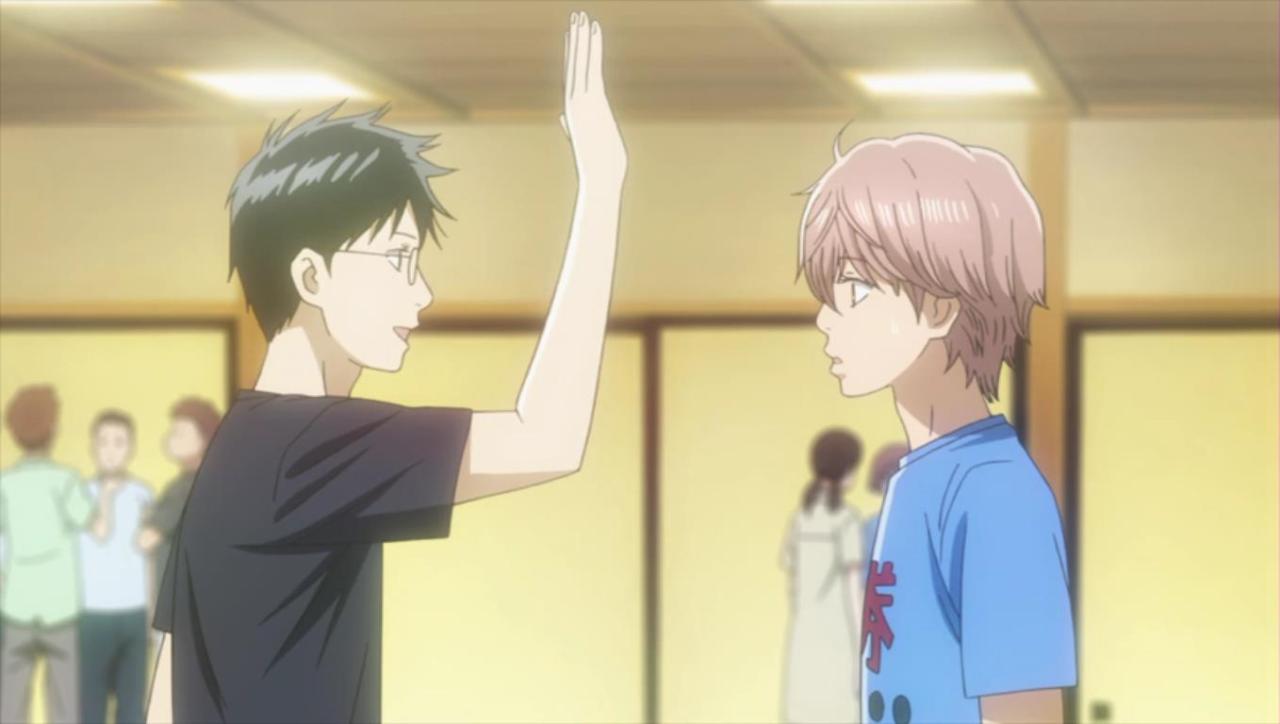
SEASON 3 PLEASE!
Okay, I'm getting ahead of myself, but I really hope we get at least one more season of Chihayafuru because it's so good. Like many other shows this season, Chihayafuru 2 had pacing problems; it covers less ground than the first series by having most of the season focus on one tournament, and some of the karuta matches go on for one episode too many. However, Chihayafuru still shows what it needs to show, that being the emotionally satisfying triumphs and losses that our characters go through. Arata finally feels like a proper part of the show now, and the issues of the love triangle Chihaya has been involved in from the start have been mostly resolved in one scene where Chihaya basically admits who she loves to the audience (though not her love in person). Season 2 ends on a good note; like season 1, it leaves room for more, but it's a nice reflection on all that has happened before and shows just how far our characters have come since first forming the karuta club.
Maybe one day I'll do a full review of Chihayafuru in general, but for now I feel as though I've already said as much about the show as I can. I've seen 50 episodes of characters playing a card game I've never heard of before, and I loved nearly every bit of it.
3) The Devil is a Part-Timer
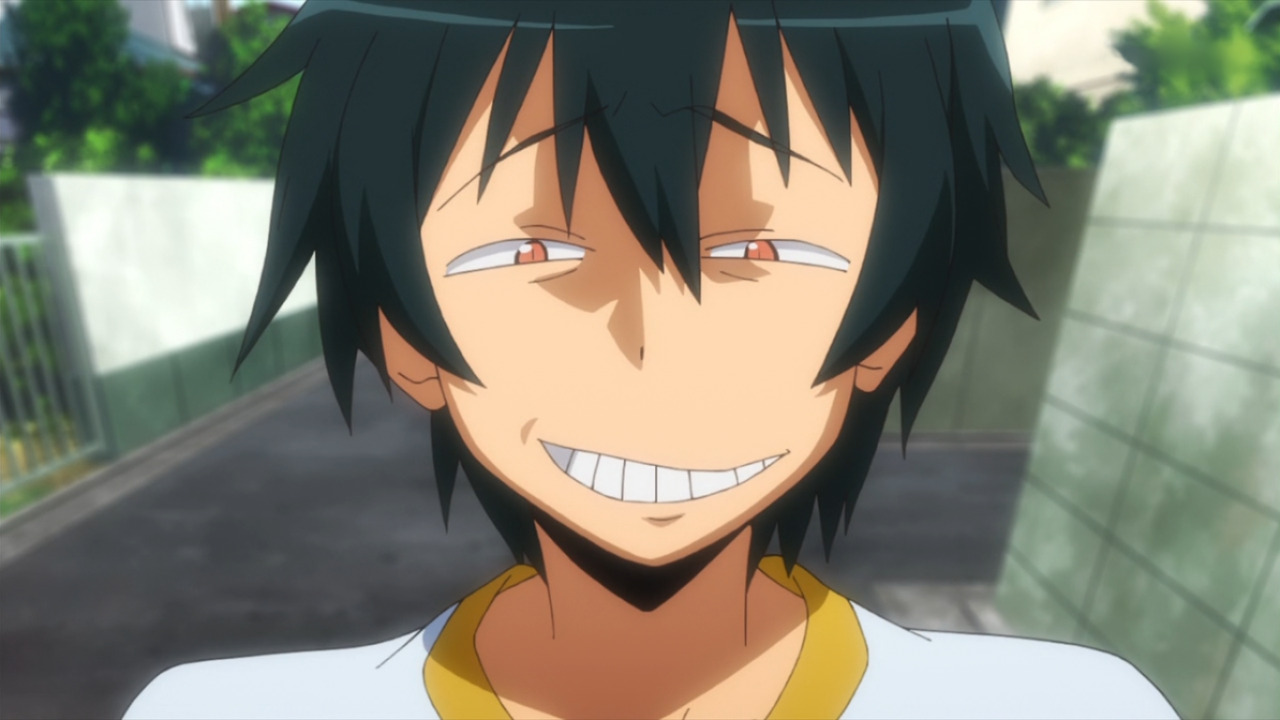
If Flowers of Evil didn't exist, this would be the most surprising anime of the season for me. An anime about Satan working at McDonald's (named MgRonald's in this show)? That sounds really dumb, it can't be that be good. Cut to me laughing for 13 episodes. Maybe this says more about my taste in comedy than about anime comedy in general, but there hasn't been an anime that has made me laugh this much in a long time.
What makes The Devil is a Part-Timer stick out from other anime comedy is that it doesn't fall prey to most of the same mistakes those shows make. Too often will anime comedy rely on overreactions, prat-falls, and yelling as jokes, when those aren't jokes at all. Devil's comedy comes from its natural character reaction and dialogue. You've got this great ensemble cast of demons, heroes, angels, and humans that all have really funny interactions with each other, whether it be just how well Satan adapts to working at MgRonald's or how budget-conscious Ashiya is or how Lucifer becomes this NEET, they all work. I ended up liking nearly all the characters due to their well-written personalities and quirks.
I mentioned earlier that most of the shows had pacing problems this season. Even my two favorite shows of the season couldn't avoid this, but Devil is a Part-Timer? Never feels too fast or too slow and the progression always feels natural. The action is actually somewhat good, though obviously not as good or important as the comedy and characters. There are a few moments in the show where Satan gets to let loose his powers, and those fight scenes are a ton of fun to watch. They border on being too serious for the show, but again, the characters are so likable by that point that the audience will be willing to let them be serious for a moment. Also, because I think it's fun to point this out, Satan saves more lives than Superman does in Man of Steel. Don't go see Man of Steel, watch The Devil is a Part-Timer instead.
However, like Chihayafuru and Flowers of Evil, the show does end on an open note. Will our heroes get back to their homeworld or be stuck in our world forever? The show doesn't say, opting to just end after an episode about Lucifer getting swindled by a door-to-door salesman. There's no real ending for the show, and I'm not sure it needs one, but some resolution for the characters would be nice. I've heard there was more material in the light novels that the show could adapt, so there's hope for a second season, but the amount of The Devil is a Part-Timer we got is still really good. It's that rare anime comedy that's actually funny.
4) Attack on Titan (first 13 episodes)

What do I need to say about Attack on Titan? What can I say about Attack on Titan that hasn't been said before? You've probably already seen the show at this point, indulged in the countless Attack on Titan opening parody videos or possibly made your own, or at least heard people talking about how awesome this show is. With all the hype behind it, Attack on Titan can't possibly live up to those expectations, right?
No, this show is really good. Oh, it's far from perfect. As cool as the idea of humans zipping around like Spider-Man and killing titans is, it drags its feet in the later episodes. I cannot tell you how sick I was of seeing "Battle of Trost" in the title card for nine episodes straight. It takes 3 episodes just for Eren (who now has the power to summon a titan body for him to control) to move a rock to stop the titans from getting into the town. It's a problem that persists in many shonen fighting anime adaptations, and there is a reason for it (writers don't want to overtake the manga storyline), but the chapter-per-episode pacing near the end of the first half does grate a bit.
Despite the pacing problems, the show's still a ton of fun. Earlier on it was a little hard to connect to the characters, but by episode 13 I found myself liking them much more. Mikasa is the stoic badass who pretty much needs no help when it comes to killing titans, and while this is a personality type I'm not often fond of, it's refreshing to see a female character like this in a show where the majority of human characters will die. Jean started out as something of an asshole rival to Eren, but through the Battle of Trost he's become a likable guy who feels guilty over losing his friends in battle. Surprisingly Armin has become my favorite character. Yeah, the wimpy blonde kid who you'd think would be among the first to die, but he's become an invaluable part of the Survey Corps thanks to his tactical intellect, and after he stood up for Eren and Mikasa in episode 10 he really won me over. I don't see much love for Eren, and it's easy to see why. He's a little archetypal "main character" for my tastes, the kind of guy who succeeds through sheer determination and heart. He's not a bad character by any means, and his titan abilities are responsible for some of the best action scenes in the series, but eh, he's not a great character.
The real reason this doesn't place as high as you'd think it would is not just the pacing problems, but the animation problems. Attack on Titan has some of the coolest looking fights, but more often than not the animation looks unfinished and the show resorts to still-shots, flashbacks, and camera pans and shakes to hide that fact, but it's still really obvious. Still, that shouldn't deter anyone from enjoying this show. It's incredibly entertaining, and I'm glad that it'll still be on this summer.
5) Valvrave the Liberator

The more I watched of Valvrave, the more I loved it. It's not good in the traditional manner; the story is honestly quite stupid and Haruto isn't the most likable or relatable protagonist in the world, but each episode makes you think "oh there's no way this show can get crazier", and then it proves you dead wrong. It's entertaining trash at its finest.
And then Haruto rapes Saki.
There's no getting around this. Valvrave has stirred up an enormous amount of controversy by having its hero rape another main character. Yes, I know Haruto was under the influence of his vampire powers at the time, but that doesn't take away the fact that the writers thought this series needs a rape scene, and a really tasteless one at that. How the show handles the rape afterwards is even worse, uncomfortably tiptoeing around the issue for an entire episode which culminates in Haruto PROPOSING TO MARRY SAKI. She doesn't accept the issue because Saki knows better, but what the hell Haruto? The rape scene leaves an uncomfortable aura over the entire series. As fun as the rest of it is, it'll be impossible to forget just how badly the show handled it.
Valvrave will be coming back for a second season in the fall, and after much debate with myself over the issue... I'm still going to watch it. Say what you like about how tasteless or bad the show is, it's great at getting you to come back for more because of how unpredictable it is, and that last episode was kind of fun, although the final Valvrave is a brat who will have to work hard to earn any sympathy. I halfheartedly recommend Valvrave the Liberator. I wouldn't call it good, but there's a fanbase for fun trash like this, and I'm among them.
6) Gargantia on the Verdurous Planet
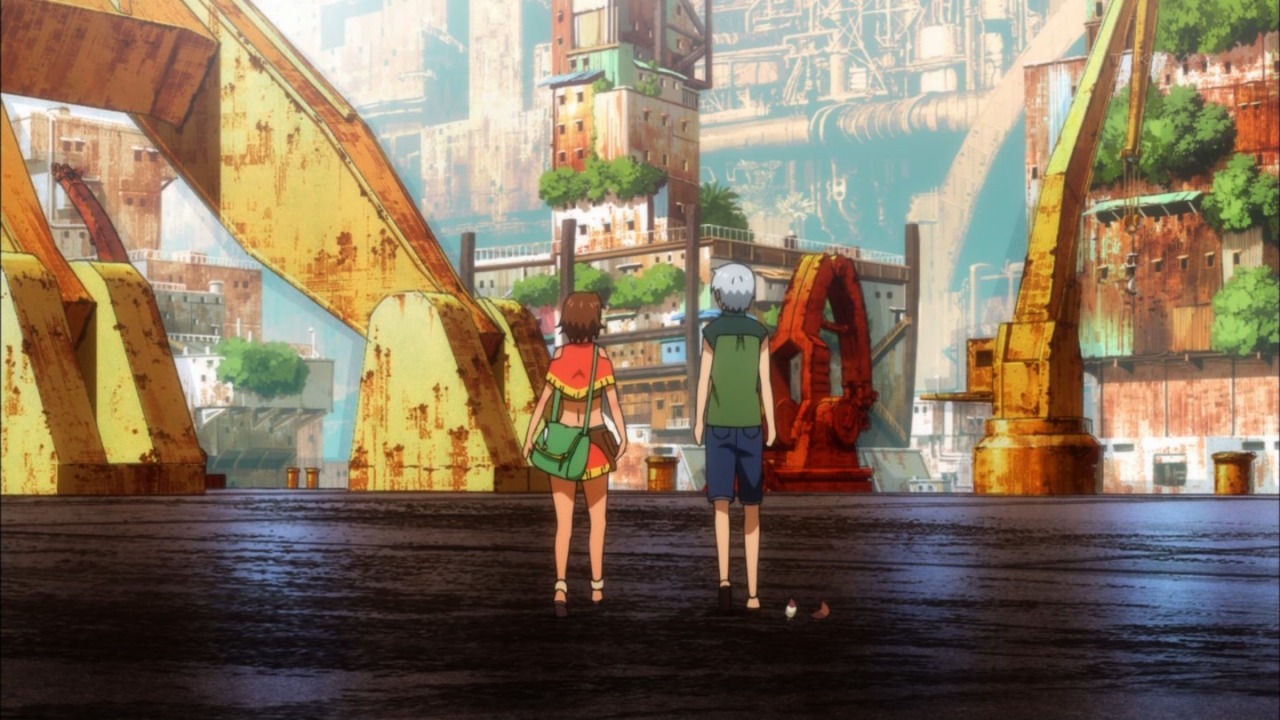
I bet you're really tired of hearing me mention the word "pacing", but my god does the pacing murder this show. What was once a show I had high expectations for became one of the more trying experiences I had this spring.
I'll get the good out of the way first: the first four episodes are a great fish-out-of-water tale with a sci-fi bent. The color design is phenomenal. There are some really good ideas behind the Galactic Alliance and Gargantia's differing philosophies on life. That's pretty much what I liked about Gargantia.
And then episodes 5 and 6 exist solely as fluffy fanservice. In a longer series, this might have been more acceptable, but they're still pointless and deter from the story. Even when the story comes back in episodes 7 and 8, the damage is still done; the plotting still feels too slow for a 13 episode series, and we spend way too much time on the funeral of a supporting character. But I still held out hope. Episode 9 takes the story away from the Gargantia and brings Ledo face-to-face with the true history of the Earth and the Galactic Alliance, and admittedly the story works at making the Hideauze important again. But then the series decides "oh, you thought we were being slow? Well now we're going to be as fast as possible! Screw your pacing!" The final 4 episodes show Pinion becoming the dictator of his own fleet, Ledo questioning Chamber's and the Galactic Alliance's motives, a cult that worships another robot like Chamber, and Amy and the rest of Gargantia no longer matters until the very end.
All this stuff comes out of nowhere and ends just as quickly, and thinking about it, I could see the show going in this direction had it been a 24-26 episode series. The fact that all this happens in the last 4 episodes makes the character motivations seem way off and the whole thing rushed, to the point that the emotional beats just feel hollow. All the plot threads are quickly resolved in the space of two minutes. I don't know what went wrong here. What was once the story of a soldier trying to find a new life in a strange land became a jumbled mess that doesn't know what it wants to be.
7) Devil Survivor 2 the Animation

So did Devil Survivor 2 break the video game adaptation and manage to be an engaging standalone story? Uh, no. Actually, from what I've heard even fans of the game don't seem to happy, so even as a way to pander to the fans it fails. So what went wrong?
Devil Survivor 2 has a huge cast of characters. Only two characters are truly important, those characters being our hero Hibiki and the villain Yamato, who have one of the most homoerotic rivalries I've seen in animation, and I've seen He-Man. Every other character exists to die. Anytime they have a moment that looks like character development is almost always immediately followed up with them biting the dust, so you never get to know them and their deaths don't register as being dramatic or shocking, just pointless. The show is trying to make a point about it being the end of the world, so some death would be expected, but the way in which the show kills off its characters is a boring pattern. Somehow Devil Survivor 2 made death and the apocalypse boring.
The show deals with big themes such as rebirth, the fate of humanity, and chaos vs order, all themes that have been explored in previous Shin Megami Tensei games, and they feel stagnant here. I think I know what the problem is, and this is a problem that seems to be persistent in anime adaptations of this franchise. The SMT games have always been built around choices; Devil Survivor 2 the game features multiple routes to choose, and your characters can die or you can save them. The power of choice is what gives the story and characters more power, and when stripped of that choice you're left with a soulless husk like Devil Survivor 2 the Animation. Though I am looking forward to seeing the Hibiki/Yamato doujinshi. Get to work on that, yaoi fans.
8) Muromi-san

There's really not much to say about Muromi-san. It's a gag comedy about a mermaid and her mythological friends who are introduced every week. There's no real story to speak of, so the show lives and dies by its gags, and honestly the show is too hit-and-miss to recommend. However, as with all comedy, taste is super subjective. I did laugh at a few jokes here and there (Muromi's relationship with penguins), but then there are episodes like episode 12 where the joke is "hey, how much can we gross the audience out by abusing this big-breasted mermaid?". Had the episodes not been 12 minutes long as opposed to 24, I probably would have dropped Muromi-san long ago. It exists, and it might make you laugh, but it'll quickly be forgotten as is the fate for most dumb gag comedies. Stick to Devil is a Part-Timer if you want some good yuks.
Dishonorable Mentions:
Mushibugyo (dropped at episode 8):
Great color design and humorous character designs can only get a bland tired story so far. I enjoyed the first few episodes of Mushibugyo, but I quickly realized it was going nowhere and the tiresome repetitive shonen fighting cliches got to me.
The Severing Crime Edge (dropped at episode 8):
I thought the relationship between the two leads was kind of cute, but the series quickly fell into tiresome battle of the week cliches and none of the other characters were particularly interesting.
Henneko (dropped at episode 7):
It was cute for one episode, and then AAAAAAAAAAAAAH IMOUTO SHIT WHHHHYYY? Incest jokes aren't funny, and neither are the other countless otaku-bait tropes in this show.
Arata the Legend (dropped at episode 7):
The terrible fire effects were amusing, but other than that? Meh, bland fantasy story.
Karneval (dropped episode 3):
It's pretty, but what's the story? Nothing made any sense and I had no reason to watch any more.
Okay, that does it for the spring! The summer sun is here and there are swimming anime to be watched. Next week I'll be starting my new anime project for the season. I think all of you space lovers will enjoy it. Stay tuned!
Sunday, June 23, 2013
Monday, June 10, 2013
DaWaRou Posts: Zero no Tsukaima
Hello again everyone! I hope I haven't kept you waiting for too long! Anyways, we're all celebrating a momentous occasion here! That being the sites FIRST BIRTHDAY! And what better way to celebrate that than to write a blog about a shitty anime series that I actually kind of like! Ladies and gentlemen, I'm John Cortez and this is my 20th post for...The Broken Infinite.
Today we venture once again into a land of Magic and Sorcery though today will actually be my first post of something based on a Light Novel. A Light Novel is basically a Japanese young adult novel with a roughly 200 page length and in theses days a high probability of being turned into an anime or manga if it does well. Light Novel anime are numerous and the best known of all of them is The Melancholy of Haruhi Suzumiya. Today though we'll be talking about a lesser known but still popular series.
 This is Zero no Tsukaima aka The Familiar of Zero aka Zero's Familiar and the Light NOvels were written by Noboru Yamaguchi who sadly died before he could finish the series. To date it has been adapted into 4 anime series, each containing 13 episodes.
The plot is this: In a magical alternate world where only the nobility are able to use Magic, Louise attends the prestigious Tristain Academy of Magic where she's known as "Louise the Zero" for her 0% success rate at anything magical besides causing explosions whenever she tries to cast a spell. Being a second year student though, she has to summon her familiar in front of her entire class and after causing another grand explosion, the dust clears to reveal that she has indeed summoned something much to the surprise of everyone; a human boy from modern day Japan named Saito Hiraga. And so begins the new lives of Saito and Louise, bound together for eternity by the magic of the familiar contract.
As far as it's visuals go, I think that Zero no Tsukaima is a beautiful looking series. As I was watching it carefully, I can safely say that there were no animation flubs and nothing seemed to be off model in any way. While the visuals aren't as outstanding as I'd like them to be for a fantasy series, they're good enough for me to enjoy the series purely for how it looks. Musically, I can't really say much besides how much I love the opening.
Now, this review will only be covering the first 13 episodes of the series since I haven't watched the other 3 seasons so my thoughts on the series as a whole will have to wait.
Personally, I really like Zero no Tsukaima. It's a fantasy series with a Harem edge that really doesn't go anywhere for the first season so I can appreciate that and it looks amazing which I think it should. I think it's length allows for it to get a lot accomplished in such a short amount of time. The characters are fleshed out enough given the time they have on screen and so are a lot of details about the world we've found ourselves in. We're learning about it at the same rate as Saito and the series never forgets that. When it takes the time to focus on other characters, it shows how they interact with each other naturally. Also, the cast while stereotypical is diverse enough to satisfy my needs from the flirty Kirche and the silent Tabitha, who get probably the most screen time apart from the main couple. There's the shy and submissive but certainly not spineless maid Siesta, the lecherous Guiche and the ever prideful and easily angered Montmorancy. Even the lovely Princess Henrietta is given some character and personality. Can't really say the same for the villains and antagonists but, what can you do? I like the air of mystery that surrounds Louise's summoning of Saito as well as the powers he gains through the Familiar Contract. The things I don't care for are very very minimal and can be chalked up to two things. Louise's treatment of Saito and all the fanservivce.
I know it was a really short post but I might decide to add to it during the week! I do want to say though how happy I am that the site has reached it's first birthday and that I look forward to writing for it for many more years to come! HAPPY BIRTHDAY BROKEN INFINITE! DaWaRou~!
Today we venture once again into a land of Magic and Sorcery though today will actually be my first post of something based on a Light Novel. A Light Novel is basically a Japanese young adult novel with a roughly 200 page length and in theses days a high probability of being turned into an anime or manga if it does well. Light Novel anime are numerous and the best known of all of them is The Melancholy of Haruhi Suzumiya. Today though we'll be talking about a lesser known but still popular series.
The plot is this: In a magical alternate world where only the nobility are able to use Magic, Louise attends the prestigious Tristain Academy of Magic where she's known as "Louise the Zero" for her 0% success rate at anything magical besides causing explosions whenever she tries to cast a spell. Being a second year student though, she has to summon her familiar in front of her entire class and after causing another grand explosion, the dust clears to reveal that she has indeed summoned something much to the surprise of everyone; a human boy from modern day Japan named Saito Hiraga. And so begins the new lives of Saito and Louise, bound together for eternity by the magic of the familiar contract.
As far as it's visuals go, I think that Zero no Tsukaima is a beautiful looking series. As I was watching it carefully, I can safely say that there were no animation flubs and nothing seemed to be off model in any way. While the visuals aren't as outstanding as I'd like them to be for a fantasy series, they're good enough for me to enjoy the series purely for how it looks. Musically, I can't really say much besides how much I love the opening.
Now, this review will only be covering the first 13 episodes of the series since I haven't watched the other 3 seasons so my thoughts on the series as a whole will have to wait.
Personally, I really like Zero no Tsukaima. It's a fantasy series with a Harem edge that really doesn't go anywhere for the first season so I can appreciate that and it looks amazing which I think it should. I think it's length allows for it to get a lot accomplished in such a short amount of time. The characters are fleshed out enough given the time they have on screen and so are a lot of details about the world we've found ourselves in. We're learning about it at the same rate as Saito and the series never forgets that. When it takes the time to focus on other characters, it shows how they interact with each other naturally. Also, the cast while stereotypical is diverse enough to satisfy my needs from the flirty Kirche and the silent Tabitha, who get probably the most screen time apart from the main couple. There's the shy and submissive but certainly not spineless maid Siesta, the lecherous Guiche and the ever prideful and easily angered Montmorancy. Even the lovely Princess Henrietta is given some character and personality. Can't really say the same for the villains and antagonists but, what can you do? I like the air of mystery that surrounds Louise's summoning of Saito as well as the powers he gains through the Familiar Contract. The things I don't care for are very very minimal and can be chalked up to two things. Louise's treatment of Saito and all the fanservivce.
I know it was a really short post but I might decide to add to it during the week! I do want to say though how happy I am that the site has reached it's first birthday and that I look forward to writing for it for many more years to come! HAPPY BIRTHDAY BROKEN INFINITE! DaWaRou~!
Sunday, June 9, 2013
The History of Galaxy Express 999
The History of Galaxy Express 999
by yamiangie

 “ The Guide has appeared in so many forms – books radio, a television series, records and soon to be a major motion picture- each time with a different story line that even it’s most acute followers have become baffled” ~ Douglass Adams LA 1983 and London 1985/1986.
 Maetel is a mysterious woman who reminds Tetsuro of his mother. More than the fact that there is only one female body type that Matsumoto draws. She’s a warm caring woman with an air of sadness about her. She’s traveled on the 999 before possibly with other young companions. And is likely older than she looks.
 Speaking of the Arcadia it’s stated to be one of the most powerful battleships in the sea of stars. The others are the Queen Emeraldas and Space Battleship Yamato (depending on copyright issues) if you are curious. The Acadia and her captain are often used to execute last minute saves from time to time. Hence saying space pirates act as the neighborhood watch. Not that this is a complaint, there is something satisfying about watching spaceships based on WWII tech blast the crap out of stuff.
by yamiangie

Moving on today we’re looking at something that’s getting brought up more and more by older anime fans. It spans several anime series and movies. A universe were in the vast expanse of the sea of stars trains span the distance between planets, pirates seem to act as the galactic neighborhood watch, and 30% of the inhabited planets look like they are out of an old western movie and all the female main characters look alike.
This is the world of Leiji Matsumoto.
Or at least the 2/3s of his body of works that one can give some semblance of continuity in. Face it, Matsumoto has been drawing manga since 1953 and he has this whole star system/reincarnation thing he calls the ring of time. So while it’s interesting to see him constantly create and recreate the mythology of his works to suite the narrative of the story at the time, the result is continuity snarls the likes of what keeps causing DC to reset their multiverse every decade or so now.
The best way to look at it is to consider these quotes by Douglass Adams from the introduction to the Ultimate Hitchhiker’s Guild to the Galaxy edition.
“The first Hitchhiker’s book was published called “The Hitchhikers Guide to the Galaxy”. It was a substantially expanded version of the first four episodes of the radio series, in which some of the characters behaved in entirely different ways and others behaved in exactly the same ways for entirely different reasons, which amounts to the same thing but saves on rewriting dialogue.”
 “ The Guide has appeared in so many forms – books radio, a television series, records and soon to be a major motion picture- each time with a different story line that even it’s most acute followers have become baffled” ~ Douglass Adams LA 1983 and London 1985/1986.
Reportedly the latest Galaxy Express 999 novel has a scene with Space Battleship Yamato villain leader Dessler hitting on Space Pirate Captain Harlock villainess Lafresia, so one should just consume a Pan Galactic Gargle Blaster so they don’t get a brain aneurism thinking about it too hard.
There is one easy way to watch something of Leiji Mastusoto’s works without going insane or destroying your liver and god knows what else, Galaxy Express 999 the movie. Galaxy Express 999 ran as an anime series ran for 113 episodes and even for a devoted Leiji fan like myself that’s a lot to watch.
It’s 1000 years in the future more or less and earth isn’t a nice place for humans. An immense class divide exists between the upper-class who can afford to turn themselves into machine men and the humans who can’t afford machine bodies. Machine bodies are insanely expensive but there are rumors of a planet in the Andromeda galaxy where you can get a machine body for free. The catch 22 being the only way to get there is on the Galaxy Express 999 whose tickets are also insanely expensive. It also only stops at earth’s station one a year. So very few people board the 999 and none are known to have returned.
Tetsuro Hoshino orphaned after his mother is killed by Count Mecha encounters the mysterious Maetel who offers him a free ride on the 999 in exchange for being her escort. Testuro wants to get a machine body so he can live a long happy life like his mother wanted him too. Also kill Cont Mecha if he runs into the guy. In the anime he’s your typical young boy protagonist always ready to go on an adventure on whatever planet the train stops at. He doesn’t think twice about rushing to help others and he takes his promise to protect Maetel very seriously. As a result of these traits and the rest of the universe being the hard place it is he’s constantly running into trouble. He reminds me of a young Goku at times but that might be the voice actors.
In the movie while being voice by the same actress there’s clearly a bit of a time skip between the death of Tetsuro’s mother and his meeting with Maetel. First off movie Tetsuro doesn’t have that potato head look when he shows up but is shown to have it when he dreams of his mother’s death. Second he seems a bit more mature than his TV counterpart which works to the advantage of the story being much shorter for a movie. He’s had to survive on his own in the slums of earth instead of having been picked up immediately by Maetel and therefore being a bit older would realize the true course of action needed to be taken in the climax of the story.
 Maetel is a mysterious woman who reminds Tetsuro of his mother. More than the fact that there is only one female body type that Matsumoto draws. She’s a warm caring woman with an air of sadness about her. She’s traveled on the 999 before possibly with other young companions. And is likely older than she looks.
The only other character that would be considered a regular is the conductor. He’s some sort of alien I think he’s kind of like a black mage or a jawa in that you can only see his yellow eyes from underneath this cap. He’s also implied to be invisible. His main function is to show up announce what planet the train is arriving at and give information on said planet if needed. In an emergence he will panic and start complaining about Galaxy Railway protocol. He tries to be a by the book conductor but he on rare occasion can be talked into bending the rules. He’s also very fond of Maetel and Tetsuro.
Beyond our two stars and one secondary character the train is mostly deserted. It’s like matel and Tetsuro are the only ones on this train. But over the course of the series there are quite a minor characters and who get much more important roles in this movie. Thought that basically means they made it into the movie.
First is Clare a female Machine man who is the waitress for the 999 dining car. As you can see her body is made of crystal making her transparent. She wishes to return to her original body so she’s saving up the money to do so. She glows in the dark and has a crush on Tetsuro
Antales is an old bandit who hates machine men because they treat humans so poorly. His hideout is full of orphaned children who have had their parents like by the likes of Count Mecha.
Count Mecha is the one who as previously stated killed Tetsuro’s mother, correction shot her like she was an exotic game animal while hunting on earth. He sets the events of both the movie and TV series in to action but ultimately is a mini boss.
Shadow is the Faceless keeper of the graveyards of Pluto that hold all frozen bodies of those mechanized. She’s vain so she could never get an artificial face to match the beauty of her human one so she went faceless and became a grave keeper to be as close as possible to her human appearance. She tries to get Tetsuro to live with her. Something that seems to happen very often in this series, what the heck is it about this kid that brings out Shota complex in every woman he meets? Says something about the how the author views the world if the only guy in the universe that’s the marrying type is 10.
Now we start getting into the people who along with Maetel are the all stars of the leijiverse:
Emeraldas is one of the most feared pirates to roam the sea of stars. She’s an icy bitch who sails alone on her dirigible with gallon gondola spaceship (don’t ask) the Queen Emeraldas searching for something. What I don’t know it changes every single time that plot point is bought up. In the TV show she’s dying of some sort of illness and a robot crew member mutiverse and wants to defeat Maetel to become the real Emeraldas. She must have gotten magically better because she shows up nice and fine in the 999 sequel manga. That episode did establish Emeraldas and Maetel as rivals.
Emeraldus is a very cold woman in comparison to Maetel. It is her aggression that has enabled her to travel her own path though the sea of stars solo. Whereas Maetel really needs an escort and to follow a path that has been set for her by others. Despite being a fearsome space pirate that will coldly kill men without batting an eye she too has a soft spot for Tetsuro, but that’s because she reminds her of someone.
The other extremely dangerous but oddly heroic space pirate is Captain Harlock. Despite being one of the most feared men in the universe Harlock is was someone who Tetsuro and the other children on earth looked up to as a role model. He’s admired because he’s a human with the strength and to seek the freedom of space. He also embodies Masumoto’s perception of manliness. Which means he’s a badass I mean he messes up a machine man with milk. You really don’t want to mess with anyone Harlock considers a friend if you don’t want his Gun or worse the cannons on his space battleship the Arcadia aimed at you.
 Speaking of the Arcadia it’s stated to be one of the most powerful battleships in the sea of stars. The others are the Queen Emeraldas and Space Battleship Yamato (depending on copyright issues) if you are curious. The Acadia and her captain are often used to execute last minute saves from time to time. Hence saying space pirates act as the neighborhood watch. Not that this is a complaint, there is something satisfying about watching spaceships based on WWII tech blast the crap out of stuff.
The last important guest star is Tochiro making a rare appearance alive in this movie. He is also chasing Count Mecha and he’s not long for this world. I’m assume he’s not searching via the Arcadia the ship he built and entrusted to his best friend because it’s I have no clue I guess he doesn’t want to bother Harlock with a revenge quest. He’s always portrayed as a little guy who’s always dreamed big. He’s also the original owner of the Hat and gun that Tetsuro receives earlier in the story. They also freakily dress alike. I believe that all of this means that Tetsuro in on his journey inherits the desires of everyone else to combat the Machine Empire.
This move came out in 1979 just as the potential of the anime as a medium as being to be realized. A lot of work went into this movie and it holds up very well as theatrical animated feature. Directed by Rintaro who is known for is slow pasted story telling style. In this movie there’s a balance take off sequences of the 999 for example are beautiful to watch. The soundtrack is also excellent with even a few moving lyrical numbers. Two of those were translated into English for the dub track and are passable the guy’s not the best singer but DVDs have dual audio. The third song left in Japanese was the best of the three and is my favorite peace from the score. Compilation movies or adaptations of long works can be a mess but here cutting out all but a few memorable events works well.
The cast of the TV series reprise their roles for the movie and for what it’s worth I do happen to think that the saiyu voicing Tetsuro actually plays the character differently than in the TV show. This is a good thing because TV Tetsuro’s attitude can get annoying. The dub was done in the early 90s by the Ocean group so you’ll get your mix of early run DBZ voices in there. For its time I think it’s a decent dub it’s much better than clips I’ve heard of the Roger Corman dub. Drunken John Wayne Harlock <shivers>. I’m just not sure they should have gone with Scott McNeil slightly British voice for Harlock. I’m not saying he shouldn’t be Harlock just I don’t get with all the voices Scott can do they went with that one. It’s not really the best of his character voices.
Galaxy Express 999 over all stands up to what I remember the first time I randomly caught it on the Sci Fi channel all those years ago.
Subscribe to:
Posts (Atom)